
Listen to this Post
 Introduction: A Mission of Precision Faces an Unexpected Test
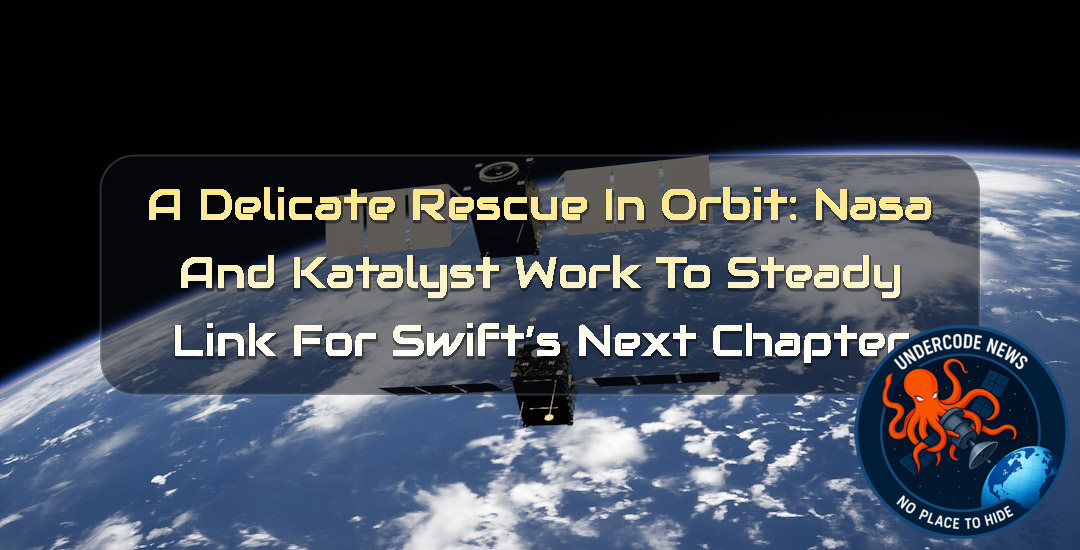
Space missions rarely follow a perfectly predictable path. Even when years of engineering, simulations, testing, and planning are invested in a spacecraft, the harsh environment of orbit can create challenges that demand patience, creativity, and rapid technical decision-making. That is the situation now facing NASA and Katalyst Space as teams work to stabilize the LINK spacecraft before it approaches NASA’s Neil Gehrels Swift Observatory.
LINK was developed to demonstrate an ambitious capability: approaching an existing spacecraft in orbit and helping raise its altitude. The mission could represent an important step toward extending the operational lives of valuable satellites and observatories rather than allowing them to become unusable when their orbits gradually decay.
However, before LINK can move toward Swift, it must first regain stable control. The spacecraft had been rotating at a significant rate, creating a difficult navigation and operations challenge. Engineers have since made meaningful progress, reducing LINK’s spin from approximately 9 degrees per second to less than 4 degrees per second through a series of carefully planned thruster burns.
The improvement is encouraging, but the work is not finished. Katalyst Space continues to evaluate the spacecraft’s condition, refine its stabilization strategy, and investigate alternative approaches that could still allow the mission to move forward. LINK is now expected to approach Swift around the end of August, marking the beginning of a critical phase for both organizations.
Original Summary: LINK’s Spin Is Slowing as Teams Explore New Mission Paths
Progress Through Controlled Thruster Burns
Katalyst Space teams have made progress in reducing the rotation of the LINK spacecraft. Using a sequence of thruster burns, engineers lowered its spin rate from roughly 9 degrees per second to below 4 degrees per second.
This reduction is significant because a rapidly rotating spacecraft can be difficult to control, navigate, and operate safely. Lowering the rotation rate gives mission teams a better opportunity to restore stable orientation and prepare LINK for its planned activities near the Swift Observatory.
Stabilization Work Remains Underway
Although LINK is rotating more slowly, the spacecraft has not yet completed its recovery process. Engineers are continuing to use the current approach while monitoring the spacecraft’s behavior and evaluating how it responds to additional control actions.
The goal is to gradually bring LINK into a more stable operational condition without introducing unnecessary risks or placing excessive stress on its systems.
NASA and Katalyst Are Considering New Options
Mission teams have also conducted further evaluations of LINK’s functionality. Their analysis indicates that potential paths remain available for achieving a boost-related objective, even if the original mission plan requires adjustments.
NASA is working closely with Katalyst Space to examine revised and innovative approaches. These alternatives may involve changes to mission timing, spacecraft operations, navigation procedures, or the way LINK performs its intended orbital service.
A Revised Timeline for the Swift Approach
LINK is now expected to approach NASA’s Neil Gehrels Swift Observatory around the end of August. The updated schedule provides additional time for stabilization, technical analysis, mission planning, and operational preparation.
NASA has stated that updates will continue as teams learn more about LINK’s condition and determine the next steps for the mission.
Why the Swift Mission Matters
A Valuable Observatory in Space
The Neil Gehrels Swift Observatory is a major space-based observatory designed to study some of the universe’s most energetic and rapidly changing events. Its scientific work includes observations of gamma-ray bursts, supernovae, black holes, neutron stars, and other powerful cosmic phenomena.
Swift’s ability to respond quickly to sudden events makes it especially valuable. When an astronomical event occurs unexpectedly, scientists may need observations within minutes or hours rather than days.
Orbit Determines a Spacecraft’s Future
A spacecraft’s orbit is not permanent. Over time, atmospheric drag and other orbital effects can gradually reduce its altitude. Even the extremely thin upper atmosphere can create enough resistance to slow a spacecraft over long periods.
As orbital altitude decreases, atmospheric drag may become stronger. This can create a feedback cycle in which the spacecraft loses altitude more quickly, potentially shortening its useful operational life.
An Orbital Boost Could Extend Scientific Operations
If LINK can successfully support an orbital boost for Swift, the mission could help preserve the observatory’s ability to continue collecting scientific data.
The value of such an operation goes beyond one spacecraft. Extending the life of an existing observatory could protect years of scientific investment and reduce the need to replace valuable capabilities immediately.
The Engineering Challenge of Stabilizing LINK
Why Spacecraft Rotation Is a Serious Operational Issue
A spacecraft rotating at several degrees per second may experience rapidly changing orientation. This can complicate communication, navigation, sensor measurements, power generation, and propulsion operations.
Spacecraft often depend on precise knowledge of their position and attitude. If the vehicle is rotating unexpectedly, onboard systems may struggle to determine exactly where the spacecraft is pointing.
Thrusters Can Change Both Rotation and Motion
Thrusters do more than move a spacecraft from one location to another. When fired in carefully selected patterns, they can also create torque, which changes the spacecraft’s rotation.
Engineers can use this principle to slow an unwanted spin. The challenge is determining the correct direction, timing, duration, and strength of each burn.
Small Errors Can Produce Large Consequences
Orbital operations require precision because even a small propulsion action can influence a spacecraft’s future trajectory. A burn that is too strong, too long, or performed at the wrong time may create additional control problems.
For this reason, stabilization is often conducted gradually. Teams may perform a burn, measure the result, update their models, and then plan the next action.
Reducing the Spin Is an Important Milestone
Lowering LINK’s rotation from approximately 9 degrees per second to less than 4 degrees per second represents a substantial improvement.
The spacecraft is still rotating, but the reduction suggests that the control strategy is producing useful results. Continued progress could provide a safer foundation for future mission operations.
Deep Analysis: How Engineers May Diagnose and Control Spacecraft Rotation
Understanding Angular Velocity
Spacecraft rotation is commonly described using angular velocity. In simplified form:
Angular Velocity = Change in Rotation Angle / Change in Time
If LINK rotates at 9 degrees per second, it completes a full 360-degree rotation approximately every 40 seconds.
At 4 degrees per second, a full rotation would take approximately 90 seconds.
This illustrates why the reduction is meaningful: the spacecraft’s rotation has slowed considerably, giving onboard systems and ground teams more time to measure and respond to its changing orientation.
Estimating the Spin Period
A simplified calculation can be written as:
spin_period_seconds = 360 / spin_rate_degrees_per_second
For a spin rate of 9 degrees per second:
360 / 9
Result: 40 seconds
For a spin rate of 4 degrees per second:
360 / 4
Result: 90 seconds
These calculations are simplified and do not describe the spacecraft’s complete attitude dynamics, but they help demonstrate the operational difference between the two rotation rates.
Using Telemetry to Track Recovery
Mission teams may analyze telemetry from multiple spacecraft systems, including:
attitude_control_status
gyroscope_measurements
star_tracker_data
reaction_wheel_status
thruster_pressure
propellant_estimates
power_generation
battery_state
communication_link_quality
thermal_sensor_readings
Each measurement can provide information about whether the spacecraft is becoming more stable and whether the control system is functioning as expected.
A Simplified Stabilization Workflow
A conceptual operational process may resemble the following:
1. Collect spacecraft attitude data
2. Estimate rotation rate and direction
3. Verify sensor reliability
- Model the expected effect of a thruster burn
5. Select a conservative control maneuver
6. Execute the maneuver
7. Measure the new rotation rate
8. Compare actual results with predictions
9. Update the spacecraft model
10. Plan the next maneuver
Real mission operations are considerably more complex and involve extensive safety checks, redundant systems, specialized flight software, and engineering review.
Why Gradual Control Is Often Safer
A large correction could theoretically reduce the spin more quickly, but it may also create greater uncertainty. A conservative sequence of burns allows engineers to observe the spacecraft’s response after each action.
This approach may reduce the risk of overcorrection and help teams identify unexpected behavior before committing to more significant maneuvers.
The Importance of Redundant Measurements
Spacecraft do not rely on one sensor alone. Engineers may compare information from gyroscopes, star trackers, Sun sensors, and other instruments.
If multiple measurements agree, confidence in the estimated spacecraft attitude can increase. If they disagree, teams may need to determine whether a sensor is affected by motion, environmental conditions, or another technical issue.
Approaching Another Spacecraft Adds Complexity
The planned LINK-Swift operation is not simply an orbital maneuver. It involves the possibility of one spacecraft operating near another valuable spacecraft.
That introduces additional requirements for navigation accuracy, relative motion analysis, communication, safety boundaries, and contingency planning.
Proximity Operations Require Conservative Decisions
Before LINK approaches Swift, mission teams must understand the spacecraft’s condition and confirm that it can operate predictably.
A spacecraft with uncertain attitude behavior could create unacceptable risks during close operations. Stabilization is therefore not merely a technical objective; it is a safety requirement.
What Undercode Say:
A Difficult Situation, but Not a Mission-Ending One
The reduction in LINK’s spin rate is a positive technical development because it shows that the spacecraft is responding to control actions.
The Recovery Is Still In Progress
A decrease from approximately 9 degrees per second to less than 4 degrees per second does not mean that LINK has fully recovered.
Stability Matters More Than Speed
Mission teams should prioritize predictable spacecraft behavior rather than rushing to meet an earlier schedule.
The Revised Timeline Is a Practical Decision
Moving the expected Swift approach toward the end of August gives engineers more time to validate the spacecraft’s condition.
Orbital Servicing Is an Emerging Capability
LINK represents a broader shift toward maintaining and extending spacecraft rather than treating them as untouchable after launch.
Spacecraft Could Become Serviceable Assets
Future satellites may be designed with inspection, repair, refueling, or orbital adjustment in mind.
The Economic Impact Could Be Significant
Extending the useful life of an expensive spacecraft could reduce replacement costs and protect long-term investments.
Scientific Missions Could Benefit Greatly
Observatories often contain specialized instruments that cannot be replaced quickly or cheaply.
Swift Has Continuing Scientific Value
Any effort that could preserve Swift’s ability to observe high-energy cosmic events deserves careful consideration.
The Mission Is Technically Ambitious
Approaching and supporting an existing spacecraft requires precise navigation and highly reliable control.
Unexpected Rotation Creates Operational Uncertainty
A spinning spacecraft may affect sensors, communications, power systems, and propulsion planning.
The Thruster Results Are Encouraging
The reduction in rotation indicates that the stabilization strategy is producing measurable progress.
More Data Is Still Needed
Engineers must understand why LINK entered its current rotational state before finalizing future operations.
Root-Cause Analysis Is Essential
Correcting the symptom is important, but identifying the cause may help prevent recurrence.
Telemetry Will Guide the Next Decisions
Every new measurement can improve the spacecraft model and influence the next maneuver.
NASA’s Involvement Adds Operational Strength
NASA’s experience in spacecraft navigation and mission safety may support the evaluation of alternative approaches.
Katalyst’s Response Demonstrates Mission Adaptability
The company is continuing to investigate technical options rather than treating the original plan as fixed.
Innovation Often Requires Flexibility
Complex space missions may need to change their procedures when real-world conditions differ from expectations.
The New Approach Could Improve the Mission
A revised plan may ultimately create a safer or more efficient path toward the mission’s objective.
The End-of-August Target Is Not a Guarantee
The timeline remains dependent on successful stabilization and further technical assessment.
Mission Safety Should Remain the Priority
Protecting Swift is more important than completing the demonstration quickly.
The Spacecraft Must Be Predictable
Before close operations, LINK must demonstrate reliable attitude and propulsion behavior.
Incremental Maneuvers Are Sensible
Small corrections allow teams to observe results and reduce the possibility of major overcorrections.
Orbital Dynamics Are Unforgiving
Small changes in velocity or orientation can influence future spacecraft behavior.
Autonomous Systems May Play a Larger Role
Future servicing missions could use more advanced onboard autonomy to manage complex operations.
Artificial Intelligence Could Support Mission Analysis
AI systems may help process telemetry, identify anomalies, and evaluate large numbers of possible maneuver plans.
Human Engineers Will Remain Essential
High-risk orbital decisions require expert oversight, validation, and accountability.
The Mission Could Become a Valuable Case Study
Even if the original objective changes, the recovery effort may provide important engineering lessons.
Failure Data Can Improve Future Spacecraft
Understanding unexpected spacecraft behavior can lead to stronger designs and better operational procedures.
Commercial Space Companies Are Expanding Their Role
Private organizations are increasingly developing technologies once associated mainly with government programs.
Public-Private Cooperation Is Growing
NASA and commercial partners can combine scientific experience with new engineering approaches.
Space Sustainability Is Becoming More Important
Extending spacecraft life may reduce unnecessary replacement launches and improve the use of existing assets.
Orbital Servicing Could Reduce Space Waste
Maintaining functional spacecraft may help prevent valuable equipment from becoming abandoned orbital infrastructure.
The Technology Must Prove Its Reliability
One successful demonstration would be important, but repeated safe operations will be needed for broad adoption.
Trust Will Depend on Transparency
Regular updates can help the scientific community understand the mission’s progress and risks.
The Current Progress Should Be Viewed Carefully
The lower spin rate is encouraging, but it is only one part of a much larger operational challenge.
The Mission Is Entering a Critical Phase
The next stabilization steps may determine whether LINK can safely proceed toward Swift.
The Outcome Could Influence Future Programs
A successful orbital boost could encourage investment in servicing technologies across the space industry.
The Most Important Achievement May Be the Learning
Regardless of the final outcome, the mission is generating valuable experience in spacecraft recovery and orbital operations.
✅ LINK’s Spin Rate Was Reduced
The reported reduction from approximately 9 degrees per second to less than 4 degrees per second is consistent with the mission update provided in the original article.
✅ Katalyst Space Is Continuing Stabilization Work
The mission update states that teams are continuing their approach to restabilize LINK in the coming days.
✅ NASA and Katalyst Are Evaluating Alternative Paths
NASA confirmed that potential paths forward remain under consideration and that revised, innovative approaches are being explored.
✅ LINK’s Approach to Swift Was Moved Toward the End of August
The updated mission timeline indicates that LINK is expected to approach the Swift Observatory around the end of August.
⚠️ A Successful Orbital Boost Is Not Yet Confirmed
The mission remains under evaluation. Progress in reducing the spacecraft’s spin should not be interpreted as confirmation that the orbital boost will occur.
⚠️ The Final Mission Design May Change
NASA and Katalyst are considering revised approaches, meaning the final operational plan may differ from the original concept.
❌ It Would Be Incorrect to Claim That LINK Is Fully Stabilized
The available update describes continuing stabilization efforts, not the completion of the recovery process.
Prediction
(+1) A Successful Stabilization Could Strengthen the Future of Orbital Servicing
If LINK continues to reduce its rotation and reaches a predictable operational state, NASA and Katalyst may be able to develop a revised path toward supporting Swift. A successful mission could accelerate interest in spacecraft servicing, orbital maintenance, and life-extension technologies.
(+1) Future Satellites May Be Designed for Serviceability
The growing interest in orbital maintenance could encourage spacecraft manufacturers to include standardized docking points, navigation markers, and systems intended to support future servicing missions.
(-1) Continued Instability Could Delay or Redesign the Mission
If LINK’s rotation cannot be reduced to an acceptable level, mission teams may need to postpone the approach, adopt a significantly different operational strategy, or reconsider the original boost objective.
(-1) Close Operations Will Remain a High-Risk Phase
Even after stabilization, approaching a valuable scientific observatory will require careful navigation and extensive safety validation. The mission’s success will depend on more than reducing the spin rate.
A Defining Moment for Spacecraft Life Extension
The LINK mission is becoming more than a simple orbital maneuver. It is a real-world test of whether spacecraft can be actively supported, adjusted, and preserved after launch. The next steps will reveal whether this challenge becomes a breakthrough for orbital servicing or a difficult lesson that shapes the next generation of space technology.
🕵️📝Let’s dive deep and fact‑check.
🎓 Live Courses & Certifications:
Join Undercode Academy for Verified Certifications
🚀 Request a Custom Project:
Secure, high-velocity infrastructure and disruptive technological engineering. Contact our engineering team for high-tier development and proprietary systems:
[email protected]
💎 Smart Architecture | 🛡️ Secure by Design | ⭐ Trusted by Thousands
References:
Reported By: science.nasa.gov
Extra Source Hub (Possible Sources for article):
https://www.twitter.com
Wikipedia
OpenAi & Undercode AI
Image Source:
Unsplash
Undercode AI DI v2
🔐JOIN OUR CYBER WORLD [ CVE News • HackMonitor • UndercodeNews ]
📢 Follow UndercodeNews & Stay Tuned:
𝕏 formerly Twitter 🐦 | @ Threads | 🔗 Linkedin | 🦋BlueSky | 🐘Mastodon | 📺Youtube


