
Listen to this Post
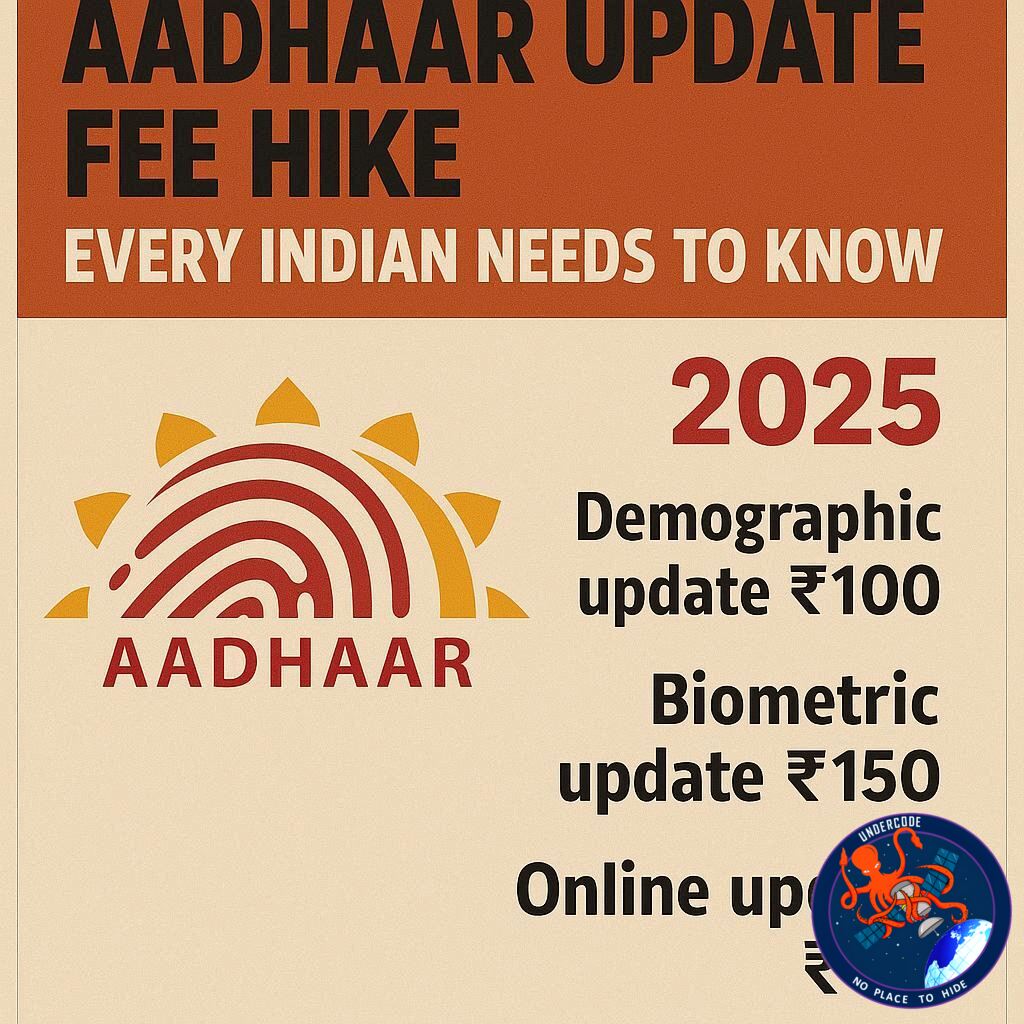
A Modern Identity System Faces a Price Shift
For the first time in five years, the Unique Identification Authority of India (UIDAI) has revised the fee structure for updating Aadhaar card details, effective October 1, 2025. The change impacts millions of residents who rely on Aadhaar for everything from banking to welfare benefits. This revision affects demographic corrections, biometric updates, and document verifications, marking a significant transition in India’s most extensive identity infrastructure.
The UIDAI, which maintains one of the largest biometric systems globally, said the revision was necessary to meet rising administrative, technological, and maintenance costs. In short, it’s a modernization tax on convenience. While the updates remain free for children at certain age milestones to ease family burdens, adults will now have to plan their updates strategically to avoid unnecessary expenses.
From name corrections to fingerprint recaptures, every update now has a specific fee structure valid until September 30, 2028, after which another revision will take effect. The authority encourages residents to use the myAadhaar online portal to save time and money, as in-person biometric appointments will cost more.
UIDAI’s latest announcement also details the next phase of charges from October 1, 2028, to September 30, 2031, ensuring financial transparency and predictable planning for both citizens and registrars. It’s a reminder that while Aadhaar remains free to enroll, maintaining its accuracy in a fast-digitizing economy will soon cost more.
UIDAI’s Reasoning Behind the Fee Increase
The UIDAI justifies the fee revision on several fronts:
Technological upkeep: Biometric verification and data encryption systems require constant upgrades.
Operational costs: Enrolment centres, personnel, and verification hubs have rising costs tied to power, connectivity, and cybersecurity.
Security & accuracy: Regular biometric updates are essential for maintaining authenticity, especially as identity fraud evolves.
Encouragement of online self-service: The higher cost of physical visits pushes users toward the digital self-update system, reducing manual load on centres.
The move aims to balance affordability for citizens and sustainability for operators while strengthening digital identity management.
Aadhaar Service Fee Highlights (2025–2028)
Demographic updates (name, address, etc.): ₹75 online or at centres.
Biometric updates (fingerprint, iris, photo): ₹125.
Mandatory biometric updates for children: Free at specific age milestones.
Document updates (PoA/PoI): ₹75 through the portal or centres.
Aadhaar printout: ₹40 for colour A4 sheet copies.
From 2028–2031, fees will increase slightly: demographic updates will cost ₹90, biometric updates ₹150, and printouts ₹50.
For enrolments, children under five and residents above five years remain free of cost, though registrars are compensated ₹75 and ₹125 respectively to maintain the ecosystem.
Why It Matters: Beyond the Numbers
Aadhaar isn’t just a card; it’s the digital backbone of India’s governance. From tax returns to subsidy distribution, it verifies identity in every sector. The revised structure ensures long-term sustainability of this vast system while protecting its data integrity.
UIDAI’s transparent timelines—validity until 2028 and a pre-declared increase till 2031—reflect strategic planning rarely seen in government operations. Yet, the increase sparks debate: should identity maintenance be costlier when Aadhaar is practically mandatory?
Critics argue that essential identity services should remain fully subsidized, while proponents say minimal fees ensure accountability and better service quality. Both perspectives highlight the fine balance between accessibility and technological advancement.
What Undercode Say:
UIDAI’s revision signals more than just a fee adjustment—it’s a strategic recalibration of India’s digital infrastructure. Over a decade since Aadhaar’s launch, maintaining over 1.3 billion identities demands unprecedented technological precision and cybersecurity. The cost of accuracy is rising.
From an analytical standpoint, UIDAI’s move is both preventive and adaptive. Preventive because it curbs over-reliance on subsidized physical services that slow down digital migration, and adaptive because it anticipates inflation and technology renewal cycles ahead of time.
Yet, this raises vital socio-economic questions. For rural residents with limited internet access, these higher fees might deepen the digital divide. While the myAadhaar portal makes online updates easy for urban users, offline communities still depend heavily on local enrolment centres. UIDAI must therefore ensure that increased fees don’t translate into exclusion.
Economically, this revision could help streamline the Aadhaar ecosystem by rewarding efficiency. Registrars now earn only for successful transactions, discouraging incomplete or erroneous data capture. This accountability-driven model reflects UIDAI’s intent to build a sustainable, error-free identity network.
Socially, Aadhaar remains a paradox: a free identity that costs money to maintain. The balance UIDAI must strike now is between operational recovery and universal inclusion. The free biometric updates for children are commendable—they promote long-term data accuracy without burdening families—but adults, especially those in informal jobs, may hesitate to update records due to costs.
Technologically, UIDAI’s shift is rational. Maintaining state-of-the-art biometric systems—fingerprint, iris, facial recognition—requires continuous hardware calibration and massive data storage. Without periodic fee adjustments, service quality could degrade, posing national security risks.
Looking ahead, this change will likely push more users toward self-service updates and digital literacy. The message is clear: digital identity is now a shared responsibility between the state and its citizens.
If UIDAI integrates AI-based verification and blockchain-backed audit trails by 2030, India could emerge as the world’s most secure identity infrastructure. But that transformation will depend on affordability and user trust. The new fees may be a step in that direction, provided accessibility remains central.
🔍 Fact Checker Results
✅ UIDAI officially confirmed the new Aadhaar update fees effective from October 1, 2025.
✅ Fee revision intervals are pre-declared up to September 30, 2031.
❌ No evidence suggests any fee waiver for adult updates beyond mandatory biometric phases.
📊 Prediction
By 2028, India will likely see a 60% surge in online Aadhaar updates as residents shift to digital channels. 🌐
Increased fees may drive innovation in mobile-based identity verification tools. 📱
UIDAI’s long-term goal could evolve into a fully automated Aadhaar update ecosystem, minimizing human errors and reducing centre congestion. 🚀
🕵️📝✔️Let’s dive deep and fact‑check.
References:
Reported By: timesofindia.indiatimes.com
Extra Source Hub (Possible Sources for article):
https://www.medium.com
Wikipedia
OpenAi & Undercode AI
Image Source:
Unsplash
Undercode AI DI v2
Bing
🔐JOIN OUR CYBER WORLD [ CVE News • HackMonitor • UndercodeNews ]
📢 Follow UndercodeNews & Stay Tuned:
𝕏 formerly Twitter 🐦 | @ Threads | 🔗 Linkedin | 🦋BlueSky | 🐘Mastodon


