
Listen to this Post
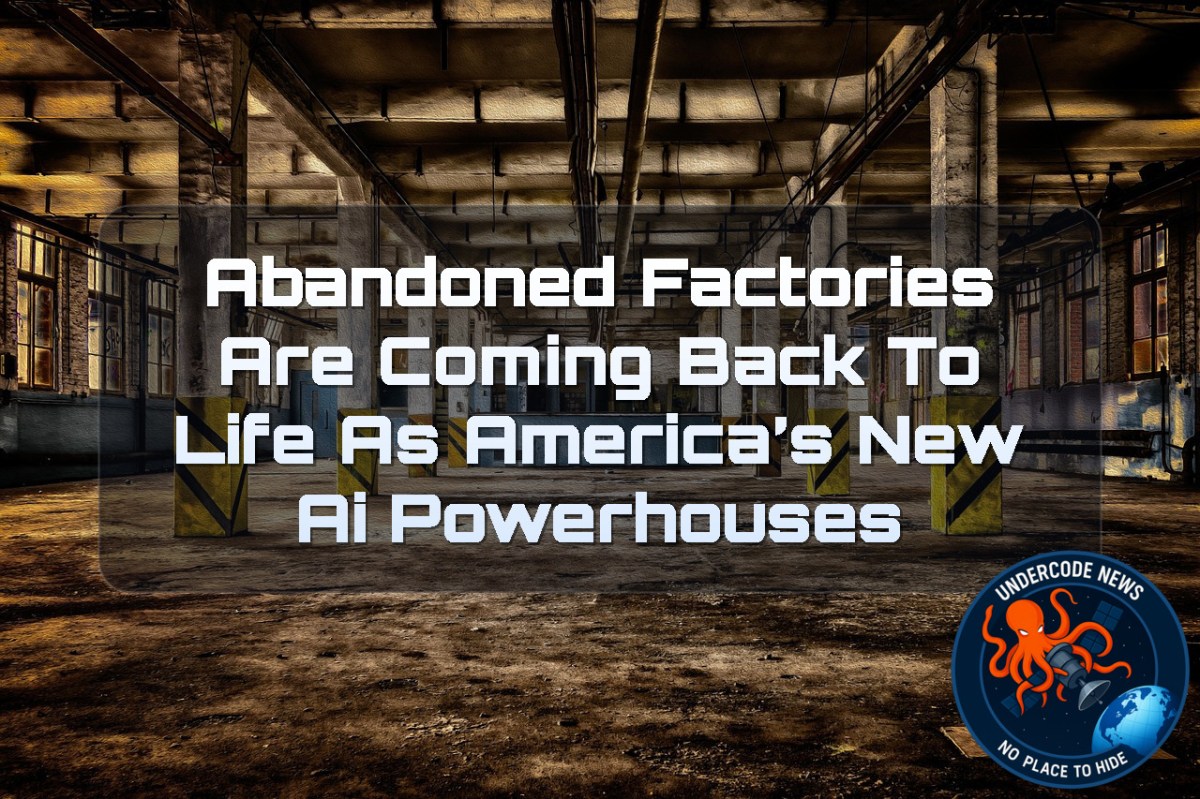
Introduction: From Empty Mills to AI Infrastructure
Across America, buildings that once symbolized industrial decline are being given a remarkable second chance. Old textile mills, manufacturing plants, warehouses, and other industrial sites that have sat empty for years are increasingly being considered for a very different purpose: powering the artificial intelligence revolution.
The transformation is particularly striking in Madison, North Carolina, where a former textile facility was left vacant after hundreds of manufacturing jobs disappeared. Instead of remaining another abandoned industrial property, the site is now being rebuilt with an entirely different future in mind. It is being prepared to support AI infrastructure, turning a reminder of the manufacturing economy into part of the emerging computing economy.
The idea reflects a growing reality in the AI race. Building enormous computing facilities from scratch can take years, require enormous amounts of capital, and face difficult permitting, construction, electrical-grid, and land-development challenges. Reusing existing industrial properties could offer a shortcut.
For companies racing to deploy AI infrastructure, that shortcut may be extremely valuable.
The Industrial Buildings America Left Behind
For decades, manufacturing communities across the United States watched factories close as production moved elsewhere, automation changed labor requirements, and entire industries contracted.
The result was a vast inventory of industrial real estate.
Some facilities were demolished. Others became warehouses, retail developments, or community projects. Many simply remained empty.
Now AI is creating a new demand for precisely the characteristics these buildings and industrial sites can sometimes provide: large footprints, existing electrical connections, access to transportation infrastructure, industrial zoning, and locations outside expensive urban centers.
What once looked like obsolete industrial infrastructure can suddenly look like an opportunity.
Madison, North Carolina, Gets a Second Life
The former textile plant in Madison illustrates this transformation particularly well.
The facility once supported hundreds of jobs before becoming vacant. Today, the property is being rebuilt for an entirely different economic purpose.
WhiteFiber CEO Sam Tabar has highlighted properties like this as an important potential advantage in the AI infrastructure race. Instead of starting with an empty piece of land, developers can begin with an existing industrial structure and surrounding infrastructure.
That does not mean the conversion is simple. AI facilities have extraordinary demands for electricity, cooling, networking, physical security, and reliable operations.
But the starting point can be dramatically different.
Why Existing Sites Could Give AI Companies a Head Start
The most valuable asset in an abandoned factory may not actually be the building itself.
It may be everything surrounding it.
Industrial facilities were often deliberately constructed in locations with access to power, roads, water, rail networks, communications infrastructure, and large parcels of land.
Those characteristics can become valuable again.
A modern AI computing facility requires enormous amounts of electricity. It also needs high-capacity fiber connections, cooling systems, backup power, physical security, and carefully engineered spaces for computing equipment.
An existing industrial location can potentially provide some of that foundation.
The AI Race Is Also a Race for Electricity
The biggest challenge facing AI infrastructure may increasingly be energy rather than computing hardware.
Training and operating advanced AI models requires massive computing capacity. That computing capacity consumes substantial amounts of electricity.
As AI companies build larger clusters of accelerators and servers, demand for reliable power rises accordingly.
This changes the economics of industrial real estate.
A building that was once considered worthless because its manufacturing operation had disappeared could become attractive if its location has access to a sufficiently powerful electrical connection.
In other words, the value of the property may increasingly depend on the infrastructure underneath and around it.
Why Building From Scratch Takes So Long
A new hyperscale computing facility is not simply a giant warehouse filled with servers.
Developers must acquire land, secure permits, design electrical systems, establish utility connections, build substations, construct cooling infrastructure, install networking systems, and satisfy environmental and safety requirements.
Then comes the hardware.
For companies operating in an industry where AI capabilities are advancing rapidly, waiting several years for infrastructure can represent a serious competitive disadvantage.
That is why existing industrial sites are becoming increasingly interesting.
If a suitable building already exists and some infrastructure is already available, developers may be able to reduce the time between investment and operation.
The Building Is Only the Beginning
There is an important distinction, however.
An old factory cannot simply be filled with servers and transformed into an AI data center overnight.
AI workloads generate enormous heat. Modern accelerators require sophisticated cooling systems. Electrical distribution must be redesigned to support high-density computing. Floors, ceilings, fire protection, networking, security, and mechanical systems may all require substantial modifications.
In some cases, the cost of renovating an old industrial facility could approach or even exceed the cost of constructing a new building.
The economic calculation therefore depends heavily on the individual site.
The Hidden Value of Industrial Infrastructure
The strongest candidates are likely to be properties where critical infrastructure already exists.
A site with strong electrical capacity, nearby substations, fiber connectivity, industrial zoning, water availability, and sufficient land could be dramatically more valuable than an otherwise similar empty building.
This creates a new form of competition.
AI companies are not simply searching for buildings.
They are searching for power-ready locations.
A New Chapter for Communities That Lost Manufacturing
There is also a human dimension to this transformation.
The disappearance of manufacturing left many American communities with vacant factories and weakened local economies.
AI infrastructure will not automatically recreate the same number of jobs that textile mills once provided. A highly automated computing facility can operate with far fewer employees than a traditional factory.
But redevelopment can still generate construction work, electrical and engineering jobs, maintenance positions, security roles, networking opportunities, and additional economic activity.
The question is whether communities can capture enough of that economic value to make the transformation meaningful.
From Blue-Collar Manufacturing to Digital Manufacturing
There is something almost symbolic about the transition.
A textile factory once converted raw materials into physical products.
An AI data center converts electricity and computing resources into digital intelligence.
Both are forms of industrial infrastructure, but their products are radically different.
The factory floor once contained looms and machinery.
The modern facility contains racks of GPUs, networking equipment, storage systems, cooling infrastructure, and power electronics.
The machinery changed.
The industrial logic did not.
WhiteFiber’s Argument
Sam Tabar of WhiteFiber has described existing industrial properties as a potentially important weapon in the AI infrastructure race.
The underlying argument is straightforward.
If a site already has some combination of buildings, electrical infrastructure, industrial zoning, and connectivity, developers may be able to move faster than competitors starting from undeveloped land.
In a market where AI companies are spending aggressively to secure computing capacity, time itself becomes an economic asset.
A facility that becomes operational months earlier can potentially begin generating revenue or supporting AI workloads months earlier.
The Real Bottleneck Could Be Time
The AI industry has become accustomed to discussing shortages of GPUs, advanced processors, memory, networking equipment, and electricity.
But another scarce resource is easy to overlook.
Time.
Technology companies can purchase hardware, sign power agreements, raise capital, and hire engineers.
They cannot instantly manufacture additional years.
That makes redevelopment attractive.
If converting an existing industrial property can meaningfully shorten the infrastructure timeline, the property can acquire strategic value far beyond its previous real-estate valuation.
The Rise of the Industrial AI Property Market
This trend could eventually create an entirely new category of real estate.
Instead of asking whether a building is suitable for manufacturing, logistics, offices, or retail, investors may ask whether it is suitable for high-density computing.
That changes the variables used to evaluate properties.
Power capacity becomes a primary metric.
Fiber availability becomes critical.
Cooling potential matters.
Grid reliability matters.
Permitting becomes strategically important.
Land availability matters.
And proximity to suitable energy infrastructure can become a deciding factor.
Why Rural and Smaller Communities Could Benefit
Large AI facilities do not necessarily need to be located in major metropolitan areas.
In fact, smaller communities may offer several advantages.
Land can be cheaper.
Industrial properties can be larger.
Local governments may be interested in attracting investment.
Existing manufacturing infrastructure may be available.
And rural locations can sometimes provide access to energy resources without the extreme land prices found near major cities.
The challenge is ensuring that the local electrical grid and communications infrastructure can support the facility.
The Electricity Problem Cannot Be Ignored
This is where the AI infrastructure story becomes much more complicated.
A factory redevelopment project may be able to reuse a building.
It cannot necessarily reuse an electrical system designed for an entirely different era.
Modern AI clusters can require extraordinary amounts of power. Utility companies may need to upgrade transmission lines, substations, transformers, and other infrastructure.
That means an abandoned factory could be structurally useful while still being electrically inadequate.
The building may already exist.
The power may not.
Cooling Could Become Another Major Challenge
AI computing produces substantial heat.
Traditional industrial buildings were not designed around the thermal density of modern AI accelerators.
A successful conversion therefore requires advanced cooling engineering.
Depending on the facility and hardware, developers may consider sophisticated air cooling, liquid cooling, chilled-water systems, heat rejection equipment, or combinations of these technologies.
This makes the redevelopment process an engineering project rather than a simple property renovation.
The Environmental Question
AI infrastructure also raises environmental questions.
Large computing facilities can consume substantial electricity and potentially significant amounts of water depending on their cooling architecture.
Communities evaluating these projects will increasingly ask where the electricity comes from, how much water the facility uses, what happens during drought conditions, and whether local infrastructure can support the demand.
Redevelopment may reduce the need for new construction, but it does not eliminate the environmental footprint of computing.
A Potential Solution to
The concept could nevertheless offer an interesting answer to a longstanding American problem.
The United States has thousands of former industrial sites that are underused or abandoned.
Some contain valuable infrastructure.
Others occupy strategically located parcels.
Repurposing even a fraction of these properties could reduce pressure to build entirely new industrial campuses on undeveloped land.
It could also return neglected properties to productive economic use.
AI Could Revive More Than Buildings
The economic effects could extend beyond the facility itself.
A major computing project can require electricians, construction companies, mechanical engineers, network specialists, security providers, equipment suppliers, maintenance teams, and local contractors.
Restaurants, hotels, transportation providers, and other businesses can also benefit during construction and ongoing operations.
The economic multiplier will vary from one project to another, but the possibility is significant.
The Job Question Is More Complicated
There is also a reason to remain cautious.
An AI data center is not a modern replacement for a textile mill in terms of employment.
A textile factory could employ hundreds or thousands of people directly.
A highly automated computing facility may require a much smaller permanent workforce.
Therefore, communities should not judge these projects solely by the number of jobs created.
Tax revenue, infrastructure investment, construction employment, local contracting, and long-term economic development can be equally important.
AI Infrastructure Is Becoming Industrial Infrastructure
The broader lesson is that artificial intelligence is no longer simply a software story.
It is becoming an industrial story.
AI requires chips.
Chips require factories.
Computing requires data centers.
Data centers require electricity.
Electricity requires generation and transmission infrastructure.
And all of it requires land, construction, cooling, networking, logistics, and capital.
The AI revolution therefore increasingly resembles an infrastructure revolution.
The Factory of the Future Looks Very Different
The old factory was loud.
The new one may be surprisingly quiet from the outside.
Instead of hundreds of workers moving through production lines, a modern AI facility may contain rows of machines operating continuously.
There may be fewer people on the floor, but the economic value of the equipment inside can be enormous.
The factory has not disappeared.
It has evolved.
A Race Between Construction and Innovation
AI companies face a strange paradox.
The technology is improving extremely quickly, but physical infrastructure moves slowly.
Software can be updated overnight.
A model can be retrained with new data.
A new AI architecture can emerge in months.
A power substation cannot.
A building permit cannot always be accelerated.
A transmission line cannot simply be downloaded.
This mismatch between digital speed and physical speed is one of the defining challenges of the AI boom.
Why Speed Could Become a Competitive Advantage
Companies that secure infrastructure earlier may gain an important advantage.
They can deploy computing capacity sooner.
They can train larger models.
They can offer more services.
They can support more customers.
They can experiment faster.
This creates a powerful incentive to look beyond traditional data-center construction.
An abandoned industrial facility could therefore become valuable not because it is beautiful or modern, but because it may provide a faster path to operational computing capacity.
The Risk of Overbuilding
There is another side to the story.
AI infrastructure investment is enormous, and forecasts about future computing demand are constantly changing.
If companies build too aggressively, some facilities could eventually become underutilized.
The same industrial properties now being viewed as strategic assets could face another cycle of technological obsolescence.
That means flexibility will matter.
Facilities designed to adapt to new generations of computing hardware may have a better chance of retaining their value.
What Communities Should Demand
Local governments should also approach AI redevelopment carefully.
They should examine electricity requirements, water consumption, tax arrangements, infrastructure costs, environmental effects, emergency planning, and long-term employment.
Tax incentives may attract investment, but communities should ensure that the public receives meaningful benefits in return.
The AI boom should not simply transfer infrastructure costs to taxpayers while private companies capture most of the economic upside.
The Bigger Economic Transformation
The redevelopment of abandoned factories illustrates a much larger shift in the American economy.
The United States once competed through factories producing physical goods.
Today, it increasingly competes through advanced computing, semiconductors, software, cloud infrastructure, robotics, and artificial intelligence.
Yet the physical foundations remain.
Digital economies still require physical places.
They require buildings.
They require electricity.
They require cables.
They require cooling.
They require machines.
That is why yesterday’s industrial infrastructure may become tomorrow’s AI infrastructure.
What Undercode Say:
AI Is Turning Real Estate Into Computing Strategy
The Madison project represents something larger than a single factory renovation.
It shows how AI is changing the value of physical infrastructure.
A building’s future value may increasingly depend on its access to electricity rather than its traditional industrial purpose.
The most important asset could be the electrical connection.
The second could be the surrounding grid.
Fiber connectivity could become almost as important as road access.
Industrial zoning could save developers months or years.
Existing structures could reduce construction requirements.
But none of these advantages guarantees a successful AI conversion.
Power availability remains the central question.
A building without adequate electricity is not an AI data center.
A building without adequate cooling cannot safely operate high-density accelerators.
A building without high-capacity networking cannot efficiently participate in massive distributed computing environments.
The AI industry is therefore creating a new definition of strategic real estate.
Developers will increasingly evaluate properties through an infrastructure lens.
The question will not simply be, “How large is the building?”
It will become, “How much computing can this location realistically support?”
That is a fundamentally different valuation model.
It could also transform abandoned industrial regions.
Communities that lost factories decades ago may suddenly find themselves sitting on infrastructure that technology companies desperately need.
However, the economic benefits must be managed carefully.
A data center can bring investment without bringing the same employment density as a traditional factory.
The construction phase may produce significant employment, while permanent staffing remains comparatively limited.
For policymakers, this means tax revenue and infrastructure investment should be evaluated alongside job creation.
The environmental footprint also deserves serious attention.
Large-scale computing consumes electricity continuously.
Cooling systems can require substantial resources.
Grid upgrades can become expensive.
Communities must therefore evaluate AI facilities as major industrial projects rather than ordinary commercial developments.
There is also a strategic national-security dimension.
Advanced computing increasingly affects military technology, scientific research, financial systems, autonomous systems, cybersecurity, and industrial competitiveness.
Computing capacity is becoming strategic infrastructure.
That makes the availability of suitable locations increasingly important to the United States.
The old industrial map of America could therefore become relevant again.
Places once known for textiles, steel, machinery, automobiles, and manufacturing may become part of the country’s next technological infrastructure network.
This does not mean America is returning to the old industrial economy.
It means the physical infrastructure of that economy may be repurposed for the new one.
That distinction is important.
The AI revolution is often presented as something happening inside software.
In reality, it is increasingly happening inside buildings.
Every large AI model ultimately depends on physical machines somewhere.
Every machine requires electricity.
Every electrical system requires infrastructure.
And every infrastructure project requires land, engineering, financing, regulation, and time.
The AI race is therefore becoming a race to control physical capacity.
Abandoned factories may unexpectedly become part of that race.
The Most Interesting Question
The most interesting question is not whether every abandoned factory can become an AI data center.
Most cannot.
The real question is how many have the right combination of power, land, connectivity, zoning, structural capacity, and location.
If even a relatively small percentage qualify, the potential market could be substantial.
America may already possess more AI-ready real estate than it realizes.
The challenge is identifying it.
Deep Analysis
Inspecting Infrastructure Before Deployment
For operators evaluating a former industrial facility, the first step should be understanding the underlying system rather than immediately deploying workloads.
A Linux-based infrastructure assessment might begin with:
lscpu
free -h
lsblk
ip -br addr
ip route
These commands provide a basic picture of processor resources, memory, storage, and network configuration.
Monitoring Power and Thermal Behavior
Once computing infrastructure is installed, continuous monitoring becomes essential.
Linux administrators can inspect system sensors with:
sensors
uptime
top
For GPU-heavy environments, vendor-specific monitoring tools can provide additional information about utilization, temperature, memory consumption, and power draw.
The objective is not merely to maximize computing capacity.
It is to maintain stable operation under sustained workloads.
Watching System Load
AI infrastructure can produce sustained workloads very different from conventional enterprise servers.
Operators can monitor system activity with:
htop
vmstat 1
iostat -xz 1
These tools can reveal CPU pressure, memory behavior, disk activity, and system bottlenecks.
In a converted industrial facility, monitoring should extend beyond the server itself.
Power distribution, cooling systems, networking equipment, and environmental controls all become part of the operational picture.
Checking Network Connectivity
High-performance AI workloads depend heavily on networking.
Basic Linux diagnostics include:
ip -s link
ss -s
ping -c 4 1.1.1.1
For production environments, administrators would normally use deeper monitoring systems, telemetry, and controlled testing rather than relying solely on simple connectivity checks.
Examining Storage Performance
AI workloads can also place substantial pressure on storage systems.
Basic diagnostics include:
df -h
lsblk
iostat -xz 1
The objective is to identify storage bottlenecks before they affect production workloads.
Why Monitoring Matters
The deeper lesson is that AI infrastructure cannot be treated as a collection of servers.
It is a complete industrial system.
Power affects computing.
Computing produces heat.
Heat affects cooling.
Cooling consumes resources.
Networking connects the machines.
Storage feeds the workloads.
And every component ultimately affects reliability.
That interconnected system is what makes AI infrastructure fundamentally different from simply renovating an old factory.
Infrastructure Trend: ✅
The reuse of existing industrial properties for AI and data-center infrastructure is a genuine emerging trend, driven by the need for power, land, and faster development timelines.
Madison Conversion: ✅
The supplied article describes a former textile facility in Madison, North Carolina, being redeveloped for AI-related infrastructure, consistent with the broader trend of repurposing industrial sites.
Ready in Months: ❌
Existing buildings can accelerate development, but saying every suitable industrial site can become operational in only a few months is too broad. Power upgrades, cooling, permitting, networking, and construction can still take substantial time.
Prediction
(+1) More Abandoned Industrial Sites Will Enter the AI Market
Existing factories and warehouses with valuable electrical infrastructure are likely to attract increasing attention from data-center developers.
(+1) Power Capacity Will Become a Major Real-Estate Metric
Investors will increasingly evaluate properties based on available electricity, grid connectivity, and the potential cost of power upgrades.
(+1) Former Manufacturing Communities Could Attract New Investment
Regions that previously lost industrial jobs may gain new infrastructure investment if their properties and electrical systems meet AI requirements.
(-1) Not Every Empty Factory Will Become an AI Facility
Structural limitations, inadequate power, weak connectivity, expensive retrofits, environmental restrictions, or unfavorable economics will eliminate many properties.
(+1) AI Infrastructure Will Become More Physical
The next stage of the AI race will increasingly involve land, electricity, cooling, construction, networking, and industrial engineering alongside algorithms and software.
The Bigger Picture
America May Be Rebuilding Its Industrial Future
There is an unexpected irony in the AI revolution.
America spent decades watching factories close, industrial buildings empty, and manufacturing communities struggle to find new economic identities.
Now some of those same buildings may become valuable again.
They will not return as textile mills.
They will not bring back the exact industrial economy that disappeared.
Instead, they may become something entirely different: enormous computing machines housed inside the skeletons of America’s industrial past.
The abandoned factory of yesterday could become the AI infrastructure of tomorrow.
And in the race to build increasingly powerful artificial intelligence, that transformation may prove that the future does not always require starting from scratch.
▶️ Related Video (84% Match):
🕵️📝Let’s dive deep and fact‑check.
🎓 Live Courses & Certifications:
Join Undercode Academy for Verified Certifications
🚀 Request a Custom Project:
Secure, high-velocity infrastructure and disruptive technological engineering. Contact our engineering team for high-tier development and proprietary systems:
[email protected]
💎 Smart Architecture | 🛡️ Secure by Design | ⭐ Trusted by Thousands
References:
Reported By: edition.cnn.com
Extra Source Hub (Possible Sources for article):
https://www.facebook.com
Wikipedia
OpenAi & Undercode AI
Image Source:
Unsplash
Undercode AI DI v2
🔐JOIN OUR CYBER WORLD [ CVE News • HackMonitor • UndercodeNews ]
📢 Follow UndercodeNews & Stay Tuned:
𝕏 formerly Twitter 🐦 | @ Threads | 🔗 Linkedin | 🦋BlueSky | 🐘Mastodon | 📺Youtube


