
Listen to this Post
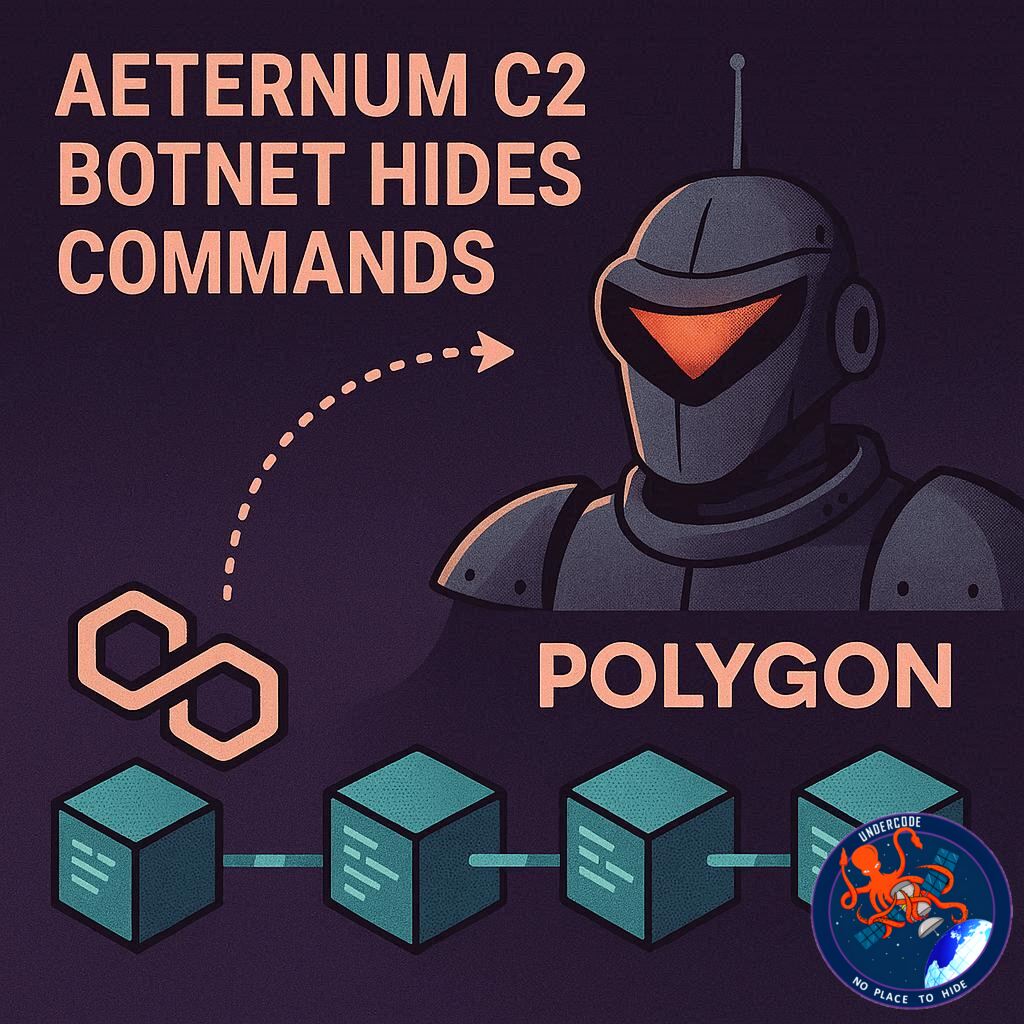
A New Era of Botnet Resilience
For years, cybersecurity defenders have relied on one fundamental weakness in botnet architecture: centralized command-and-control infrastructure. Once investigators locate and seize the servers or domains powering a criminal network, the entire operation can collapse almost overnight. This strategy has worked against some of the most notorious botnets in history, including Emotet, TrickBot, and QakBot.
But a newly identified loader known as Aeternum C2 signals a potentially disruptive shift in cybercriminal strategy. According to researchers at Qrator Research Lab, this emerging threat appears to eliminate the very weakness defenders have depended on for years.
Instead of relying on traditional servers or domain names, Aeternum stores its command instructions directly on the Polygon blockchain. In doing so, it replaces centralized infrastructure with decentralized permanence.
Commands Written Into the Blockchain
Aeternum embeds its command instructions inside smart contracts deployed on Polygon. Once recorded on-chain, these commands are permanently stored and distributed across thousands of nodes worldwide.
Infected devices do not connect to suspicious domains. Instead, they query public remote procedure call endpoints to retrieve updated instructions. From a network monitoring perspective, this traffic resembles ordinary interaction with legitimate blockchain infrastructure.
There is no single server to shut down.
There is no domain to seize.
There is no central host to dismantle.
The immutable and decentralized nature of blockchain technology becomes the botnet’s shield.
How the Control Panel Operates
Based on observed panel screenshots, Aeternum is developed in native C++ and distributed in both 32-bit and 64-bit versions. Operators manage infections through a web-based dashboard.
From this interface, attackers select a smart contract, define a command type, and submit the instruction as a blockchain transaction. Once confirmed, usually within two to three minutes, the command becomes visible to all infected systems polling the network.
Each smart contract can correspond to a specific payload. Examples observed in the dashboard include contracts labeled “Clipper,” “ps1,” and “putty.exe.” In one case, 13 active contracts were running simultaneously, each mapped to a different Polygon contract address.
Payloads may include:
Credential stealers
Cryptocurrency clippers
Remote Access Trojans
Cryptocurrency miners
DLL loaders
This modular structure allows operators to diversify operations without modifying their core infrastructure.
Tracking Infections and Targeted Commands
Aeternum includes a built-in “ping” feature. Bots send HTTP GET requests containing hardware identifiers and user-agent strings. This enables operators to track infections, monitor device characteristics, and issue targeted commands when needed.
Because all outbound communications resemble legitimate blockchain queries, detection becomes significantly more challenging. Security systems looking for malicious domains or suspicious hosting providers will find nothing obvious to block.
The malicious instructions are simply data entries on a public ledger.
Low Cost, High Durability
Operational expenses are strikingly low. Researchers estimate that roughly one dollar in MATIC tokens can fund between 100 and 150 command transactions. There are no hosting bills, no server maintenance costs, and no domain registrations required.
All that is needed is a cryptocurrency wallet and access to the control dashboard.
Beyond its decentralized infrastructure, Aeternum includes anti-analysis measures. It performs anti-virtual-machine checks to evade sandbox environments. It also integrates antivirus scanning through the Kleenscan API, enabling operators to test payloads against multiple detection engines before deployment.
This dual focus on resilience and stealth suggests careful engineering rather than experimental design.
A Shift in the Takedown Playbook
Security experts warn that blockchain-based command frameworks represent a significant evolution in botnet durability.
Traditional takedown strategies rely on removing infrastructure. In the case of Aeternum, there may be no infrastructure to remove.
Even if infected devices are cleaned, the underlying smart contracts remain active and reusable. A criminal group could rebuild its botnet by simply distributing a new loader configured to read from the same contracts.
The backend lives indefinitely on-chain.
This changes the defensive equation.
What Undercode Say:
Decentralization as a Weapon
Blockchain was designed for resilience, transparency, and decentralization. Ironically, those same features now provide an ideal environment for persistent command channels. Aeternum demonstrates how technologies built for financial innovation can be repurposed for cybercrime durability.
This is not just technical experimentation. It is strategic adaptation.
Infrastructure Takedowns Are Losing Leverage
For over a decade, coordinated global operations have dismantled botnets by targeting centralized assets. Law enforcement seized servers. Registrars suspended domains. Hosting providers cooperated with investigators.
With blockchain-based C2, those leverage points disappear.
There is no registrar to pressure.
There is no hosting company to subpoena.
There is no physical server to confiscate.
Defenders must pivot from infrastructure disruption to endpoint detection and behavioral analysis.
Detection Must Move to Behavior
If traffic blends in with legitimate RPC calls to Polygon nodes, signature-based blocking becomes ineffective. Instead, defenders will need to focus on anomaly detection:
Unexpected RPC polling patterns
Suspicious contract interaction frequencies
Endpoint behaviors tied to blockchain queries
Network-level intelligence must evolve to understand blockchain communication patterns at scale.
Smart Contracts as Criminal Infrastructure
Aeternum also introduces a troubling precedent. Smart contracts are permanent once deployed. Unless the blockchain itself is compromised or undergoes a governance intervention, the data remains accessible.
This means malicious contracts could be cataloged and reused by multiple actors over time. Underground markets may soon offer ready-to-deploy blockchain C2 kits.
What was once advanced tradecraft could become commoditized.
Cost Efficiency Encourages Experimentation
The extremely low transaction costs remove financial barriers to entry. Small criminal groups can test campaigns with minimal investment. Failed operations no longer represent major sunk costs.
Lower risk encourages innovation.
And innovation in cybercrime often spreads quickly.
Legal and Ethical Complexities
Unlike centralized infrastructure, blockchain networks operate globally and autonomously. Taking action against malicious smart contracts raises difficult legal and technical questions.
Should node operators filter malicious transactions?
Can blockchain governance intervene without undermining decentralization principles?
Would censorship mechanisms create larger systemic risks?
These questions extend beyond cybersecurity into philosophy and governance.
A Glimpse of the Future
Aeternum may represent the beginning of a broader trend. Decentralized storage networks, peer-to-peer file systems, and smart contract platforms offer resilient, censorship-resistant environments.
If criminals continue adopting these technologies, defenders will face an ecosystem where infrastructure takedown becomes nearly obsolete.
The battleground will shift permanently toward proactive detection and rapid remediation.
Fact Checker Results
✅ Aeternum C2 uses smart contracts on the Polygon blockchain to store command instructions.
✅ Infected systems retrieve commands via public RPC endpoints rather than centralized servers.
❌ There is currently no public evidence that blockchain governance has removed or disabled malicious Aeternum contracts.
Prediction
⚠️ Blockchain-based C2 frameworks will become more common in underground malware markets within the next two years.
⚠️ Security vendors will begin integrating blockchain traffic analytics into endpoint and network detection tools.
⚠️ Law enforcement strategies will shift from infrastructure seizures to financial tracing of crypto wallets linked to botnet operators.
🕵️📝✔️Let’s dive deep and fact‑check.
References:
Reported By: cyberpress.org
Extra Source Hub (Possible Sources for article):
https://www.twitter.com
Wikipedia
OpenAi & Undercode AI
Image Source:
Unsplash
Undercode AI DI v2
Bing
🔐JOIN OUR CYBER WORLD [ CVE News • HackMonitor • UndercodeNews ]
📢 Follow UndercodeNews & Stay Tuned:
𝕏 formerly Twitter 🐦 | @ Threads | 🔗 Linkedin | 🦋BlueSky | 🐘Mastodon


