
Listen to this Post
Introduction: The Rise of Intelligent Agents in Medicine
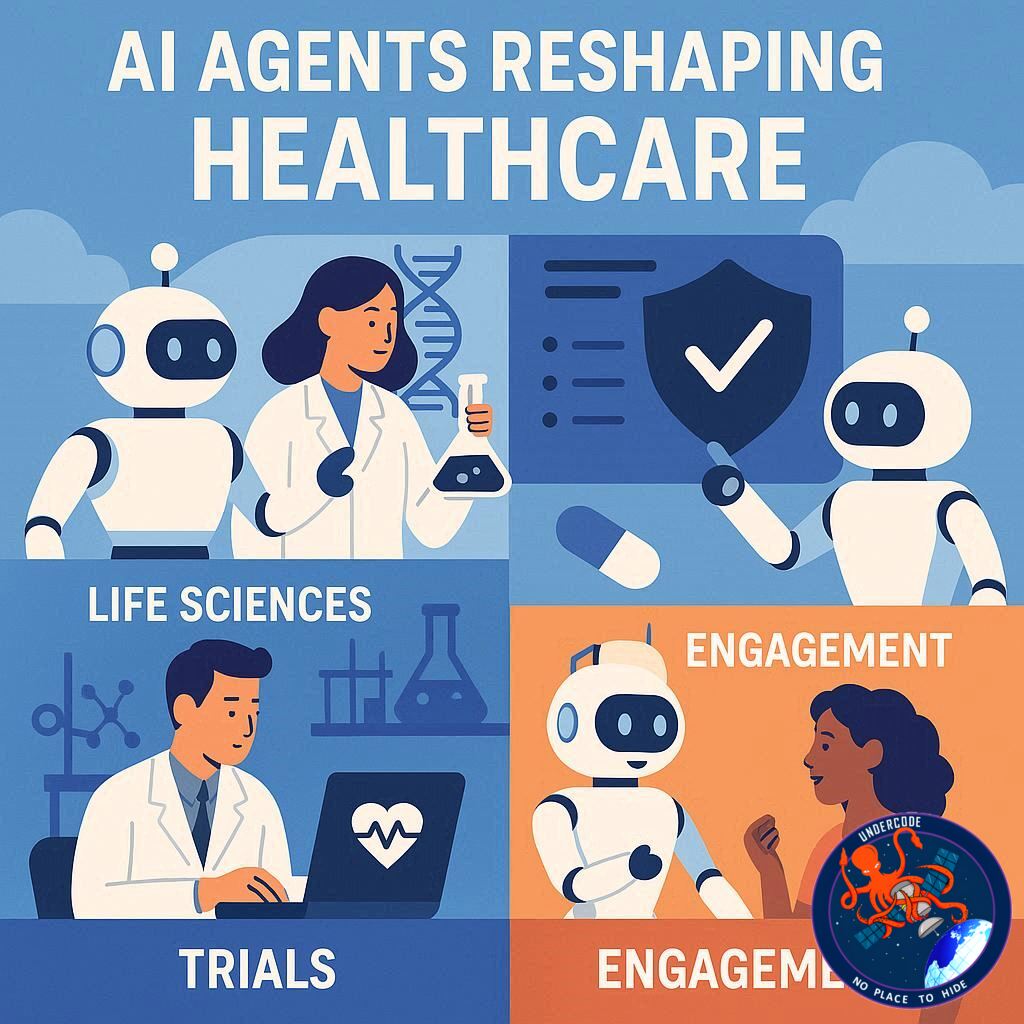
The healthcare and life sciences industry is undergoing a seismic shift. Artificial intelligence (AI) agents, once viewed as futuristic experiments, are now becoming indispensable tools for research, compliance, clinical operations, and professional engagement. With escalating regulatory demands, increasingly complex clinical trials, and massive spending on healthcare communications, the sector is looking to AI as a stabilizing force. Industry leaders are not just experimenting with AI anymore—they are betting on it as the backbone of future operations.
How AI Agents Are Transforming Healthcare and Life Sciences
Leaders in the life sciences sector are embracing AI agents as a response to mounting challenges. From compliance pressures to sluggish clinical trials, AI promises scalable solutions. According to a Salesforce study, 94% of executives believe AI agents will be essential to expand capacity and reinforce operations. Almost all participants (96%) predict that AI will be indispensable within the next two years.
However, enthusiasm does not eliminate obstacles. Data remains the largest barrier. Security, privacy, and compliance risks continue to raise red flags. Concerns also surround regulatory clarity, adoption of untested platforms, and integration with existing workflows. Although 97% of leaders acknowledge that trusted data is essential, only 46% feel fully confident in the timeliness and accuracy of their information.
When it comes to healthcare professional (HCP) engagement, the cracks are showing. Despite spending over $30 billion in 2024 on outreach and advertising, leaders admit strategies often fail. A third describe their engagement efforts as broken, with sales and marketing teams struggling to scale. Misaligned segmentation strategies and reliance on generic messaging dilute effectiveness. AI agents could fill this gap by personalizing communications, streamlining interactions, and providing round-the-clock responses to medical inquiries. In fact, 89% of leaders see AI as vital for summarizing communications, while 88% support its role in multi-channel engagement.
Clinical trials present another pressure point. Long delays, high costs, and external disruptions plague the system. Leaders cite manual regulatory workflows, poor tracking of long-term outcomes, and onboarding delays as major bottlenecks. More than 90% see AI as a solution, especially for tasks such as site selection, real-time patient monitoring, and recruitment. R&D executives are particularly optimistic, with 81% expressing strong excitement for AI’s impact on trials.
Compliance, while a stumbling block, is also an area where AI could shine. Regulatory demands are growing heavier, and 64% of leaders admit compliance teams are overwhelmed. Interestingly, compliance emerges as both the top reason for hesitation and the area where AI has the most potential. Automating document generation, streamlining reporting, and simplifying consent processes are among the most valuable use cases. Ultimately, 94% of leaders expect AI to be a cornerstone for managing regulatory volatility.
In summary, the research suggests AI is no longer optional for life sciences—it is becoming mandatory. From reducing wasted marketing spend to accelerating therapy development and keeping pace with shifting regulations, AI agents stand as the industry’s next essential infrastructure.
What Undercode Say:
The promise of AI in life sciences is both revolutionary and fraught with caution. On one hand, the survey results highlight a near-unanimous belief that AI will soon be essential across compliance, clinical research, and professional engagement. On the other, they reveal a sector grappling with its own trust deficit—particularly around data integrity and platform reliability.
Data quality emerges as the Achilles’ heel of AI adoption. With only 46% of technical leaders expressing confidence in data accuracy, the enthusiasm for AI risks being undermined by foundational weaknesses. The lesson is clear: without reliable, timely, and clean data, even the most sophisticated AI systems will fail to deliver consistent value.
Compliance illustrates this paradox. It is simultaneously the reason many hesitate to embrace AI and the reason many need it most. Heavily burdened teams struggle to keep pace with evolving regulations, yet AI has the potential to automate reporting, contract management, and regulatory submissions. The irony is stark—organizations may delay AI adoption because of compliance fears, even though AI could be the very solution to those fears.
Clinical trials serve as another microcosm of this tension. Trials are the costliest and most time-consuming stage of drug development, with delays causing billions in losses. AI’s ability to match patients, streamline recruitment, and monitor outcomes could radically cut timelines. However, reliance on AI for participant selection raises ethical concerns: are algorithms sufficiently unbiased to ensure fair representation across demographics? If these systems inherit flawed data, the results could amplify existing disparities in clinical research.
The issue of healthcare professional engagement is equally layered. The sector spends billions on outreach, yet generic and repetitive messaging renders much of this investment ineffective. AI’s potential to tailor interactions and summarize communications is promising, but only if organizations avoid the trap of over-automation. If HCPs feel they are engaging with machines rather than receiving meaningful insights, the strategy could backfire, further eroding trust.
The wider trend suggests a race against time. Leaders know AI is coming and acknowledge its inevitability, but they are also aware of the risks of moving too fast without proper safeguards. Industry history offers a cautionary tale: many technologies launched with excitement only to later face backlash due to oversight in regulation, ethics, or security. AI may be different in scale, but not in vulnerability.
Undercode’s perspective leans toward a pragmatic middle ground. AI agents will indeed become indispensable in life sciences, but their adoption must be tempered with robust governance, ethical frameworks, and a relentless focus on data quality. Companies rushing into adoption without securing these foundations may find themselves trapped in cycles of inefficiency, mistrust, or even regulatory penalties.
The opportunity is real and urgent: automate the repetitive, accelerate the trials, personalize the engagement, and secure compliance. Yet the warning is just as important: if AI is to transform healthcare and life sciences sustainably, it cannot be treated as a silver bullet. Instead, it must be approached as part of a larger system of accountability, innovation, and human oversight.
Fact Checker Results
✅ 96% of leaders believe AI agents will be essential within two years.
✅ Over 90% see AI as valuable in clinical trials and compliance.
❌ Only 46% of leaders are confident in their data accuracy, creating a major risk.
Prediction
AI agents will evolve from experimental pilots to enterprise-wide infrastructure within the next three years. Organizations that invest early in trusted data systems, ethical governance, and human-machine collaboration will lead the sector. Those that ignore these foundations may face failed implementations, regulatory pushback, and wasted capital. 🚀
🕵️📝✔️Let’s dive deep and fact‑check.
References:
Reported By: www.zdnet.com
Extra Source Hub:
https://www.digitaltrends.com
Wikipedia
OpenAi & Undercode AI
Image Source:
Unsplash
Undercode AI DI v2
🔐JOIN OUR CYBER WORLD [ CVE News • HackMonitor • UndercodeNews ]
📢 Follow UndercodeNews & Stay Tuned:
𝕏 formerly Twitter 🐦 | @ Threads | 🔗 Linkedin | 🦋BlueSky | 🐘Mastodon


