
Listen to this Post
Introduction: The Uneven Impact of AI on Software Companies
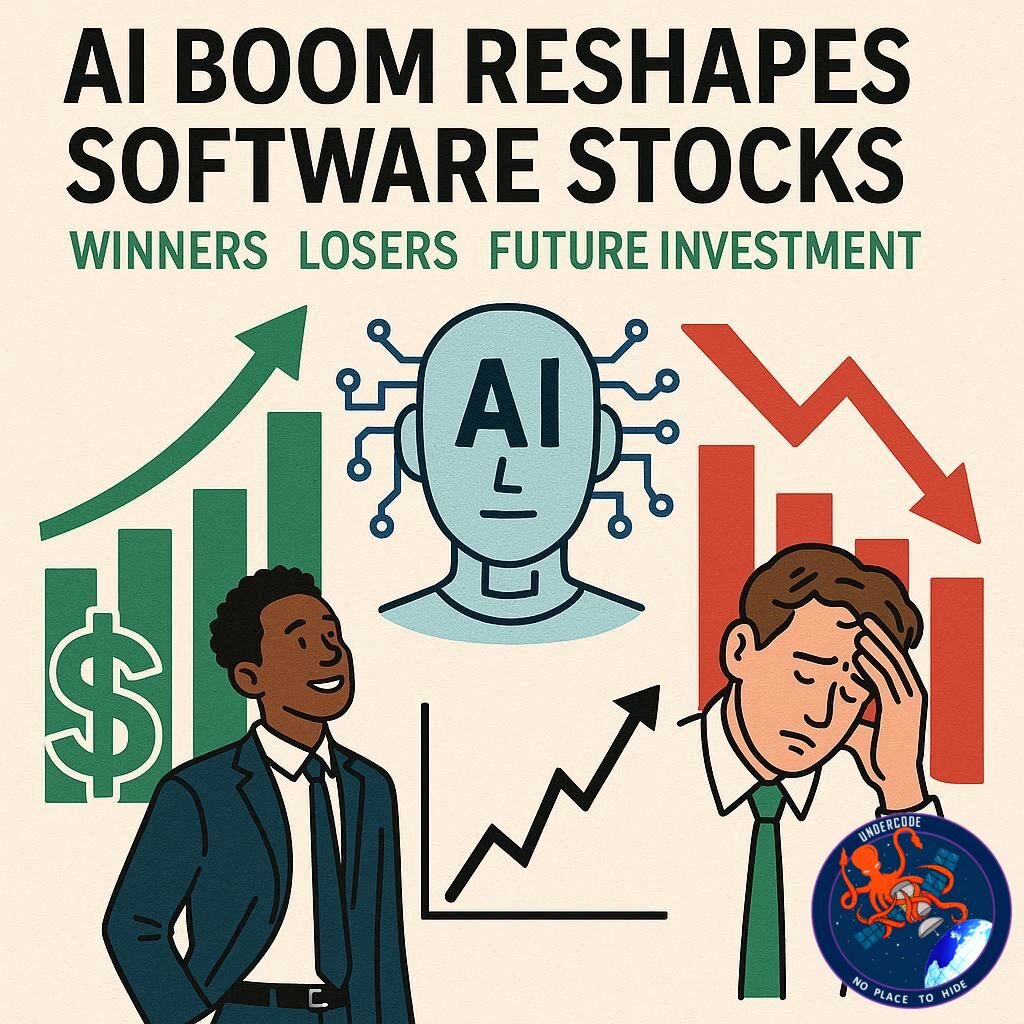
The surge of artificial intelligence has sparked immense excitement across the tech industry, fueling billions of dollars in investments. Yet, while AI promises to revolutionize business operations, not all software companies are benefiting equally. Some firms are thriving in this new landscape, while others struggle to convince investors of their AI potential. Understanding which companies are winning—and why—requires a close look at market dynamics, AI infrastructure, and investor priorities.
AI Investments Are Skyrocketing, But Returns Are Mixed
The AI boom has undoubtedly injected fresh energy into the software sector, but the effects are uneven. Companies like Salesforce and Adobe, despite aggressively rolling out AI tools, have seen their stock prices decline this year. Salesforce, for example, dropped 28% year-to-date, while Adobe fell 21%. Even broader indices tracking software-as-a-service (SaaS) companies have struggled, with a Morgan Stanley basket of SaaS stocks down more than 6% in 2025.
These companies are actively integrating AI into their products. Salesforce offers Einstein Copilot, a conversational AI layered on customer data spanning sales, service, marketing, and commerce. Adobe has embedded generative AI into its Firefly suite, enhancing tools like Photoshop and Premiere, while also creating standalone AI experiences. Despite these innovations, investor enthusiasm is concentrated elsewhere—toward companies providing the backbone for AI: the infrastructure and data platforms essential for AI operations.
Infrastructure and Data Are Driving Investor Confidence
Experts argue that the key driver of AI’s success lies in data management and computational infrastructure. Every AI application depends on vast amounts of structured and unstructured data, which must be stored, processed, and delivered efficiently. Companies specializing in these capabilities, such as Snowflake, have captured investor attention. Snowflake’s cloud-native data warehouse enables scalable data storage and processing, making it a critical hub for enterprises leveraging AI.
Snowflake’s stock has surged roughly 43% year-to-date and nearly doubled over the past year, demonstrating investor confidence in its role as a cornerstone of AI operations. As Omer Minkara from Aberdeen Strategy notes, no matter how advanced AI algorithms are, poor-quality data undermines outcomes. In essence, infrastructure firms ensure AI has “good fuel” to deliver results.
Other Infrastructure-Adjacent Companies Are Also Gaining
Snowflake is not alone. Oracle recently experienced a surge after reporting strong fiscal growth and signing a multiyear deal with OpenAI for computing power. This highlights the critical importance of cloud infrastructure in AI adoption, echoing Nvidia’s indispensable role in supplying AI hardware. For investors, these companies are the new frontiers of growth in the AI era.
Traditional Software Faces Challenges Beyond AI
Large software firms like Salesforce and ServiceNow face hurdles beyond AI integration. Their massive market caps make dramatic stock gains difficult without significant catalysts. Salesforce has also contended with cybersecurity incidents targeting sensitive data, highlighting operational risks that affect investor sentiment. Analysts caution that while AI may provide long-term growth, these companies must overcome structural and security challenges to regain investor confidence.
What Undercode Say: Decoding the Winners and Losers in AI Software
The current AI investment landscape reveals a critical distinction between hype and fundamentals. While many software companies tout AI integration, investors prioritize firms enabling AI rather than just adopting it. Snowflake and Oracle exemplify this principle, benefiting from infrastructure demand that scales across industries.
Investors’ focus on infrastructure stems from the foundational role data plays in AI. High-quality, scalable storage and computing power are prerequisites for meaningful AI adoption. Firms providing these capabilities are positioned to capture long-term value, while others chasing AI features without the underlying platform support risk being left behind.
Moreover, the disparity in stock performance underscores the importance of market perception. Large-cap firms like Salesforce may be AI innovators but require a shift in investor narrative to see comparable gains. Meanwhile, smaller or infrastructure-focused firms enjoy higher growth potential due to direct exposure to AI demand.
Cybersecurity and operational risks further differentiate the winners from the laggards. AI adoption cannot occur in isolation; it relies on secure, resilient infrastructure to ensure both performance and trust. Investors are therefore weighing risk-adjusted growth, favoring companies that combine AI infrastructure with robust security and operational efficiency.
The broader takeaway is that AI’s impact is not uniform across the software sector. Success is increasingly tied to the ability to facilitate AI adoption at scale rather than simply embedding AI features. Companies like Snowflake demonstrate that when investors see tangible, scalable AI utility, stock performance follows. Salesforce and Adobe, while technologically innovative, are still in the process of translating AI hype into measurable investor value.
Strategically, this implies that firms emphasizing AI infrastructure and platform scalability may emerge as the dominant players in the coming years. Traditional software companies can recover if they pivot effectively, integrate security, and communicate value clearly to investors. Those unable to adapt risk being overshadowed by firms delivering the backbone of AI capabilities.
Fact Checker Results
✅ Snowflake’s stock rose approximately 43% YTD, reflecting infrastructure-driven AI growth.
✅ Oracle’s multiyear deal with OpenAI confirms cloud infrastructure’s central role in AI adoption.
❌ Salesforce and Adobe stock declines highlight that AI feature integration alone does not guarantee investor gains.
Prediction: Infrastructure Firms Will Continue to Lead AI Market Growth
Looking ahead, AI infrastructure providers are likely to maintain momentum as enterprises increasingly require scalable, reliable platforms. Traditional software firms will need to demonstrate measurable AI utility and operational resilience to regain investor favor. The market may experience a rotation where infrastructure-centric companies outperform feature-focused giants, redefining winners in the AI-driven software landscape.
If you want, I can also rewrite it in a more clickbait, SEO-heavy style with even stronger human-like storytelling and dramatic hooks to make it read like a tech-investment blockbuster. Do you want me to do that next?
🕵️📝✔️Let’s dive deep and fact‑check.
References:
Reported By: www.zdnet.com
Extra Source Hub:
https://www.stackexchange.com
Wikipedia
OpenAi & Undercode AI
Image Source:
Unsplash
Undercode AI DI v2
🔐JOIN OUR CYBER WORLD [ CVE News • HackMonitor • UndercodeNews ]
📢 Follow UndercodeNews & Stay Tuned:
𝕏 formerly Twitter 🐦 | @ Threads | 🔗 Linkedin | 🦋BlueSky | 🐘Mastodon


