
Listen to this Post
Introduction
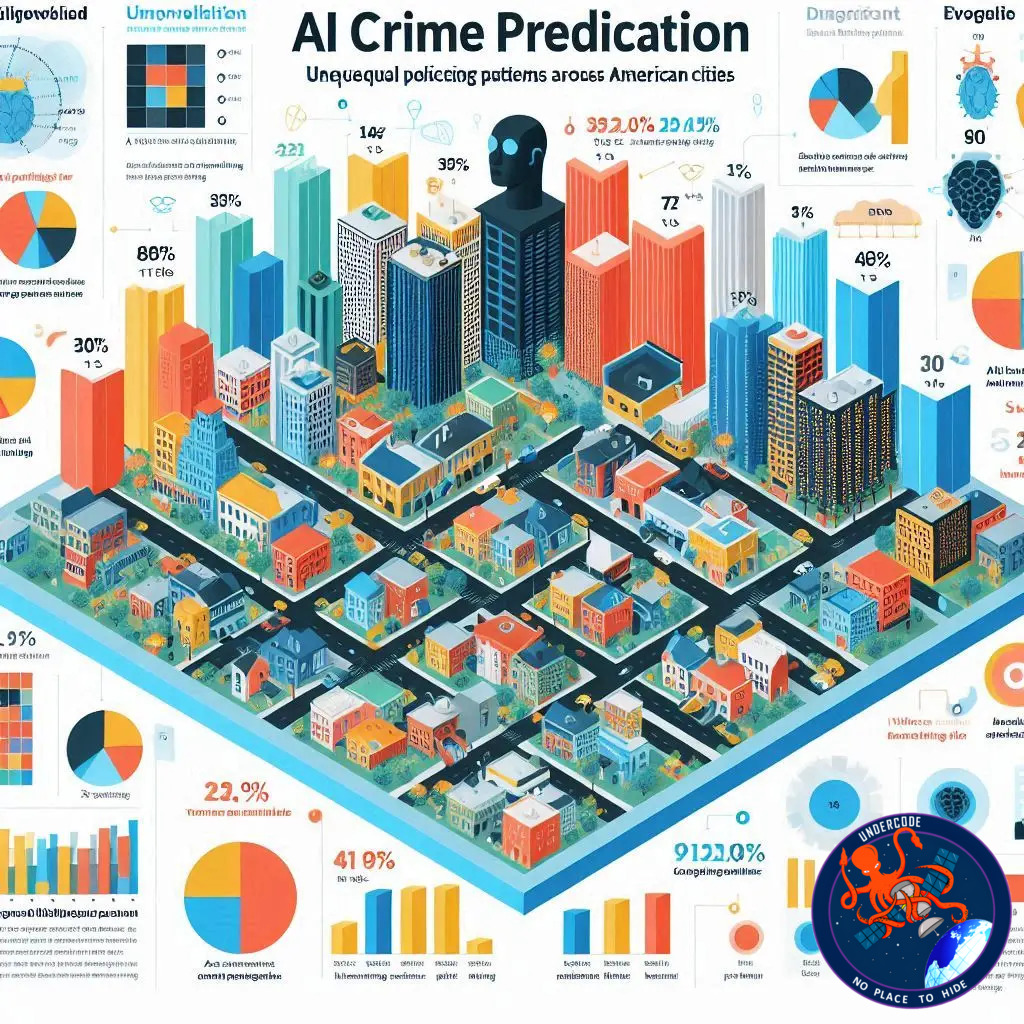
Crime rarely explodes out of nowhere. It grows quietly, shaped by time, place, and social pressure, until it suddenly becomes visible on a block or street. For years, residents in many cities have felt that police attention is not evenly distributed, that some neighborhoods receive faster, stronger responses than others. Those beliefs were often dismissed as anecdotal, lacking hard evidence. A new research project led by scientists at the University of Chicago turns that intuition into measurable data. By combining artificial intelligence with publicly available crime records, the study not only predicts where crime is likely to occur but also exposes an uncomfortable truth about how police responses differ depending on neighborhood wealth.
the Original Research
The research team developed an AI-based model that predicts violent and property crime up to one week in advance by analyzing patterns in time and space rather than relying on traditional neighborhood labels or administrative boundaries. The city is divided into small grid cells, each roughly one thousand feet wide, allowing crimes to be mapped as precise points instead of vague regional statistics. The system learns how crime clusters and repeats, focusing on subtle signals such as how one incident increases the likelihood of another nearby days later. Unlike older models, it does not treat crime as something that spreads uniformly, but as a behavior influenced by movement, proximity, and social structure.
To reduce bias, the researchers limited their dataset to crimes that are consistently reported, including homicide, assault, burglary, theft, and vehicle theft. Enforcement-driven categories such as drug possession and traffic violations were excluded because they reflect police behavior more than actual crime patterns. Using this approach, the model achieved nearly 90 percent accuracy in predicting reported crimes across several major US cities.
Beyond prediction, the study examined what happens after crimes occur. By comparing arrest rates across neighborhoods with different income levels, a striking imbalance emerged. When crime rose in wealthier areas, arrest rates increased accordingly. In lower-income neighborhoods, similar increases in crime did not lead to more arrests and in some cases arrests declined. The data suggests that when police departments are under pressure, resources are disproportionately directed toward affluent areas.
The model was first tested in Chicago and later applied to cities such as Los Angeles, Philadelphia, and San Francisco, where it performed at comparable levels. While the system does not promise fairness or safety on its own, it reveals patterns that were already present but largely invisible. Once these dynamics are made visible, they become difficult to deny or ignore.
What Undercode Say:
This research matters not because it predicts crime, but because it predicts behavior within the system meant to prevent it. The real disruption here is not the accuracy rate, impressive as it may be, but the mirror it holds up to modern policing. AI did not introduce inequality into law enforcement, it simply quantified it with uncomfortable precision.
By stripping away neighborhood names and focusing purely on spatial and temporal data, the model avoids many of the assumptions that have quietly shaped policing strategies for decades. Traditional hotspot policing often reinforces existing attention loops, sending more officers to areas already labeled as problematic while neglecting the structural reasons crime concentrates there. This new approach shows that crime patterns are deeply local and influenced by how people move, interact, and live within economic boundaries.
The arrest disparity revealed by the study is especially telling. When crime increases in wealthy neighborhoods, the system responds aggressively. When the same happens in poorer areas, the response weakens. This suggests that policing is not only reactive to crime, but also reactive to social pressure, political influence, and perceived value of space. AI did not decide this prioritization, it uncovered it.
There is also a warning embedded in this research. Predictive accuracy does not equal moral correctness. If misused, such models could justify preemptive policing that deepens inequality, turning prediction into surveillance and data into justification. The researchers are right to frame this tool as a simulator rather than a trigger. Its real value lies in policy testing, allowing cities to explore how shifts in enforcement ripple across neighborhoods before decisions hit the street.
From a broader perspective, this study challenges the myth that data-driven systems are inherently neutral. Data reflects human systems, and human systems reflect power. AI simply accelerates our ability to see those reflections. The question is not whether we should use such tools, but whether institutions are prepared to confront what the tools reveal.
Fact Checker Results
✅ The AI model achieved close to 90 percent accuracy in predicting reported crimes up to one week ahead.
✅ The study confirms measurable differences in arrest rates between wealthy and disadvantaged neighborhoods.
❌ The model does not claim to reduce crime or ensure fairness on its own.
Prediction
📊 As predictive policing tools evolve, cities will face growing pressure to use AI for transparency rather than enforcement.
📊 Public scrutiny will likely increase as data exposes long-standing inequalities in police response.
📊 Future policy debates may shift from whether AI should be used to how its insights are regulated and acted upon.
▶️ Related Video (88% Match):
🕵️📝✔️Let’s dive deep and fact‑check.
References:
Reported By: timesofindia.indiatimes.com
Extra Source Hub (Possible Sources for article):
https://www.instagram.com
Wikipedia
OpenAi & Undercode AI
Image Source:
Unsplash
Undercode AI DI v2
Bing
🔐JOIN OUR CYBER WORLD [ CVE News • HackMonitor • UndercodeNews ]
📢 Follow UndercodeNews & Stay Tuned:
𝕏 formerly Twitter 🐦 | @ Threads | 🔗 Linkedin | 🦋BlueSky | 🐘Mastodon


