
Listen to this Post
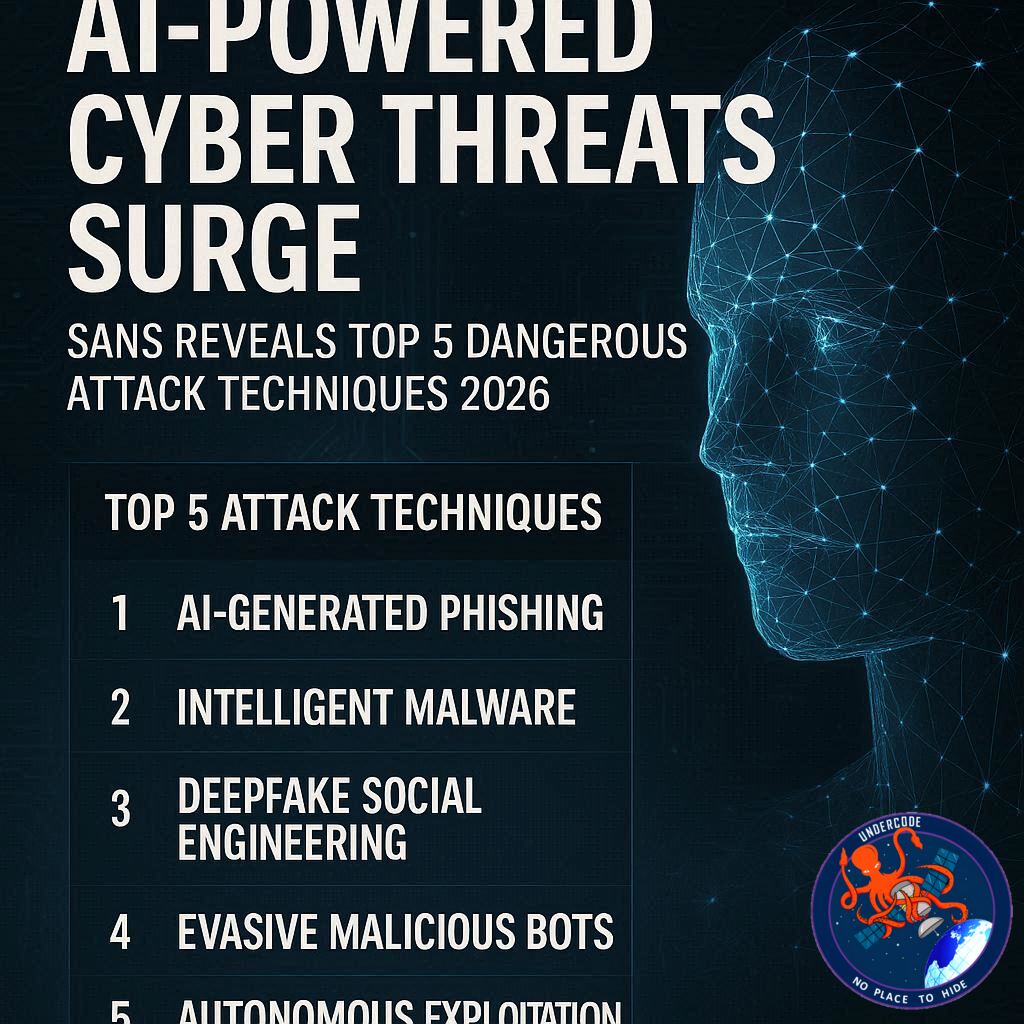
Introduction: The New Era of AI-Driven Cyber Warfare
Cybersecurity has entered a turning point where artificial intelligence is no longer just a defensive tool, but a powerful weapon in the hands of attackers. At the 2026 RSAC Conference, experts from the SANS Institute delivered a stark warning: every major emerging attack technique now shares a common engine, AI. This shift signals not just an evolution in cyber threats, but a complete transformation of how digital warfare is conducted. The traditional gap between attackers and defenders is widening rapidly, forcing organizations to rethink their strategies before the imbalance becomes irreversible.
AI Dominates the Top Threat Landscape
For the first time, all five of the most dangerous attack techniques identified by SANS researchers are powered by artificial intelligence. According to SANS leadership, ignoring AI in threat analysis is no longer realistic. The cybersecurity battlefield has shifted toward automation, speed, and scale, where human-only defense strategies are increasingly inadequate.
AI-Generated Zero-Day Exploits Become Mass Accessible
Zero-day vulnerabilities were once rare and expensive, typically discovered by highly funded nation-state actors. That exclusivity has collapsed. With AI, independent researchers and even low-budget attackers can now uncover critical vulnerabilities at a fraction of the previous cost. Reports suggest that some zero-day discoveries now require as little as $116 in AI processing costs, compared to millions spent in the past. This dramatic shift has transformed zero-days from scarce strategic weapons into widely accessible tools, significantly increasing global risk exposure.
Supply Chain Attacks Expand Beyond Direct Vendors
Software supply chain attacks have intensified, affecting a majority of organizations over the past year. The threat no longer comes only from direct vendors, but from entire ecosystems of dependencies. Incidents like the Shai-Hulud worm, which infected over a thousand open-source packages, demonstrate how deeply attackers can infiltrate digital infrastructures. Similarly, compromised update systems such as those affecting Notepad++ highlight how attackers selectively distribute backdoors across industries like energy, finance, and government. The modern attack surface now includes every layer of software development and distribution.
Operational Technology Faces Visibility Crisis
Operational Technology (OT) environments are experiencing a growing accountability problem. In many cases, critical forensic data simply disappears after an incident, leaving investigators without answers. Real-world attacks on energy infrastructure have already shown how disruptions can occur without any clear trace of attacker activity. In extreme scenarios, even catastrophic events such as facility explosions cannot be definitively linked to cyberattacks due to lack of monitoring. This absence of visibility creates dangerous uncertainty, especially in sectors where human safety is at risk.
Misuse of AI in Incident Response Weakens Defense
While AI offers powerful capabilities, its misuse in digital forensics and incident response introduces new vulnerabilities. Experts warn that organizations deploying AI without proper training or validation frameworks risk making critical mistakes. AI systems can generate confident but incorrect conclusions, which may mislead investigations rather than accelerate them. Decision-making remains a human responsibility, and over-reliance on AI can compromise the accuracy and effectiveness of response efforts.
Autonomous Attacks Accelerate Beyond Human Speed
AI-driven attacks are now significantly faster than traditional methods, with some estimates suggesting they operate up to 47 times quicker. Attackers can escalate privileges and gain full system control within minutes. Campaigns such as the AI-driven “GTG 1002” operation demonstrate how automation can handle reconnaissance, exploitation, and lateral movement with minimal human input. This level of speed and efficiency forces defenders into a reactive position unless they adopt similar technologies.
The Rise of AI-Powered Defensive Systems
To counter AI-driven threats, cybersecurity professionals are turning toward autonomous defense solutions. Initiatives like Protocol SIFT, developed by the SANS Institute, aim to enhance analyst capabilities by integrating AI into workflows. These systems help organize data, identify threats, and accelerate investigations, while still relying on human oversight for decision-making. Early results show significant reductions in response times, transforming complex investigations into processes that can be completed in minutes rather than weeks.
What Undercode Say: The Real Cybersecurity Crisis Is Speed, Not Just AI
The most critical insight from this report is not simply that AI is being used in cyberattacks, but that it fundamentally alters the speed equation. Cybersecurity has always been a race, but now it is a race where one side has been given exponential acceleration. Attackers are no longer limited by human fatigue, skill gaps, or time constraints. They can scale operations instantly, test vulnerabilities continuously, and adapt strategies in real time.
This creates a dangerous asymmetry. Traditional defense models rely on detection, analysis, and response cycles that inherently take time. Even the most advanced security teams cannot manually match the pace of AI-driven attacks. The result is a widening gap where attackers increasingly dictate the timeline of breaches.
Another overlooked dimension is accessibility. AI democratizes offensive capabilities. Previously, launching sophisticated cyberattacks required deep expertise and significant funding. Now, with AI tools, less experienced actors can execute highly complex operations. This lowers the barrier to entry and increases the number of potential threat actors globally.
The supply chain issue further amplifies this risk. Organizations often focus on securing their own systems while ignoring the broader ecosystem they depend on. AI enables attackers to identify and exploit weak links across interconnected networks, turning minor vulnerabilities into large-scale breaches. Trust is becoming one of the most fragile components of cybersecurity.
The OT visibility crisis introduces a more alarming consequence: the inability to understand or even confirm attacks. When critical infrastructure lacks monitoring, incidents can escalate into physical disasters without clear attribution. This is not just a cybersecurity issue but a national security and public safety concern. The absence of data means the absence of accountability, and that is a dangerous place for any industry to operate.
The misuse of AI in defense also reveals a deeper problem. Technology alone cannot solve cybersecurity challenges. Without proper training, governance, and human oversight, AI becomes another layer of risk. Blind trust in automated systems can lead to incorrect decisions, delayed responses, and ultimately greater damage.
The emergence of autonomous defense systems is promising, but it is not a complete solution. These tools must be integrated carefully, ensuring that human analysts remain central to decision-making processes. The goal should not be to replace humans, but to enhance their capabilities and reduce response times.
Ultimately, the cybersecurity landscape is shifting toward a model where speed, adaptability, and intelligence integration define success. Organizations that fail to adopt AI-driven defenses while maintaining strong human oversight will struggle to keep up. The future of cybersecurity will belong to those who can balance automation with expertise, and speed with accuracy.
Fact Checker Results
✅ AI is now widely used in both cyberattacks and defensive tools, confirmed by industry reports.
✅ Supply chain attacks and open-source compromises have significantly increased in recent years.
❌ AI alone cannot fully replace human decision-making in cybersecurity operations.
Prediction
🔮 AI-driven cyberattacks will become fully autonomous within the next few years, reducing human involvement even further.
🔮 Organizations will be forced to adopt real-time AI defense systems as a baseline security requirement.
🔮 Regulatory bodies will introduce stricter rules around AI usage in cybersecurity to prevent misuse and systemic risks.
▶️ Related Video (78% Match):
🕵️📝✔️Let’s dive deep and fact‑check.
References:
Reported By: www.darkreading.com
Extra Source Hub (Possible Sources for article):
https://www.github.com
Wikipedia
OpenAi & Undercode AI
Image Source:
Unsplash
Undercode AI DI v2
Bing
🔐JOIN OUR CYBER WORLD [ CVE News • HackMonitor • UndercodeNews ]
📢 Follow UndercodeNews & Stay Tuned:
𝕏 formerly Twitter 🐦 | @ Threads | 🔗 Linkedin | 🦋BlueSky | 🐘Mastodon


