
Listen to this Post
Introduction: Why This Expansion Matters Now
Artificial intelligence is no longer a future promise in cybersecurity—it is the present battlefield. As AI-powered attacks grow more sophisticated, governments and enterprises are scrambling to close a widening skills gap. Against this backdrop, a major certification body has announced a bold expansion aimed squarely at strengthening U.S. cyber and AI readiness. The move signals not just an update to training programs, but a strategic response to how cyber defense itself is evolving in the age of automation and machine intelligence.
the Original
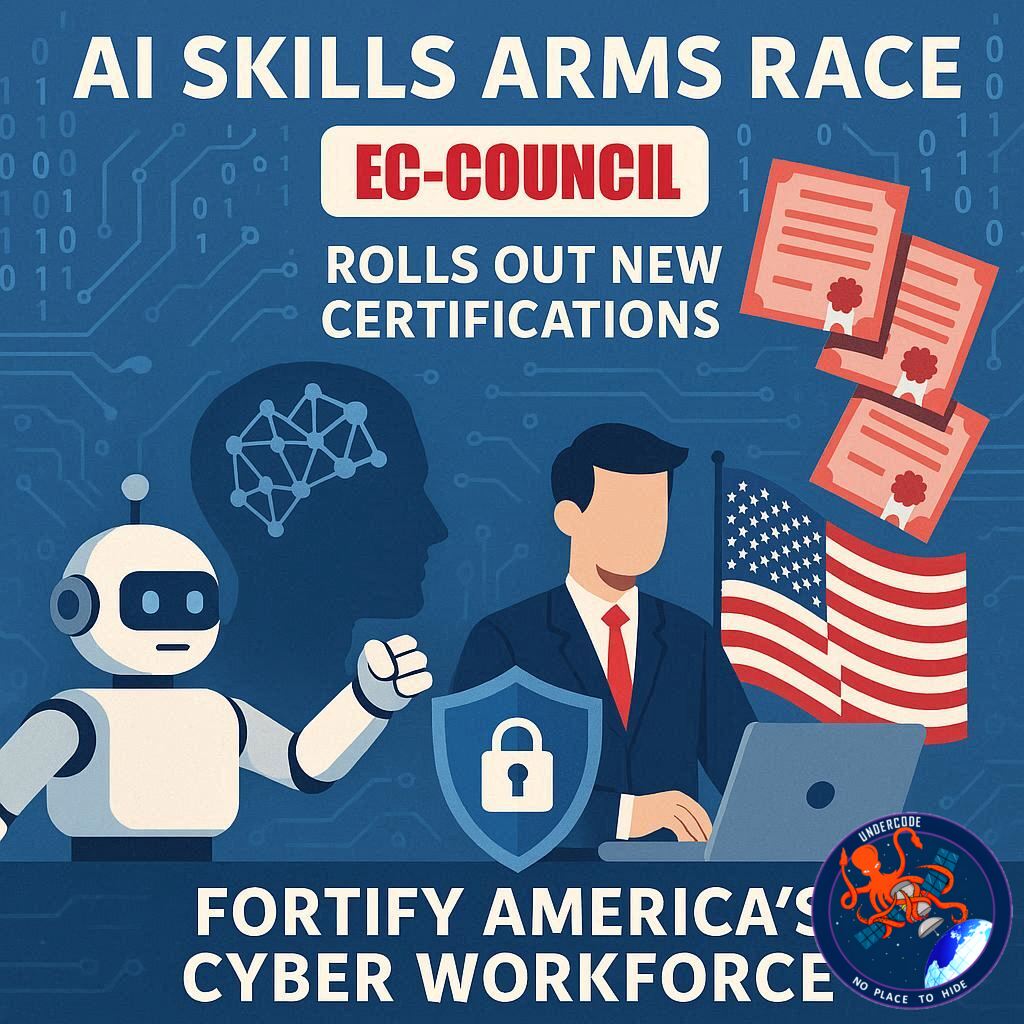
The original report highlights how EC-Council has expanded its artificial intelligence certification portfolio by introducing four new role-based AI credentials alongside an updated Certified CISO v4 program. This expansion is positioned as a direct contribution to strengthening the United States’ AI workforce readiness under the Adopt.Defend.Govern framework.
The announcement emphasizes that these new certifications are designed to address specific professional roles rather than offering generic AI knowledge. By doing so, EC-Council aims to ensure that cybersecurity practitioners, executives, and technical specialists can apply AI in ways that are practical, ethical, and defensible in real-world environments. The focus is not limited to technical skills alone, but also includes governance, risk management, and leadership decision-making in AI-driven security operations.
According to the article, the updated Certified CISO v4 program integrates AI risk awareness and strategic oversight into executive-level cybersecurity training. This reflects a growing recognition that CISOs must understand not only how AI tools work, but also how they can fail, be abused, or introduce new compliance challenges. The four newly introduced AI credentials are framed as role-based, aligning AI competencies with job functions such as threat analysis, defense engineering, and policy oversight.
The article also underscores the broader national context. With the U.S. government pushing for stronger domestic AI capabilities, workforce development has become a priority. Certifications are increasingly viewed as fast, scalable mechanisms to upskill professionals without waiting for long academic cycles. EC-Council positions its expanded portfolio as a response to this urgency, aiming to create a pipeline of professionals who can responsibly adopt AI, defend against AI-driven threats, and govern AI systems within regulatory and ethical boundaries.
Overall, the source frames the announcement as a strategic alignment between industry certification, national security priorities, and the accelerating pace of AI adoption in cybersecurity.
What Undercode Say:
AI Certifications as Strategic Infrastructure
This move by EC-Council should be read less as a marketing update and more as an infrastructure play. Certifications are becoming the “middleware” between fast-moving AI innovation and slow-moving institutional adoption. By creating role-based AI credentials, EC-Council is acknowledging a critical truth: not everyone in cybersecurity needs to build AI models, but everyone needs to understand how AI reshapes their specific responsibilities.
Why Role-Based AI Training Is a Smart Pivot
Generic AI courses often fail because they overwhelm learners with theory while offering little operational relevance. Role-based certifications flip this model. A SOC analyst, a red team operator, and a CISO face fundamentally different AI risks and opportunities. Tailoring AI education to those realities increases the chance that skills learned will actually be used, not forgotten after an exam.
Certified CISO v4 Reflects a Shift in Executive Accountability
Updating Certified CISO to version 4 is arguably the most important part of this announcement. Boards and regulators are increasingly holding executives accountable for AI-related failures, from data misuse to automated decision errors. A modern CISO can no longer delegate “AI stuff” to technical teams. They must understand AI risk at a strategic level, and this update signals that expectation clearly.
Adopt, Defend, Govern Is More Than a Slogan
The Adopt.Defend.Govern framing mirrors how mature organizations approach emerging technology. First, you adopt AI to stay competitive. Then, you defend against its misuse. Finally, you govern it to ensure compliance, trust, and sustainability. Embedding this mindset into certifications helps normalize AI governance as a core security function, not an afterthought.
Implications for the U.S. Cyber Workforce
From a workforce perspective, this expansion could accelerate standardization in AI security skills. Employers often struggle to evaluate AI competence on résumés. Recognized certifications provide a shorthand signal of capability, which can speed hiring and reduce uncertainty. For professionals, it offers a clearer roadmap for career development in an AI-dominated security landscape.
The Competitive Certification Market Angle
It’s also worth noting the competitive undertone. As more organizations enter the AI training space, certification bodies risk becoming irrelevant if they move too slowly. EC-Council’s expansion suggests it understands this pressure and is attempting to stay ahead by integrating AI deeply into its flagship programs rather than bolting it on as an elective.
🔍 Fact Checker Results
✅ EC-Council has announced an expansion of its AI certification portfolio.
✅ Certified CISO has been updated to a new version incorporating AI considerations.
❌ No evidence suggests these certifications alone can close the entire U.S. AI skills gap.
📊 Prediction
Over the next two years, AI-specific cybersecurity certifications will become a baseline requirement rather than a differentiator. Organizations will increasingly expect CISOs and security teams to demonstrate formal AI governance training, and programs like Certified CISO v4 will shape how executive accountability for AI risk is defined across the industry.
🕵️📝✔️Let’s dive deep and fact‑check.
References:
Reported By: x.com
Extra Source Hub (Possible Sources for article):
https://www.quora.com/topic/Technology
Wikipedia
OpenAi & Undercode AI
Image Source:
Unsplash
Undercode AI DI v2
Bing
🔐JOIN OUR CYBER WORLD [ CVE News • HackMonitor • UndercodeNews ]
📢 Follow UndercodeNews & Stay Tuned:
𝕏 formerly Twitter 🐦 | @ Threads | 🔗 Linkedin | 🦋BlueSky | 🐘Mastodon


