
Listen to this Post
Introduction
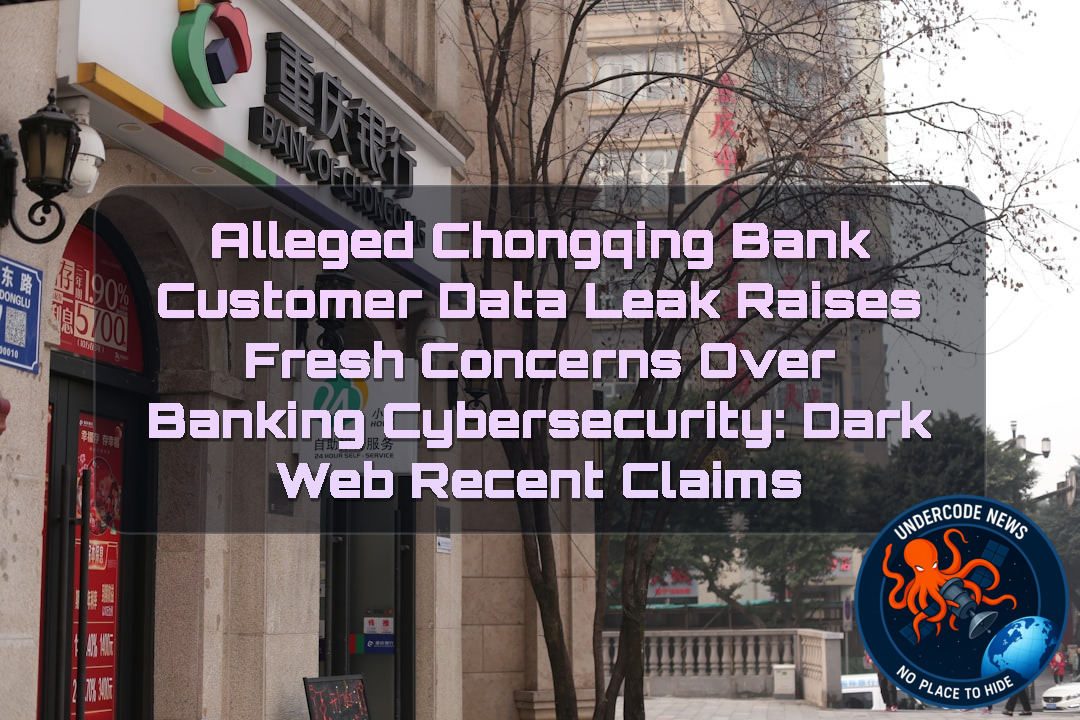
The cybercrime ecosystem continues to target financial institutions worldwide, with threat actors increasingly using underground forums to advertise allegedly stolen databases. A recent claim circulating within dark web monitoring communities suggests that customer-related data linked to Chongqing Bank in China may have been exposed and offered for sale on a cybercrime forum. While the authenticity of the dataset has not been independently verified, the allegation highlights the persistent risks facing banks and financial organizations in an era where data has become one of the most valuable commodities for cybercriminals.
Dark Web Monitoring Report Draws Attention
A report shared by Dark Web Intelligence on June 22, 2026, claimed that a threat actor is advertising what is described as a database belonging to Chongqing Bank. According to the post, the seller alleges that the database contains customer-related records associated with the Chinese banking institution.
At the time of reporting, no public confirmation from Chongqing Bank had been issued regarding the alleged breach. Likewise, there has been no independently verified evidence confirming that the advertised data is authentic, complete, or obtained through unauthorized access.
Why Banking Data Remains a Prime Target
Financial institutions represent some of the most attractive targets for cybercriminal groups. Banks manage vast quantities of personal information, financial records, account details, identity documents, and transactional data that can be monetized through multiple criminal channels.
Even when direct financial information is absent, customer databases often contain valuable personally identifiable information. Such records can be exploited for identity theft, phishing campaigns, social engineering attacks, financial fraud, or sold to other criminal actors for future operations.
The underground economy has evolved significantly over the last decade. Today, cybercriminal marketplaces function much like legitimate e-commerce platforms, complete with seller reputations, customer reviews, escrow services, and specialized categories for stolen data.
Understanding the Risks of Alleged Data Exposure
If the claims surrounding the Chongqing Bank database prove accurate, several risks could emerge for affected customers and the institution itself.
Customers could become targets of highly personalized phishing campaigns. Attackers often use leaked information to craft convincing emails, SMS messages, or phone calls that appear legitimate. Such campaigns tend to achieve higher success rates because criminals possess details that build trust with victims.
Organizations also face reputational damage when customer information is exposed. Public confidence is a critical asset in banking, and any security-related controversy can lead to increased scrutiny from regulators, investors, and customers.
Additionally, investigations into alleged breaches frequently require significant resources. Digital forensic teams, legal experts, regulators, and cybersecurity professionals may become involved to determine the source, scope, and impact of a potential incident.
China’s Expanding Cybersecurity Landscape
China has invested heavily in strengthening cybersecurity regulations and data protection frameworks over recent years. Financial institutions operating within the country are subject to increasingly strict compliance requirements designed to safeguard customer information and critical infrastructure.
The
The reported claim serves as another reminder that cybersecurity remains an ongoing process rather than a one-time achievement. Even organizations with mature security programs must continuously adapt to evolving threats.
The Growing Market for Stolen Financial Information
Dark web marketplaces remain one of the primary distribution channels for allegedly stolen corporate and consumer data. Threat actors frequently advertise databases from government agencies, healthcare providers, educational institutions, technology firms, and banks.
In many cases, sellers exaggerate the size or quality of datasets to attract buyers. Some listings contain duplicated information from previous breaches, while others may consist of partial records or fabricated samples designed to generate interest.
Because of this, cybersecurity researchers typically treat dark web advertisements as claims until technical validation can confirm whether the data is genuine.
The distinction between an alleged leak and a confirmed breach is crucial. Responsible reporting requires acknowledging that a forum advertisement alone does not automatically prove that a security incident has occurred.
How Financial Institutions Respond to Such Claims
When allegations emerge online, banks generally follow a structured response process. Security teams investigate whether any indicators support the claims and determine whether unauthorized access may have occurred.
Organizations often analyze leaked samples, review system logs, assess access controls, and conduct forensic examinations. If evidence supports the existence of a breach, institutions may coordinate with regulators, law enforcement agencies, cybersecurity partners, and affected customers.
Rapid detection and transparent communication are increasingly viewed as essential components of modern incident response strategies.
Broader Implications for the Global Banking Industry
Whether this particular claim is ultimately validated or disproven, the incident reflects broader trends affecting the global financial sector.
Cybercriminal groups continue targeting institutions that store large volumes of sensitive information. Attack techniques have expanded beyond traditional hacking to include credential theft, supply chain compromises, insider threats, cloud misconfigurations, and advanced social engineering campaigns.
As digital banking adoption increases worldwide, protecting customer information remains one of the industry’s most critical responsibilities. Continuous monitoring of underground forums, proactive threat hunting, and rapid incident response capabilities are becoming standard requirements rather than optional security measures.
What Undercode Say:
The alleged Chongqing Bank data leak demonstrates how cybercrime intelligence often begins with observations made on underground forums rather than confirmed breach disclosures.
One of the most important aspects of this case is the distinction between a claim and a verified incident.
Many organizations become associated with breach reports long before forensic investigations are completed.
Threat actors frequently use well-known company names to increase visibility and attract buyers.
Dark web advertisements alone should never be treated as definitive evidence.
Verification remains the foundation of responsible cybersecurity reporting.
Financial institutions have become preferred targets because customer information possesses long-term criminal value.
Unlike stolen credit cards, personal data can be reused repeatedly across multiple fraud schemes.
Attackers increasingly combine leaked records with artificial intelligence tools to create convincing phishing operations.
Banking customers are particularly vulnerable to social engineering attacks because financial communications often require urgent action.
The alleged database advertisement highlights the commercialization of cybercrime.
Modern underground forums increasingly resemble legitimate online marketplaces.
Reputation systems among criminals create a level of trust within illicit communities.
This development has accelerated the global trade of stolen information.
Threat intelligence providers monitor these forums to identify emerging risks before large-scale exploitation occurs.
Early detection can reduce organizational exposure.
The case also illustrates why organizations invest heavily in dark web monitoring programs.
Such monitoring allows security teams to identify references to company assets, employee credentials, and customer information.
Even false claims can generate operational challenges.
A bank may need to launch internal investigations simply because its name appears in a criminal marketplace listing.
Regulatory expectations continue rising across the financial sector.
Authorities increasingly expect rapid detection and reporting of cybersecurity incidents.
Data protection laws around the world are becoming stricter.
Organizations that fail to protect customer information may face financial penalties and reputational consequences.
The banking industry is simultaneously undergoing rapid digital transformation.
Mobile banking, cloud infrastructure, and API-driven services increase operational efficiency.
However, expanded digital ecosystems also create larger attack surfaces.
Cybersecurity therefore becomes a strategic business function rather than a purely technical responsibility.
Threat actors continue adapting their tactics.
Defensive technologies improve each year.
Yet attackers leverage automation, credential theft, malware, and underground intelligence sharing to maintain pressure on organizations.
The most resilient institutions are those that assume attacks will occur and prepare accordingly.
Security maturity is increasingly measured by detection and response speed.
Proactive threat hunting remains critical.
Continuous monitoring remains critical.
Employee awareness remains critical.
Incident response readiness remains critical.
The Chongqing Bank allegation serves as another reminder that cybersecurity is not solely about preventing breaches.
It is equally about rapidly validating claims, understanding risks, and protecting customer trust when allegations emerge.
Deep Analysis: Linux Commands and Threat Intelligence Investigation
Cybersecurity teams investigating claims like this often rely on a variety of forensic and monitoring tools.
Monitor authentication logs
sudo journalctl -xe
Search for suspicious access attempts
grep "Failed password" /var/log/auth.log
Identify active network connections
ss -tulpn
Analyze running processes
ps aux
Review recently modified files
find / -mtime -7
Check user accounts
cat /etc/passwd
Monitor network traffic
sudo tcpdump -i any
Analyze open files
lsof
Verify system integrity
rpm -Va
Review login history
last
Monitor security events
sudo ausearch -ts recent
Investigate suspicious IP addresses
whois <IP_ADDRESS>
Check firewall status
sudo iptables -L -n -v
Examine DNS activity
dig example.com
Scan for vulnerabilities
nmap -sV target-host
Review cron jobs
crontab -l
These commands form part of the foundational toolkit used by analysts to investigate suspicious activity, validate security events, and determine whether unauthorized access may have occurred within enterprise environments.
✅ A dark web monitoring account reported an alleged database sale linked to Chongqing Bank.
✅ There is currently no publicly verified evidence presented within the claim proving that the advertised database is authentic.
✅ Responsible cybersecurity reporting requires distinguishing between a marketplace advertisement and a confirmed data breach, which has not yet been publicly established.
Prediction
(+1) Financial institutions will continue increasing investments in dark web monitoring and threat intelligence platforms.
(+1) More banks will adopt automated breach detection and rapid-response capabilities to reduce exposure from emerging cyber threats.
(+1) Regulatory agencies will likely strengthen reporting and customer notification requirements following future data exposure incidents.
(-1) Cybercriminal marketplaces will continue expanding their trade in financial and customer-related information.
(-1) False or exaggerated breach claims may increase, creating additional challenges for organizations attempting to assess real threats.
(-1) Banking institutions worldwide will face growing pressure from increasingly sophisticated phishing and social engineering campaigns.
▶️ Related Video (76% Match):
🕵️📝Let’s dive deep and fact‑check.
🎓 Live Courses & Certifications:
Join Undercode Academy for Verified Certifications
🚀 Request a Custom Project:
Secure, high-velocity infrastructure and disruptive technological engineering. Contact our engineering team for high-tier development and proprietary systems:
[email protected]
💎 Smart Architecture | 🛡️ Secure by Design | ⭐ Trusted by Thousands
References:
Reported By: x.com
Extra Source Hub (Possible Sources for article):
https://www.linkedin.com
Wikipedia
OpenAi & Undercode AI
Image Source:
Unsplash
Undercode AI DI v2
🔐JOIN OUR CYBER WORLD [ CVE News • HackMonitor • UndercodeNews ]
📢 Follow UndercodeNews & Stay Tuned:
𝕏 formerly Twitter 🐦 | @ Threads | 🔗 Linkedin | 🦋BlueSky | 🐘Mastodon | 📺Youtube


