
Listen to this Post
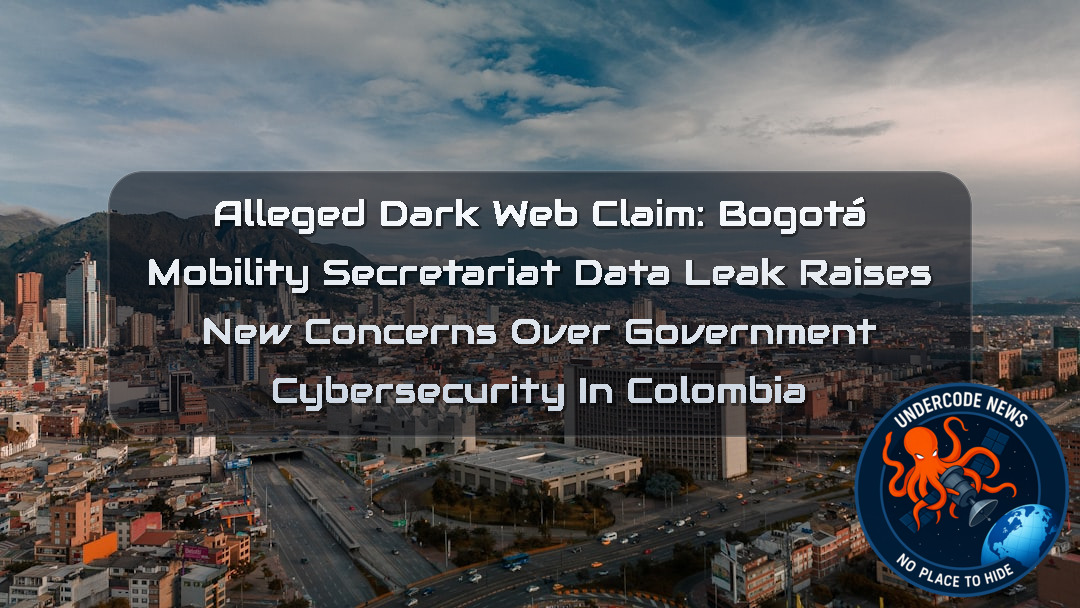 Introduction: A New Warning Sign for Public Sector Security
Government institutions around the world continue to face growing cyber threats as attackers increasingly target agencies responsible for critical public services. Transportation authorities are especially attractive targets because they often manage large volumes of operational records, contractor details, infrastructure information, and citizen-related data.
A recent post circulating on a dark web monitoring channel claims that the Bogotá Mobility Secretariat (Secretaría Distrital de Movilidad), a government transportation agency operating under Bogotá’s Mayor’s Office in Colombia, may have suffered a data exposure incident. The claim suggests that a threat actor obtained internal information linked to the organization through what was described as a strategic partner.
At this stage, the allegation remains unverified. No official confirmation has been provided indicating that the Bogotá Mobility Secretariat experienced a confirmed breach, and the exact nature, size, and sensitivity of the allegedly exposed information remain unknown.
However, the incident highlights a broader cybersecurity challenge facing government organizations: attackers no longer rely only on direct attacks against their targets. Increasingly, they exploit suppliers, contractors, service providers, and trusted partners as indirect entry points into government networks.
Alleged Bogotá Mobility Secretariat Data Leak Appears on Hacking Forum
Threat Actor Claims Access to Government Transportation Data
According to a dark web intelligence report, a threat actor allegedly advertised information connected to the Bogotá Mobility Secretariat on a hacking forum. The actor claims that the data was obtained through a strategic partner associated with the government transportation authority.
The post reportedly identifies the Bogotá Mobility Secretariat as the alleged victim and describes the target as a government transportation organization responsible for mobility-related operations in Colombia’s capital city.
The attacker did not provide extensive technical details regarding the alleged compromise. The available information does not confirm whether the actor obtained databases, documents, employee records, internal communications, credentials, or other categories of information.
No Evidence Yet Confirms the Alleged Breach
Verification Remains Pending
At the time of reporting, there is no independent verification confirming that the Bogotá Mobility Secretariat has suffered a cybersecurity incident.
Dark web claims frequently appear before organizations have the opportunity to investigate. Some posts represent genuine breaches, while others may involve outdated information, recycled datasets, exaggerated claims, or attempts by threat actors to gain reputation within underground communities.
For this reason, cybersecurity researchers typically treat initial leak advertisements as intelligence leads rather than confirmed incidents.
A proper investigation would require technical validation, including checking whether exposed samples match authentic government systems, reviewing access logs, identifying unauthorized activity, and determining whether sensitive information was actually compromised.
Why Government Transportation Agencies Are Attractive Targets
Critical Infrastructure Holds Valuable Information
Transportation authorities are valuable targets because their systems often contain information that can be useful for espionage, fraud, disruption, or future cyberattacks.
Organizations like mobility departments may manage:
Vehicle registration information
Licensing-related records
Contractor and supplier information
Internal operational documents
Infrastructure planning data
Employee information
Citizen service records
Even when attackers do not obtain highly sensitive personal data, internal government information can provide valuable intelligence about organizational structures, technology environments, and potential attack pathways.
The Strategic Partner Risk: A Growing Cybersecurity Problem
Attackers Increasingly Target Supply Chains
One of the most important details in the allegation is the claim that access was obtained through a strategic partner.
Modern organizations rarely operate alone. Government agencies depend on external companies for software platforms, maintenance services, cloud systems, consulting, transportation technology, and administrative solutions.
This interconnected ecosystem creates a larger attack surface.
A smaller vendor with weaker security controls can become a bridge into a much larger government network. Cybercriminal groups and advanced threat actors have repeatedly demonstrated that supply-chain attacks can provide access to organizations that would otherwise be difficult to compromise directly.
Potential Impact If the Claims Are Confirmed
Possible Consequences for Bogotá and Citizens
If the alleged breach is later confirmed, the impact could vary significantly depending on the type of information involved.
A limited exposure of internal documents may create operational risks, while a database containing personal or administrative records could create privacy concerns for citizens and employees.
Potential consequences could include:
Increased phishing campaigns targeting government employees
Identity theft attempts against affected individuals
Fraud using exposed personal information
Additional attacks against connected systems
Reputation damage for the affected institution
Government organizations must consider that stolen information often remains valuable long after an initial breach because attackers can reuse it for future operations.
Recommended Security Response for Government Agencies
Immediate Investigation and Containment Measures
If Bogotá Mobility Secretariat systems were affected, cybersecurity teams would typically begin with a comprehensive incident response process.
Recommended actions include:
Conducting forensic analysis of potentially affected systems
Reviewing authentication logs and unusual activity
Checking third-party access pathways
Rotating potentially compromised credentials
Monitoring for leaked internal information
Assessing legal notification requirements
Strengthening supplier security reviews
Rapid investigation is essential because the time between initial compromise and detection can determine how much damage attackers are able to cause.
Deep Analysis: Government Cybersecurity Risks in the Era of Dark Web Data Markets
Deep Analysis Commands
Command: Analyze the Nature of the Claim
The current information represents an allegation rather than a confirmed breach. The primary indicator is a threat actor’s forum advertisement claiming possession of internal government information.
Dark web marketplaces frequently use claims as a way to attract buyers, increase reputation, or pressure organizations into negotiations.
The absence of disclosed sample data, database size, or technical evidence makes verification difficult.
Command: Evaluate the Target Selection
The Bogotá Mobility Secretariat represents a strategically valuable target because transportation agencies are connected to essential public services.
Cybercriminals often prioritize government institutions because disruption creates pressure, while stolen information can have long-term value.
The target selection aligns with broader trends where municipal governments, healthcare systems, education institutions, and transportation agencies face increasing cyber threats.
Command: Examine the Supply Chain Possibility
The mention of a strategic partner is particularly important.
Supply-chain compromises have become one of the most effective methods for attackers because third-party organizations often have trusted access.
A compromised vendor account can provide attackers with legitimate credentials, reducing the chance of detection compared with traditional intrusion methods.
Command: Assess Possible Data Value
The value of the alleged information depends entirely on what was accessed.
Internal government documents could assist future attacks by revealing employee structures, technology platforms, and operational procedures.
Personal records could create direct privacy risks.
Authentication-related information could be even more dangerous because attackers may use it for additional compromises.
Command: Compare With Global Government Cyber Trends
This allegation reflects a global pattern.
Government organizations worldwide continue to experience ransomware attacks, data leaks, phishing campaigns, and espionage attempts.
Attackers understand that public institutions often operate complex legacy environments while managing large amounts of sensitive information.
Command: Identify Defensive Priorities
The most important defensive lesson is visibility.
Organizations cannot protect systems they cannot monitor.
Government agencies should prioritize:
Zero-trust security models
Multi-factor authentication
Vendor security assessments
Continuous monitoring
Network segmentation
Employee awareness training
Regular security audits
What Undercode Say:
Government Data Has Become a Strategic Cyber Target
The alleged Bogotá Mobility Secretariat leak demonstrates how public-sector organizations remain attractive targets for cybercriminal groups. Government databases often contain information that can provide attackers with financial opportunities, intelligence value, or future attack capabilities.
Dark Web Claims Require Careful Verification
Not every underground forum claim represents a successful breach. Threat actors frequently exaggerate their capabilities, publish recycled information, or attempt to damage an organization’s reputation. Verification through technical evidence remains essential.
Supply Chain Security Is Now a Major Battlefield
The claim involving a strategic partner reflects one of the biggest cybersecurity challenges today. Organizations must understand that protecting internal systems is not enough when external providers have access to sensitive environments.
Public Services Need Stronger Cyber Resilience
Transportation agencies support essential daily operations. A successful attack against mobility infrastructure could affect citizens, government operations, and public trust.
Data Exposure Creates Long-Term Risks
Even if stolen information appears harmless at first, attackers can combine leaked details with other datasets to create more powerful attack campaigns.
Government Cybersecurity Must Move From Reaction to Prevention
Many organizations still respond after incidents occur. Modern security requires continuous monitoring, proactive threat hunting, and stronger collaboration between government agencies and cybersecurity teams.
The Bogotá Case Represents a Larger Global Pattern
Whether this specific allegation is confirmed or not, the incident reflects a wider reality: government networks are increasingly targeted because they represent valuable sources of information and influence.
✅ The Bogotá Mobility Secretariat is a real government transportation authority in Colombia.
The agency operates under Bogotá’s municipal government and is responsible for mobility-related services and policies.
❌ No confirmed public evidence currently proves that the organization suffered a data breach.
The available information originates from an alleged dark web claim that has not been independently verified.
✅ Supply-chain attacks are a recognized cybersecurity threat.
Attackers frequently target third-party providers because they can offer trusted access into larger organizations.
Prediction: What Could Happen Next?
(+1) Positive Prediction
If the claim is investigated quickly and no major compromise is found, the incident could serve as a valuable security exercise. The organization may strengthen third-party controls, improve monitoring, and reduce future risks.
(-1) Negative Prediction
If the allegations are confirmed and sensitive internal information was exposed, the Bogotá Mobility Secretariat could face follow-up attacks, phishing campaigns, privacy concerns, and increased scrutiny regarding government cybersecurity practices.
Future Outlook
The most likely next step will be verification rather than immediate confirmation. Cybersecurity researchers and government officials will need to determine whether the alleged data originates from authentic systems or whether the claim is exaggerated.
Regardless of the final outcome, the case reinforces an important cybersecurity lesson: government institutions must treat every third-party connection as a potential security boundary and prepare for threats before attackers exploit them.
▶️ Related Video (74% Match):
🕵️📝Let’s dive deep and fact‑check.
🎓 Live Courses & Certifications:
Join Undercode Academy for Verified Certifications
🚀 Request a Custom Project:
Secure, high-velocity infrastructure and disruptive technological engineering. Contact our engineering team for high-tier development and proprietary systems:
[email protected]
💎 Smart Architecture | 🛡️ Secure by Design | ⭐ Trusted by Thousands
References:
Reported By: x.com
Extra Source Hub (Possible Sources for article):
https://www.reddit.com
Wikipedia
OpenAi & Undercode AI
Image Source:
Unsplash
Undercode AI DI v2
🔐JOIN OUR CYBER WORLD [ CVE News • HackMonitor • UndercodeNews ]
📢 Follow UndercodeNews & Stay Tuned:
𝕏 formerly Twitter 🐦 | @ Threads | 🔗 Linkedin | 🦋BlueSky | 🐘Mastodon | 📺Youtube


