
Listen to this Post
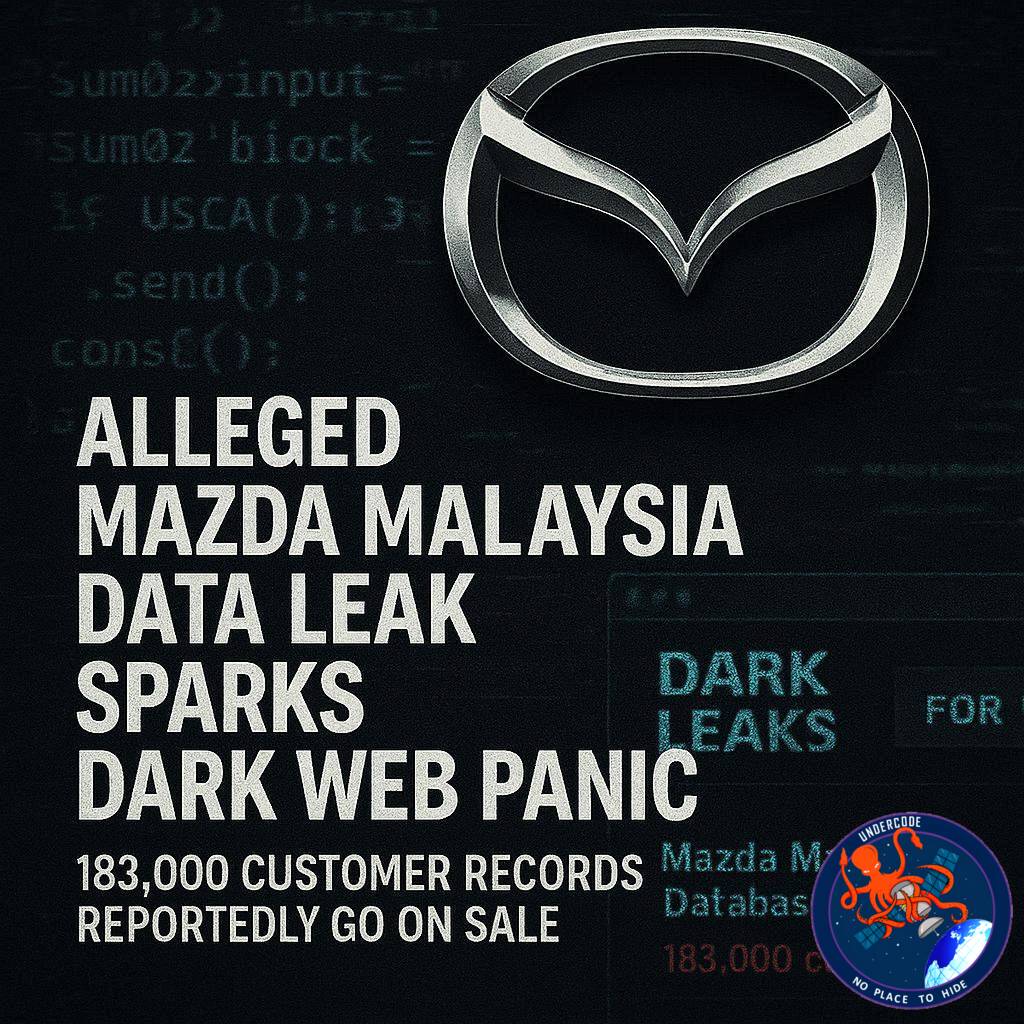
Growing Cybersecurity Fears Surround Mazda Malaysia Customers
A new dark web post has triggered concern across Malaysia’s automotive and cybersecurity sectors after a threat actor allegedly offered a massive Mazda Malaysia customer database for sale online. According to claims published by the cyber threat monitoring account Dark Web Intelligence, the dataset may contain sensitive information tied to nearly 183,000 customers.
The alleged breach has not yet been independently verified, but the claims alone are enough to raise alarms among security experts and consumers alike. Data leaks involving vehicle owners are becoming increasingly valuable in underground cybercrime markets because they combine personal identity details with highly specific automotive records.
The threat actor claims the stolen database includes customer names, phone numbers, email addresses, vehicle registration information, chassis numbers, engine numbers, and even detailed vehicle model and variant data. If authentic, this would represent a significant exposure of personal and technical records connected to Mazda vehicle owners in Malaysia.
Cybercriminals are known to weaponize this type of information in sophisticated phishing attacks. Unlike generic spam campaigns, targeted scams built around vehicle ownership data appear far more convincing to victims. Fraudsters can impersonate dealerships, warranty providers, insurance companies, or service centers using accurate customer information to manipulate victims into sharing financial details or making fraudulent payments.
Security analysts warn that vehicle-related information has become particularly attractive on dark web marketplaces because it allows criminals to create highly personalized attack campaigns. A scammer who knows the exact car model, registration details, or service history of a target can easily gain trust during phone calls or emails.
Another major concern is identity profiling. Combining automotive ownership information with phone numbers and email addresses enables cybercriminals to build extensive digital profiles on individuals. These profiles may later be sold, reused in future attacks, or merged with previously leaked databases from unrelated breaches.
The situation also highlights a growing trend within the automotive industry itself. Modern car manufacturers and dealerships now collect enormous amounts of customer data, ranging from financing details to maintenance histories and connected vehicle telemetry. As the automotive industry becomes more digitalized, it also becomes a larger target for hackers.
Over the past few years, cyberattacks targeting automotive companies have increased dramatically worldwide. Manufacturers, dealerships, insurance providers, and even smart vehicle platforms have all become attractive targets due to the sheer volume of customer information they store.
For affected users, cybersecurity experts recommend remaining highly cautious about suspicious communications claiming to originate from Mazda dealerships, insurers, or repair centers. Customers should avoid clicking unknown links, downloading attachments from unsolicited emails, or sharing verification codes over the phone.
Experts also recommend enabling multi-factor authentication on important accounts, monitoring bank activity for unusual behavior, and verifying all dealership-related communications directly through official channels rather than responding to incoming messages.
At this stage, there is still no official confirmation regarding the authenticity or scope of the alleged leak. The listing remains a claim posted on a dark web forum, and investigations may be required before the true scale of the incident becomes clear.
However, even unverified listings can create serious risks. Cybercriminals sometimes use leaked samples or partial records to generate fear, attract buyers, or pressure organizations into responding publicly.
The incident comes amid a broader global surge in cybercrime activity targeting customer databases across both private corporations and government systems. Interestingly, the same monitoring account also reported another alleged dark web sale involving a Burkina Faso government biometric database containing approximately 60,500 records.
The growing frequency of such incidents demonstrates how data has effectively become one of the world’s most valuable underground commodities. From healthcare to finance to automotive industries, no sector appears immune from cyber threats anymore.
What Undercode Says:
The Automotive Industry Is Quietly Becoming a Massive Cybersecurity Battlefield
The alleged Mazda Malaysia leak represents more than just another dark web listing. It reflects a dangerous transformation happening across the global automotive industry. Cars are no longer isolated mechanical machines — they are now deeply connected digital ecosystems filled with customer information, cloud-based services, software integrations, financing records, and behavioral data.
That transformation has created a goldmine for cybercriminals.
Automotive databases are uniquely valuable because they often contain a combination of identity information and physical ownership records. Unlike leaked email-password combinations, vehicle ownership data provides criminals with contextual information that can dramatically improve the success rate of scams.
Imagine receiving a phone call from someone claiming to be a dealership employee who already knows your exact Mazda model, registration details, and service history. Many people would instinctively trust that caller. That trust becomes the weapon.
The dark web economy increasingly revolves around “precision phishing,” where attackers use accurate personal information to bypass human skepticism. Large automotive leaks fit perfectly into that ecosystem.
There is also a deeper issue that many companies underestimate: third-party exposure.
In many automotive ecosystems, customer data is not stored in one single secure environment. It is often shared across dealerships, insurers, maintenance providers, financing firms, warranty systems, customer support platforms, and marketing agencies. Every additional access point becomes another possible vulnerability.
This means that even if Mazda Malaysia itself maintains strong cybersecurity protections, external vendors or partners could still become weak links.
Another major concern is the long-term value of automotive records. Unlike passwords, people rarely change their names, vehicle registration histories, or ownership identities frequently. That gives cybercriminals data with extended operational usefulness.
The incident also demonstrates how dark web intelligence accounts are becoming unofficial early-warning systems for the cybersecurity world. In many cases, dark web listings surface before companies publicly acknowledge incidents. Threat monitoring communities now play a significant role in identifying potential breaches long before traditional corporate disclosures occur.
At the same time, users should avoid panic. Dark web claims are sometimes exaggerated or partially fabricated to attract buyers and generate attention. Some threat actors recycle older datasets or combine multiple leaks into one listing to inflate perceived value.
Verification remains critical.
Still, even the possibility of a breach is enough to justify caution from consumers. Attackers do not always need complete databases to launch effective scams. Even partial records can be operationally dangerous when combined with social engineering tactics.
The automotive industry may soon face cybersecurity pressure similar to what banks experienced a decade ago. Regulatory scrutiny, mandatory breach disclosures, stronger encryption standards, and customer protection laws are likely to intensify globally.
Manufacturers are also entering a future where vehicles themselves become internet-connected devices. As smart cars expand, future breaches may eventually move beyond customer databases into connected vehicle systems, remote controls, telematics, and software ecosystems.
That future raises difficult questions.
Could hackers eventually target vehicle access systems? Could stolen customer profiles be paired with connected car vulnerabilities? Could attackers manipulate digital ownership systems or remote vehicle functions?
Those scenarios may sound extreme today, but cybersecurity history repeatedly shows that industries often underestimate threats until major incidents force change.
The Mazda Malaysia case — whether fully verified or not — serves as another warning sign that data protection is no longer optional for modern automotive companies. It has become central to customer trust, brand reputation, and operational survival.
Consumers, meanwhile, are entering an era where owning a vehicle also means becoming part of a constantly expanding digital footprint.
🔍 Fact Checker Results
✅ Dark Web Listing Was Publicly Reported
The alleged Mazda Malaysia dataset sale was publicly mentioned by the threat-monitoring account Dark Web Intelligence on social media.
❌ No Independent Verification Yet
There is currently no confirmed public evidence proving the leaked database is authentic or complete.
✅ Automotive Data Is Frequently Used in Phishing
Cybersecurity experts widely recognize vehicle ownership data as valuable for targeted phishing and impersonation scams.
📊 Prediction
The automotive sector is likely to become one of the fastest-growing cyberattack targets over the next five years. As vehicles become more connected and dealerships continue digitizing operations, cybercriminals will increasingly pursue automotive databases for identity fraud, phishing campaigns, and financial scams.
If incidents like this continue, governments may introduce stricter cybersecurity regulations for automakers and dealership networks, especially regarding customer data storage and third-party vendor access.
Consumers should also expect a future where cybersecurity becomes a standard part of vehicle ownership, much like insurance or maintenance today.
🕵️📝Let’s dive deep and fact‑check.
References:
Reported By: x.com
Extra Source Hub (Possible Sources for article):
https://www.medium.com
Wikipedia
OpenAi & Undercode AI
Image Source:
Unsplash
Undercode AI DI v2
Bing
🔐JOIN OUR CYBER WORLD [ CVE News • HackMonitor • UndercodeNews ]
📢 Follow UndercodeNews & Stay Tuned:
𝕏 formerly Twitter 🐦 | @ Threads | 🔗 Linkedin | 🦋BlueSky | 🐘Mastodon


