Listen to this Post
Introduction
Apple has long marketed its devices as some of the most secure consumer technologies on the planet. Over the years, the company invested heavily in hardware-based protections designed to stop hackers from exploiting memory corruption vulnerabilities — one of the most dangerous forms of cyberattack. But a new breakthrough by security researchers at Calif has shaken that confidence.
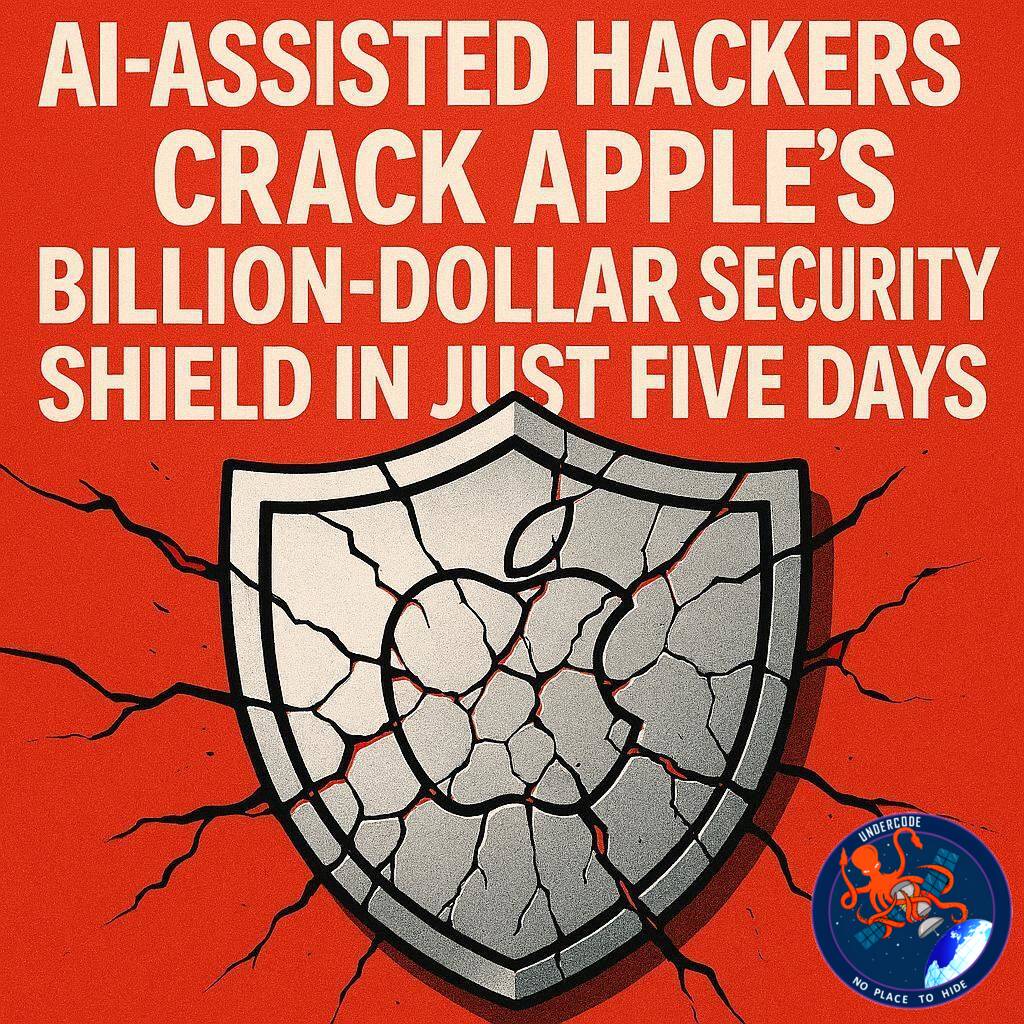
In a dramatic revelation, researchers successfully created the first public macOS kernel memory corruption exploit targeting Apple’s new M5 silicon. What makes the discovery even more shocking is not just the exploit itself, but the speed at which it was developed. According to the researchers, Apple spent nearly five years engineering its advanced Memory Integrity Enforcement (MIE) security system, yet a small team using Anthropic’s AI model, Mythos Preview, managed to bypass it in only five days.
The incident is already raising major questions across the cybersecurity industry about whether modern AI tools are accelerating offensive hacking capabilities faster than companies can build defenses.
Apple’s MIE Was Supposed to Change Everything
Apple introduced Memory Integrity Enforcement, also known as MIE, as a next-generation hardware-assisted memory protection system. The company designed it around Arm’s Memory Tagging Extension (MTE), a security technology first introduced in 2019 to detect memory corruption vulnerabilities before attackers can exploit them.
The concept behind MTE is relatively simple but highly effective in theory. Every chunk of allocated memory receives a hidden “tag” or secret identifier. When software attempts to access that memory, the hardware checks whether the access request contains the correct matching tag. If the tags do not match, the system immediately crashes the process and logs the event.
Apple believed this approach could significantly reduce entire classes of attacks that traditionally allowed hackers to take over devices.
However, Apple engineers reportedly discovered weaknesses in the original Arm implementation and decided to build a more advanced internal solution. That became MIE — a system tightly integrated into Apple’s hardware and software stack, especially for modern iPhones and newer MacBooks powered by M-series chips.
The company considered MIE one of its strongest modern defenses against memory corruption exploits.
Calif Researchers Found a Way Around It
Despite Apple’s confidence, researchers from Calif discovered a working exploit chain capable of bypassing MIE protections on M5-powered Macs.
The exploit targeted macOS 26.4.1 and achieved local privilege escalation, allowing an ordinary unprivileged user account to gain full root-level access to the system. According to the researchers, the attack relied entirely on standard system calls and required no unusual permissions.
The exploit chain combined two vulnerabilities alongside several advanced techniques to corrupt kernel memory successfully even while MIE protections remained active.
Even more surprising was the timeline.
Researcher Bruce Dang reportedly identified the vulnerabilities on April 25. Dion Blazakis joined the project only two days later. With additional tooling developed by Josh Maine, the team completed a fully functioning exploit by May 1.
In cybersecurity terms, that speed is almost unheard of for bypassing a major hardware-backed security mitigation.
AI Played a Central Role in the Attack
The Calif team openly credited Anthropic’s Mythos Preview AI model for dramatically accelerating the process.
According to the researchers, Mythos Preview excelled at identifying vulnerabilities because the bugs belonged to previously known vulnerability classes. Once the AI recognized the attack patterns, it could generalize those techniques to locate similar weaknesses quickly.
The researchers explained that while AI handled much of the bug discovery process efficiently, bypassing Apple’s advanced MIE protections still required significant human expertise. The collaboration between experienced exploit developers and advanced AI appears to have been the key factor behind the breakthrough.
The team described the pairing as a glimpse into the future of cybersecurity, where highly capable AI systems work alongside human researchers to discover vulnerabilities at unprecedented speed.
That possibility is already alarming security professionals worldwide.
Apple’s Security Model Faces a New Era
One of the most striking comments from the Calif researchers was their observation that modern security mitigations were designed “in a world before Mythos Preview.”
That statement highlights a growing reality inside cybersecurity circles: defensive technologies may no longer evolve fast enough to match AI-assisted offensive research.
For years, large-scale exploit development required massive teams, extensive funding, and months of analysis. AI systems are now lowering those barriers dramatically. Smaller teams can suddenly operate with capabilities that previously belonged only to nation-state actors or elite private research labs.
This does not necessarily mean Apple’s security has failed completely. In fact, many experts still consider MIE one of the strongest memory safety systems currently deployed in consumer hardware. But the Calif exploit demonstrates that no mitigation is invulnerable once AI accelerates vulnerability research.
The implications extend far beyond Apple.
The Rise of AI-Driven Exploit Development
The cybersecurity world may now be entering what some researchers are calling the “AI bugmageddon” era.
In traditional exploit development, researchers spent enormous amounts of time manually auditing code, analyzing crash data, and building proof-of-concept exploits. AI models are increasingly automating portions of that process.
Large language models trained on vulnerability patterns can already identify insecure code paths, suggest exploit strategies, and correlate multiple vulnerabilities faster than many human analysts.
This dramatically changes the economics of cyberattacks.
A small team empowered by AI can potentially rival the productivity of much larger organizations. That could lead to an explosion in vulnerability discoveries — both ethical and malicious.
Security companies, operating systems vendors, and chip manufacturers are now facing a difficult question: can defensive innovation keep pace with AI-enhanced offensive capabilities?
The Calif exploit may become one of the earliest major examples showing that the balance is beginning to shift.
What Undercode Says:
AI Is Becoming the Ultimate Force Multiplier for Hackers
The most important part of this story is not that Apple got hacked. Every security system eventually faces bypass attempts. The truly disruptive element is how rapidly the exploit was developed once AI entered the workflow.
For years, cybersecurity experts warned that artificial intelligence would eventually reshape offensive hacking. This case may represent one of the first public demonstrations proving those fears were justified.
The Calif researchers did not merely use AI as a chatbot assistant. They used it as an active collaborator capable of recognizing vulnerability classes, accelerating discovery, and streamlining exploit development.
That fundamentally changes the threat landscape.
Apple’s Five-Year Investment May Reveal a Larger Industry Problem
Apple reportedly spent billions of dollars and half a decade building MIE into its hardware ecosystem. Yet a small expert team bypassed it within days.
This does not necessarily mean Apple made poor engineering decisions. On the contrary, MIE still represents extremely advanced defensive architecture. The real issue is that AI drastically compresses the time needed to challenge those defenses.
Traditional security models assume attackers require long development cycles. AI weakens that assumption.
Suddenly, even smaller organizations or independent researchers may possess offensive research capabilities that scale far beyond historical expectations.
Hardware Security Alone Is No Longer Enough
For over a decade, major technology companies focused heavily on hardware-assisted security mitigations. Apple, Microsoft, Intel, and Google all invested aggressively in chip-level protections because hardware defenses are traditionally harder to bypass than software-only safeguards.
But AI introduces a new dynamic.
When machine learning systems rapidly analyze patterns across known exploit classes, they can help attackers discover entirely new pathways around those protections.
That means hardware security can no longer function as the final defensive wall. Future security models may need continuous adaptive AI-driven defenses that evolve in real time against AI-assisted attacks.
The Security Industry May Be Entering an Arms Race
This incident strongly suggests the cybersecurity industry is entering a full-scale AI arms race.
Attackers will increasingly use AI to automate vulnerability discovery, exploit chaining, privilege escalation, and persistence techniques. Defensive teams will likely respond by deploying AI systems capable of detecting anomalies, predicting exploit behavior, and patching weaknesses faster.
The challenge is speed.
Historically, attackers only needed to succeed once, while defenders needed to succeed constantly. AI amplifies that imbalance because offensive discovery can now happen dramatically faster.
Smaller Teams Could Become Major Threat Actors
One overlooked aspect of this story is organizational scale.
The Calif exploit was not created by a giant intelligence agency or multinational corporation. It came from a relatively small group of researchers empowered by advanced AI tooling.
That democratization of offensive capability could become one of the most dangerous consequences of generative AI.
As powerful models become more accessible, the barrier to advanced exploit development decreases. The number of capable threat actors could rise significantly over the next several years.
Apple Will Likely Respond Aggressively
Apple is unlikely to treat this as a minor embarrassment.
The company historically moves very aggressively when high-profile security bypasses become public. Since the Calif team privately shared the vulnerability report at Apple Park, engineers are almost certainly already working on mitigations.
Apple may also accelerate investments into AI-assisted defensive analysis internally.
Ironically, the same technology that helped researchers break MIE may become necessary to strengthen future versions of it.
The Public Should Not Panic Yet
Although headlines about “AI-powered hacking” sound terrifying, average users are not suddenly defenseless overnight.
This exploit reportedly required local system access and highly advanced technical knowledge. It is not the kind of attack random criminals can immediately deploy at massive scale.
However, the long-term trend is undeniable.
AI is steadily lowering technical barriers inside cybersecurity, and both defenders and attackers are adapting to that new reality faster than many people expected.
🔍 Fact Checker Results
✅ Apple Really Introduced MIE as a Hardware Security Feature
Apple publicly discussed Memory Integrity Enforcement as a hardware-assisted protection system designed to strengthen memory safety against exploitation attempts.
✅ Calif Researchers Confirmed a Working macOS Kernel Exploit
The Calif team publicly stated they achieved a kernel memory corruption exploit on M5 hardware running macOS 26.4.1 with MIE enabled.
✅ AI Assistance Was Explicitly Mentioned by the Researchers
The researchers directly credited Anthropic’s Mythos Preview model for helping identify vulnerabilities and accelerate exploit development.
📊 Prediction
AI-Assisted Cyberattacks Will Become the Industry’s Biggest Security Crisis
Over the next five years, AI-driven exploit development will likely become one of the most disruptive forces in cybersecurity history. Major technology companies including Apple, Microsoft, and Google will increasingly integrate defensive AI directly into operating systems and hardware architectures.
At the same time, independent researchers and malicious actors alike will gain access to increasingly sophisticated offensive AI tools capable of automating vulnerability discovery.
The companies that survive this transition will not necessarily be the ones with the strongest hardware, but the ones capable of adapting their defenses at machine speed.
🕵️📝Let’s dive deep and fact‑check.
References:
Reported By: 9to5mac.com
Extra Source Hub (Possible Sources for article):
https://www.quora.com/topic/Technology
Wikipedia
OpenAi & Undercode AI
Image Source:
Unsplash
Undercode AI DI v2
Bing
🔐JOIN OUR CYBER WORLD [ CVE News • HackMonitor • UndercodeNews ]
📢 Follow UndercodeNews & Stay Tuned:
𝕏 formerly Twitter 🐦 | @ Threads | 🔗 Linkedin | 🦋BlueSky | 🐘Mastodon