
Listen to this Post
Introduction
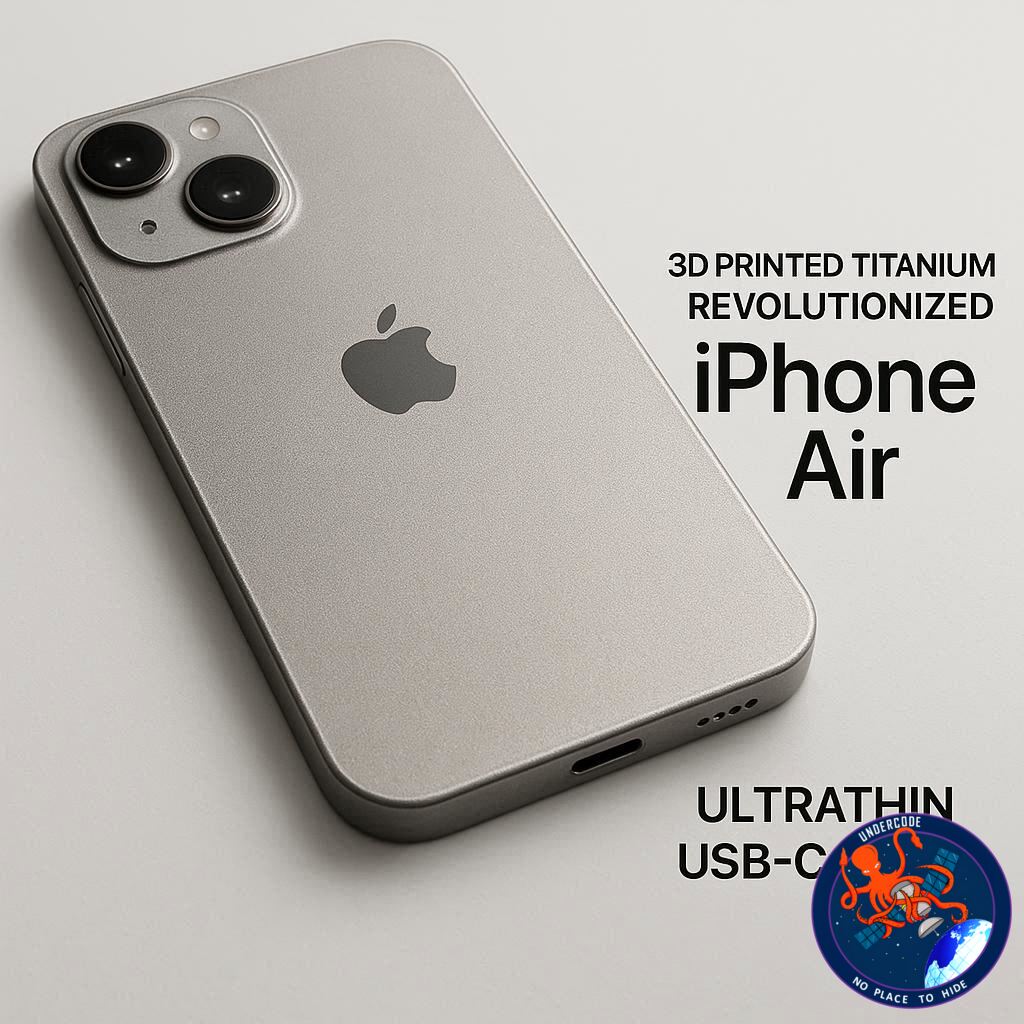
Apple has always been obsessed with pushing design boundaries — thinner, lighter, stronger. From the MacBook Air’s razor-slim profile to the featherlight iPad Pro, each product signals Apple’s relentless pursuit of minimalism. But with thinner designs comes a major engineering headache: the charging port. For years, analysts believed the USB-C port would limit just how slim Apple could make its devices. Yet, Apple surprised the tech world with the iPhone Air, introducing a groundbreaking 3D-printed titanium USB-C port that is both thinner and stronger than anything before.
iPhone Air’s Titanium USB-C Revolution
Last year, rumors spread about Apple working on an ultra-thin iPhone, sparking debates about the feasibility of shrinking components like the charging port. The breakthrough came with the iPhone Air, where Apple unveiled a 3D-printed titanium USB-C connector.
This innovation wasn’t just a design trick — it was a technological leap. By 3D-printing titanium, Apple reduced the port size while making it 33% more material-efficient than conventional forging methods. Titanium’s natural durability meant the port could withstand stress without bending, solving a long-standing weakness in ultra-thin devices.
The idea first gained attention with the M4 iPad Pro, Apple’s thinnest device to date. Tech experts noticed the USB-C charger barely fit into the razor-thin chassis, raising questions about whether future iPhones could realistically adopt such designs. Apple, however, was already preparing its titanium solution.
Interestingly, Apple limited this breakthrough to the iPhone Air. The iPhone 17, iPhone 17 Pro, and iPhone 17 Pro Max still carry traditional USB-C builds. This suggests Apple is testing the durability of titanium ports on a single product line before expanding it across its ecosystem.
Functionality-wise, users won’t notice any difference when charging. The slimmer port is purely an internal engineering upgrade, ensuring cables, adapters, and accessories connect seamlessly. Still, the innovation highlights Apple’s commitment to going thinner without sacrificing strength — a balancing act that few companies have mastered.
What Undercode Say:
Apple’s titanium USB-C experiment reflects broader trends in consumer tech. The industry has reached a point where cosmetic design improvements require radical rethinking of internal architecture. What looks like a small adjustment — shaving millimeters off a charging port — represents years of R\&D in materials science, 3D-printing precision, and stress testing.
Titanium itself is not new in Apple products; it has been used in Apple Watch Ultra models for durability. But combining titanium with additive manufacturing for structural electronics marks a rare innovation. It reduces material waste, lowers production weight, and sets a precedent for how future smartphones may be built.
Another angle worth noting is Apple’s business strategy. By limiting the titanium USB-C port to iPhone Air, Apple is creating product differentiation. It adds exclusivity, making the iPhone Air not just thinner but symbolically more advanced than the mainstream iPhone 17 lineup. This strategy mirrors Apple’s playbook with ProMotion displays and titanium frames — test features in niche models, then expand later.
If successful, 3D-printed titanium could extend beyond ports. Imagine lighter, stronger hinges in MacBooks, or internal frames in iPads made this way. The cost is currently high, but Apple’s scale could normalize titanium 3D-printing for consumer electronics within a few years.
Moreover, this move has environmental implications. By cutting material usage by one-third, Apple reduces resource waste — a major talking point in its green energy initiatives. As regulators push for sustainability in tech, Apple can leverage such advances to strengthen its eco-friendly branding.
Still, there are unanswered questions. Will these ultra-thin titanium ports endure years of daily plugging and unplugging? Can repairs be handled by third parties, or will the complexity of 3D-printed titanium make replacements costly? Apple’s history suggests limited repairability, which may spark debates in the Right-to-Repair movement.
The iPhone Air thus becomes more than just another slim phone. It represents Apple’s long-term philosophy: redefining limits through clever engineering, while strategically keeping the most advanced features exclusive — until the market is ready.
✅ Fact Checker Results
Apple officially confirmed the iPhone Air uses a 3D-printed titanium USB-C port.
The port uses 33% less material compared to traditional forging.
Current iPhone 17 lineup does not use this titanium design.
🔮 Prediction
Looking forward, Apple is likely to expand 3D-printed titanium beyond the iPhone Air. Within two to three years, Pro models could adopt the technology, making devices thinner without compromising durability. Eventually, this could reshape MacBooks and iPads, where internal space is precious. The next frontier? A fully modular titanium internal frame that makes Apple products stronger, lighter, and greener at the same time.
🕵️📝✔️Let’s dive deep and fact‑check.
References:
Reported By: 9to5mac.com
Extra Source Hub:
https://www.stackexchange.com
Wikipedia
OpenAi & Undercode AI
Image Source:
Unsplash
Undercode AI DI v2
🔐JOIN OUR CYBER WORLD [ CVE News • HackMonitor • UndercodeNews ]
📢 Follow UndercodeNews & Stay Tuned:
𝕏 formerly Twitter 🐦 | @ Threads | 🔗 Linkedin | 🦋BlueSky | 🐘Mastodon


