
Listen to this Post
🎯 Introduction
Apple has always been the master of storytelling, from the iconic “1984” commercial to the minimalist charm of its product launches. But its latest attempt, the BSOD ad released on October 7, 2025, takes a controversial turn. With humor aimed squarely at Microsoft’s infamous Blue Screen of Death, Apple’s new commercial tries to mock Windows’ vulnerabilities, but ends up revealing more about Apple’s own marketing misfire than Microsoft’s flaws. What should have been a witty nod to stability and innovation becomes an oddly misplaced jab at an old rival who’s already moved on.
🧩 The Story So Far
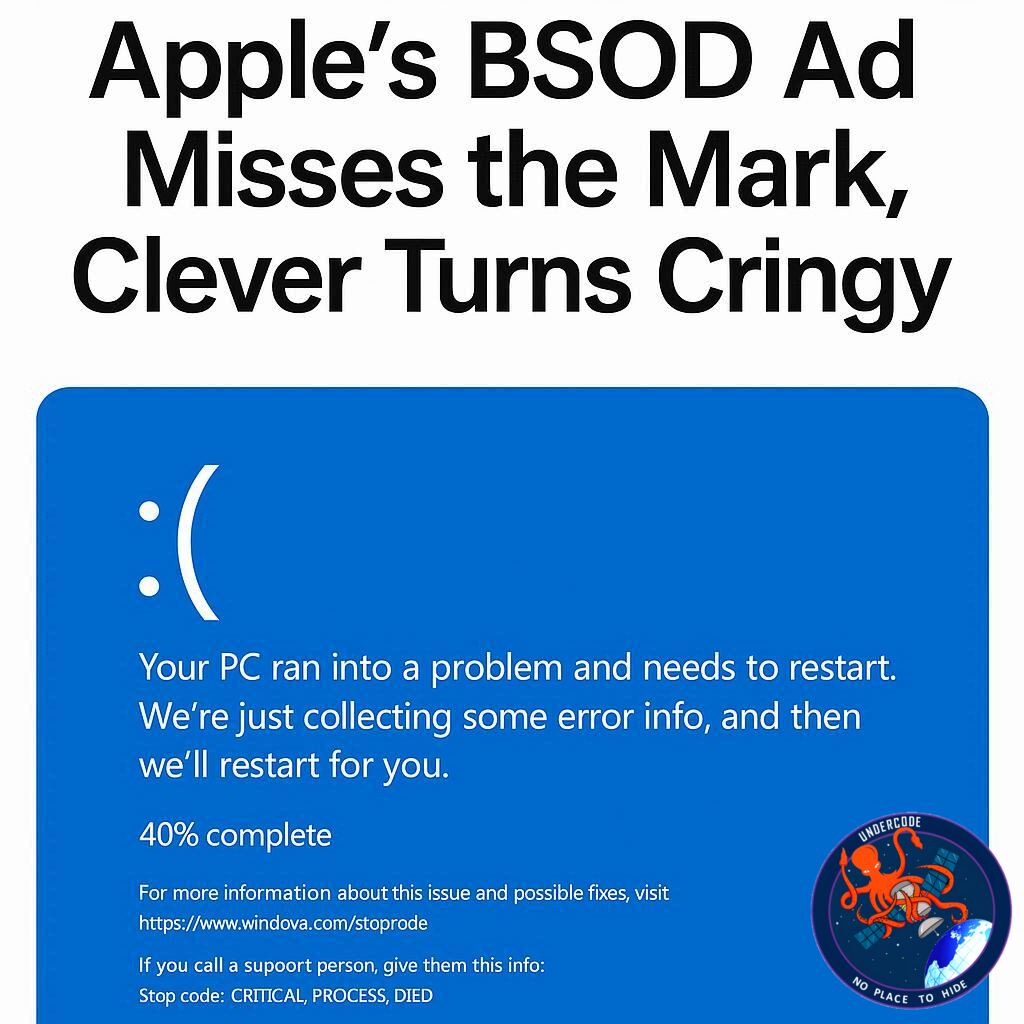
Apple’s new commercial, BSOD, brings back its quirky fictional office heroes—The Underdogs—in another dramatized workplace saga. This time, the group finds themselves at a tech tradeshow called Container Con, where chaos erupts as millions of Windows PCs crash with the Blue Screen of Death. The setting recalls the real-life incident of July 19, 2024, when a CrowdStrike software update spiraled out of control, causing widespread PC failures worldwide. Banks stalled, airlines halted operations, and even hospitals were disrupted. The ad cleverly mirrors that event, showing the “cool” Mac-using team as the only ones left standing.
Yet, beneath the comedy, something feels off. While the 2024 incident was indeed catastrophic, Apple’s portrayal leans more toward mockery than insight. The company avoids mentioning CrowdStrike or the root cause of the meltdown, focusing instead on a symbolic “Windows collapse” to prop up its narrative of Mac superiority.
But here’s where Apple’s aim wobbles. The “Blue Screen of Death” trope feels outdated in 2025. Modern Windows systems are more stable than ever. Gone are the days when users held their breath every time they booted up. Even the notorious BSOD has evolved—Microsoft quietly shifted from blue to black screens, signaling the decline of those dramatic crashes.
Most users today experience Windows 10 or 11 as fast, stable, and secure platforms. Windows Defender provides real-time protection without third-party antivirus software, a far cry from the virus-ridden 2000s. Even businesses, traditionally risk-averse, rely heavily on Windows infrastructure for their daily operations. By contrast, Apple’s ad paints an image of a digital apocalypse that feels disconnected from the real state of modern computing.
Where Apple truly stumbles, though, is in its choice of target. If the company wanted to poke at Microsoft’s weaknesses, it had plenty of fresh ammo. The forced transition from Windows 10 to Windows 11, for example, has frustrated millions of users who now face the need to buy new hardware simply because their older PCs lack TPM 2.0 chips. Or take Microsoft’s persistent push for Edge browser adoption, system-level advertising, and the growing criticism around Copilot integration. Each of these would’ve made for sharper, more relevant satire.
Instead, Apple chose nostalgia. By laughing at a crash from the past, it inadvertently reminded everyone how dominant Windows still is. After all, in the ad, 99% of the computers—even the fictional billboards—run Windows. The lone group using Macs are the quirky outliers. It’s irony wrapped in self-congratulation.
So while BSOD may be entertaining, it feels like a missed opportunity. A brand that once changed the world with bold, visionary messages now risks looking like it’s picking low-hanging fruit. Humor alone can’t disguise when the punchline is out of date.
💭 What Undercode Say:
Apple’s BSOD commercial reveals something deeper than a marketing misstep—it exposes how legacy rivalries can cloud creative judgment. For years, Apple positioned itself as the innovator against Microsoft’s bureaucratic rigidity. The “I’m a Mac, I’m a PC” ads worked because they reflected the cultural zeitgeist of their time. But today, the tech battlefield has shifted.
Apple’s real competition isn’t Windows anymore—it’s AI ecosystems, cloud platforms, and cross-device integration. Microsoft has quietly evolved into a hybrid powerhouse that blends enterprise, gaming, and AI through tools like Copilot and Azure. Meanwhile, Apple still leans heavily on emotional branding and polished aesthetics.
The BSOD ad, while witty on the surface, betrays a hint of creative stagnation. It’s as if Apple is reaching for nostalgia because it hasn’t found a fresh narrative in the era of artificial intelligence. The company could have shown how Macs enhance productivity, creativity, or security in an AI-driven workspace. Instead, it replays the old “Macs good, PCs bad” routine, which feels tone-deaf to modern professionals who use both systems interchangeably.
From a business perspective, the timing is also questionable. Microsoft’s push to end Windows 10 support this month has already made headlines, stirring debates about planned obsolescence and forced upgrades. A clever Apple response could’ve tapped into that frustration—showing how Macs offer longer software support cycles or smoother transitions. That’s where the emotional punch could’ve landed. Instead, we got a joke about a crash from 2024 that few people still care about.
There’s also an unintended irony in the ad’s setup. The Underdogs are meant to symbolize small teams who thrive on creativity and resilience. Yet they operate within Apple’s corporate giant, a company now worth over $3 trillion. The “underdog” narrative rings hollow when coming from the most powerful tech brand on the planet.
What’s missing in Apple’s modern storytelling is humility. The charm of early Apple ads came from their authenticity—the sense that innovation was rebellion. Today, it feels like corporate theater. The BSOD ad reminds us that cleverness without relevance can turn from charm to cringe in seconds.
Apple needs a new cultural story—one that aligns with the challenges of AI ethics, sustainability, and privacy in a hyperconnected age. Mocking Windows feels like fighting yesterday’s war when the real competition is happening in data centers and neural networks. If Apple wants to keep its edge, it must evolve its message from superiority to significance.
🔍 Fact Checker Results
✅ The July 19, 2024, CrowdStrike incident did cause a massive global Windows outage.
✅ BSOD frequency has dramatically decreased in modern Windows versions.
❌ Apple’s ad implication that Windows systems are inherently unstable is misleading.
📊 Prediction
🔮 Expect Apple to pivot toward AI-driven marketing narratives in 2026, shifting focus from rivalry to innovation.
💻 Microsoft will continue strengthening its brand with enterprise AI integration, narrowing Apple’s perceived tech gap.
📱 Consumers will become increasingly hybrid—using both ecosystems interchangeably, caring less about brand wars and more about seamless experience.
🕵️📝✔️Let’s dive deep and fact‑check.
References:
Reported By: www.techradar.com
Extra Source Hub (Possible Sources for article):
https://www.github.com
Wikipedia
OpenAi & Undercode AI
Image Source:
Unsplash
Undercode AI DI v2
Bing
🔐JOIN OUR CYBER WORLD [ CVE News • HackMonitor • UndercodeNews ]
📢 Follow UndercodeNews & Stay Tuned:
𝕏 formerly Twitter 🐦 | @ Threads | 🔗 Linkedin | 🦋BlueSky | 🐘Mastodon


