
Listen to this Post
Introduction
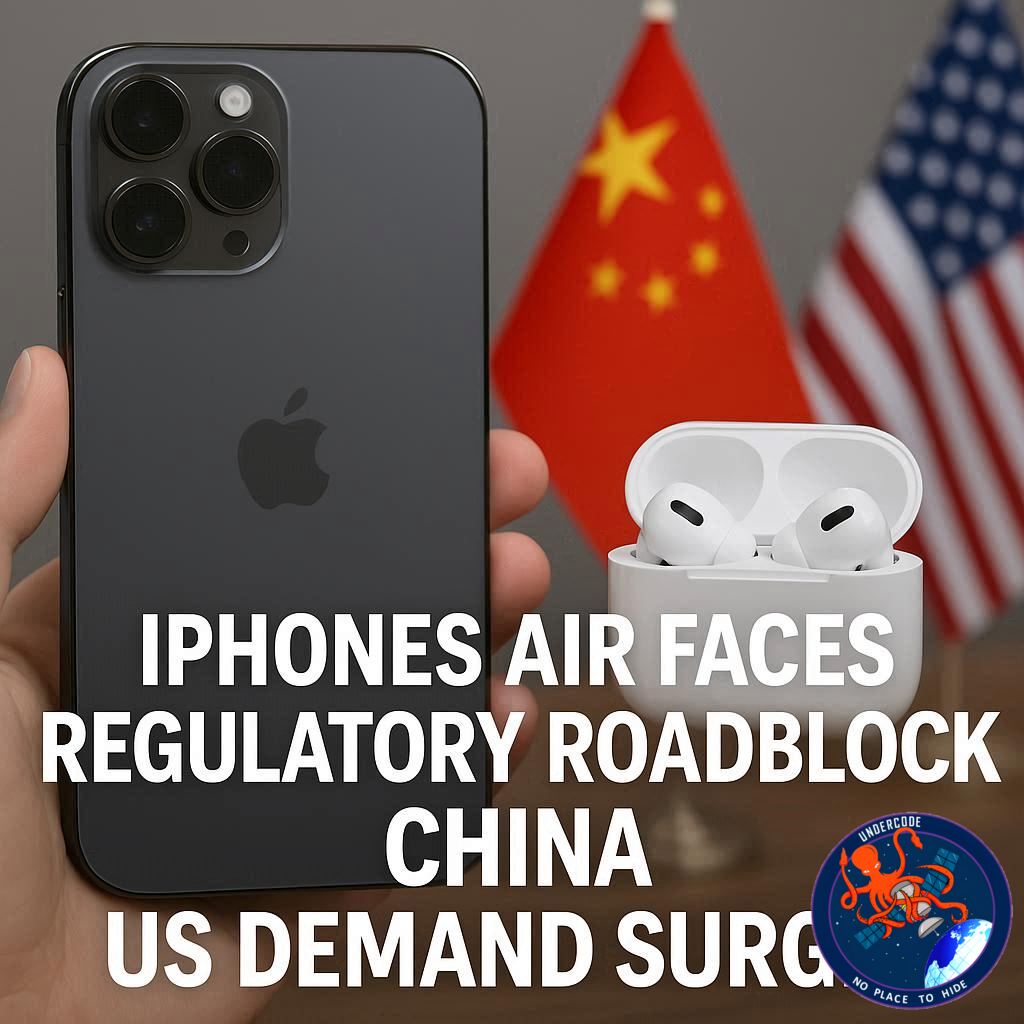
Apple’s much-anticipated iPhone Air has hit an unexpected hurdle in its global rollout. While the device was supposed to launch in mainland China alongside other markets, the company has delayed its release, citing regulatory approval issues. The setback comes at a critical time when Apple is relying heavily on China, its second-largest market, to boost sales. Meanwhile, in the United States, early demand for the iPhone 17 lineup appears strong, with shipping dates for premium models already pushed back due to high preorders.
Apple’s China Setback
Apple has officially confirmed that the iPhone Air will not launch in China on September 19 as initially planned. A notice on Apple’s Chinese website stated: “Release for the information will be updated later. All models will be released after approval.”
The delay highlights the regulatory complexity Apple faces in China compared to other markets. The iPhone Air, designed with a slimmer frame, uses only eSIM technology, while China’s telecom infrastructure still largely depends on physical SIM cards.
At launch, Apple had announced that iPhone Air activation would only be supported by China Unicom. Customers would need to physically visit stores to activate their eSIM. Eventually, other carriers such as China Mobile and China Telecom would extend compatibility.
In contrast, Apple’s other new models — iPhone 17, 17 Pro, and 17 Pro Max — launched in China as scheduled since they still support physical SIM cards.
Why eSIM Is a Challenge in China
Bloomberg reports that eSIM adoption remains limited in China, making it harder for Apple to align the iPhone Air with local requirements. Unlike the U.S., where eSIM usage is standard, Chinese regulators take a cautious approach. The delay suggests ongoing negotiations between Apple and telecom authorities to ensure compliance and consumer readiness.
U.S. Market Signals Strong Demand
Across the Pacific, Apple is experiencing a different kind of challenge — supply constraints driven by demand. Certain iPhone 17 Pro Max models, especially the silver and orange variants, now show delivery dates between October 6 and October 13. Even some blue models face delays.
The iPhone Air, along with the iPhone 17 and 17 Pro, appears less affected in the U.S., although the cloud white iPhone Air is now scheduled for late September to early October deliveries. This indicates Apple may have underestimated demand for specific color and storage combinations of its flagship model.
What Undercode Say:
Apple’s delay in launching the iPhone Air in China reveals more than just a regulatory hiccup — it underscores the tension between innovation and market readiness. The iPhone Air’s exclusive reliance on eSIM is a bold step toward the future, but it collides with China’s slower adoption curve and stricter regulatory oversight. This creates a strategic dilemma: Apple must balance pushing technological boundaries while adapting to local realities.
In China, the iPhone Air delay could dampen initial sales momentum. Chinese consumers are highly status-conscious with tech purchases, and delays may push buyers toward other models like the iPhone 17 Pro or even rival brands like Huawei, which has been aggressively regaining market share. Timing is everything in China’s competitive smartphone landscape, and Apple risks losing the “first wave” of enthusiasm.
Another layer to this is geopolitical. China’s regulators are increasingly assertive, especially in tech industries where national interests overlap with consumer policies. Apple’s reliance on eSIM-only devices may have triggered extra scrutiny, possibly tied to concerns over security, control, and local infrastructure readiness. This shows how Apple’s hardware strategy is never just technical — it’s political.
On the U.S. side, the shipping delays point to robust demand, especially for the Pro Max models. This is a positive signal for Apple, showing that premium consumers are still eager to upgrade despite higher price tags. The bottlenecks around color variants also reflect how design aesthetics play a critical role in driving sales. Apple has mastered creating scarcity and desirability, and these delays may even amplify hype rather than harm sales.
However, one should not overlook the potential long-term implications. If China does not swiftly resolve eSIM compatibility, Apple may face recurring obstacles for future devices. This could delay its broader transition away from physical SIM cards, slowing global innovation for the sake of one critical market. At the same time, Apple’s brand strength and loyal user base give it a cushion. Many Chinese customers may be willing to wait rather than switch.
Ultimately, this situation reflects a tale of two markets. In the U.S., the iPhone Air’s narrative is one of demand-driven delays, while in China it’s one of regulatory resistance. For Apple, both carry risks — one of logistics, the other of market access. The company’s ability to navigate both challenges will define whether the iPhone Air becomes a smooth global success or a cautionary case of innovation colliding with uneven adoption.
🔍 Fact Checker Results
✅ Apple confirmed the iPhone Air delay in China due to regulatory approval.
✅ The iPhone Air uses eSIM exclusively, unlike other models with physical SIM options.
✅ U.S. shipping delays are limited to certain iPhone 17 Pro Max models, indicating strong demand.
📊 Prediction
If Chinese regulators approve eSIM integration in the coming weeks, Apple will likely roll out the iPhone Air in late Q4 2025, just in time for holiday sales. However, if the delay drags into 2026, Apple risks losing momentum to domestic competitors like Huawei. In the U.S., the iPhone 17 Pro Max will dominate sales this cycle, while the iPhone Air may remain a niche product until eSIM becomes more universally accepted.
🕵️📝✔️Let’s dive deep and fact‑check.
References:
Reported By: timesofindia.indiatimes.com
Extra Source Hub:
https://www.github.com
Wikipedia
OpenAi & Undercode AI
Image Source:
Unsplash
Undercode AI DI v2
🔐JOIN OUR CYBER WORLD [ CVE News • HackMonitor • UndercodeNews ]
📢 Follow UndercodeNews & Stay Tuned:
𝕏 formerly Twitter 🐦 | @ Threads | 🔗 Linkedin | 🦋BlueSky | 🐘Mastodon


