
Listen to this Post
Introduction: Apple’s Quiet Revolution in Laptops
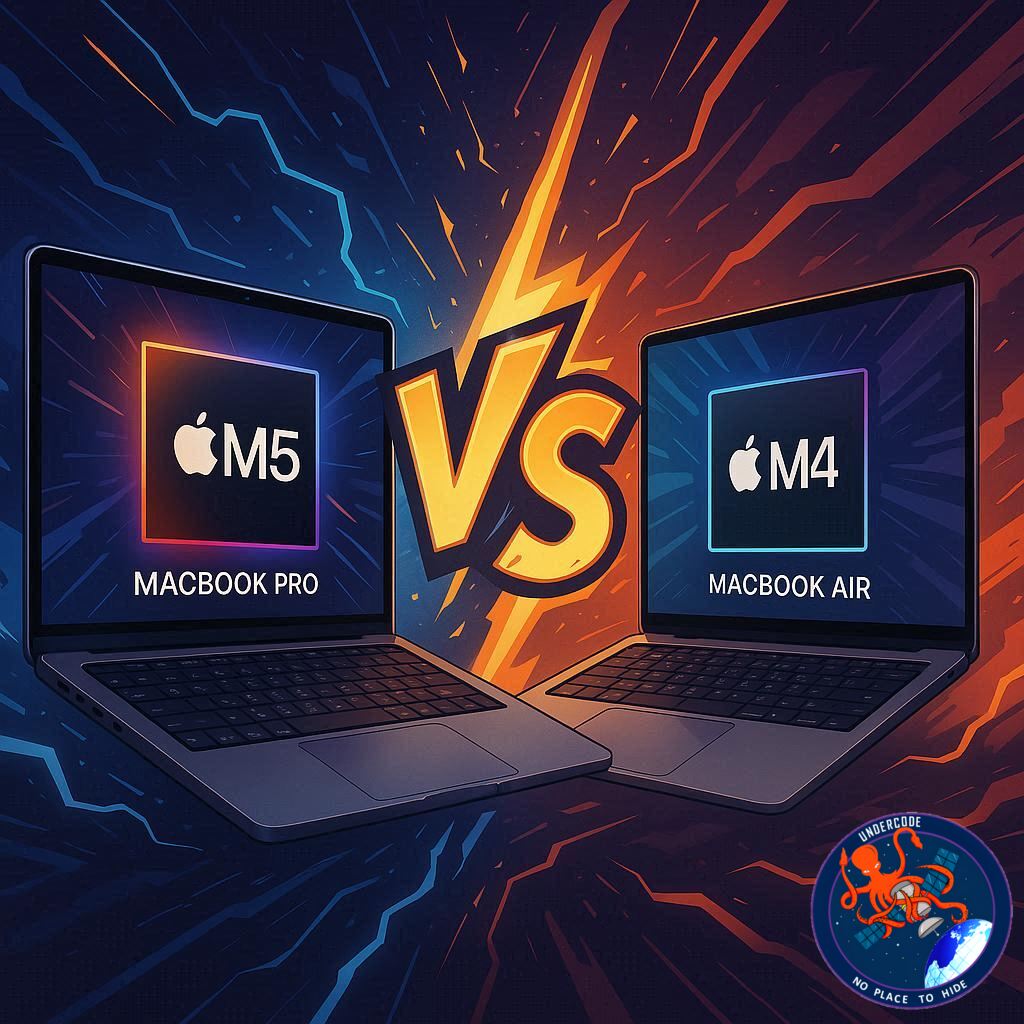
Apple has once again stirred the tech world with its unveiling of the new 14-inch MacBook Pro powered by the M5 chip. Priced at $1,599, it stands as Apple’s latest entry-level Pro model—though “entry-level” hardly does justice to what this machine offers. The announcement immediately reignited one of the most familiar debates in the Apple ecosystem: is it still worth buying the MacBook Air, now that it ships with older Apple Silicon?
At a glance, the price gap between the M4 MacBook Air and the new M5 MacBook Pro is surprisingly small—just a few hundred dollars when similarly configured. Yet, beneath that modest difference lies a world of performance leaps, design refinements, and strategic signals from Apple about where the Mac lineup is headed next.
A the New Battle: M5 vs M4, Air vs Pro
Apple’s latest M5 chip headlines the show, marking a major leap in both raw performance and AI capability. Compared to the M4, the M5 delivers 15% faster multithreaded CPU speeds, 45% faster GPU performance, and a 30% boost in unified memory bandwidth. More notably, Apple boasts of 4x peak GPU compute power for AI tasks, underscoring its growing focus on on-device machine learning.
While the M5 clearly outpaces the M4 on paper, Apple’s marketing narrative remains cautious—it still compares much of its new silicon to the older M1 series, perhaps a subtle admission that the generational leap has plateaued for everyday users.
The MacBook Air, meanwhile, remains a lightweight icon: ultra-thin, fanless, and beautifully simple. But that simplicity comes with limitations. Without an active cooling system, sustained performance under heavy workloads can lead to thermal throttling, especially with macOS Tahoe still ironing out optimization issues. Some Air users report their systems running unusually hot during extended tasks.
By contrast, the 14-inch MacBook Pro introduces several “pro-grade” advantages beyond the chip itself. It brings an active cooling system, ensuring stable performance during demanding workloads, a Mini-LED HDR display with up to 1,000 nits of brightness, and additional ports including HDMI and an SD card slot—small but meaningful improvements for creatives and professionals.
Even the displays differ subtly: the Air’s 13.6-inch screen versus the Pro’s 14.2-inch HDR-ready panel. For photographers, designers, or anyone working outdoors, that extra brightness and dynamic range are game-changers.
But the catch remains the price. The Air starts at $1,199 (256GB), while the Pro begins at $1,599 (512GB). Equalize their specs, and you’re paying around $400 more for the Pro’s enhancements. For casual users, that’s a steep premium. But for professionals or hybrid users needing consistent performance and better visuals, it could be money well spent.
In the end, Apple’s strategy is clear: the MacBook Air is now positioned as the sleek, consumer-friendly option, while the 14-inch Pro becomes the new standard for those wanting longevity and raw capability.
Still, many reviewers suggest waiting—Apple’s laptops often see quick discounts within weeks of release, and the M4 MacBook Air remains a strong performer, with frequent sales offering the 512GB/16GB version for as low as $999.
What Undercode Say:
Apple’s latest refresh might seem iterative, but it’s strategically profound. The introduction of the M5 chip in an entry-level Pro model signals a deeper realignment in Apple’s product philosophy. It’s less about revolutionizing design and more about subtly reshaping consumer psychology.
Apple knows that buyers increasingly choose devices based on longevity and AI-readiness rather than raw specs. The M5’s focus on AI acceleration and GPU compute performance is no accident—it’s a prelude to a future where on-device intelligence becomes as vital as battery life or screen brightness. With AI workloads expected to grow exponentially, Apple is planting the seeds early.
From a business standpoint, the shrinking gap between the Air and Pro is a clever pricing maneuver. It subtly nudges customers toward the higher-margin model. When the difference feels “just $400,” consumers often rationalize the upgrade—especially when Apple ties it to “future-proofing.”
But for most users, the M4 MacBook Air remains the smarter buy today. Its power is ample for nearly all creative, academic, and business workflows. The lack of active cooling is only a problem for developers, video editors, or anyone running sustained GPU loads. And macOS Tahoe’s current inefficiencies might even make the Air feel more sluggish than it truly is—something likely to improve with software updates.
Another interesting angle is Apple’s marketing restraint. The company continues to compare its chips primarily to the M1 generation, avoiding direct references to M2 or M3 performance deltas. This deliberate choice hints that the leap between each new generation is becoming narrower—at least in real-world use.
Where the M5 truly shines is in sustained workloads and AI acceleration. Developers, researchers, or designers leveraging local large language models (LLMs), on-device rendering, or real-time graphics will benefit enormously. Yet, for students, office users, or even content creators working with standard 4K video, the M4 Air’s balance of performance and portability remains unmatched.
Apple’s playbook here mirrors its iPhone strategy: iterate, refine, and reposition. The M5 Pro isn’t meant to disrupt—it’s meant to establish a new baseline for what an “entry-level professional laptop” means in Apple’s ecosystem.
In the grander scheme, Apple is preparing for the AI Mac era, where each new silicon generation won’t just be faster—it’ll be smarter, optimized for real-time learning, adaptive power management, and generative creativity. The M5 MacBook Pro is the first whisper of that future.
If you need a laptop that will last five to seven years with minimal compromise, the 14-inch MacBook Pro M5 is a safe bet. But if you want Apple performance at its most cost-effective, the M4 MacBook Air still offers the best value in Apple’s current lineup.
The real decision lies not in power, but in perspective: do you want to buy into today’s best deal, or tomorrow’s potential?
Fact Checker Results
✅ M5 delivers up to 45% faster GPU performance compared to M4.
✅ MacBook Pro offers superior cooling and HDR Mini-LED display.
❌ macOS Tahoe optimization is still incomplete, leading to occasional overheating on the Air.
Prediction 🔮
Within six months, expect Apple to announce AI-driven macOS updates that fully utilize the M5’s local inference capabilities. Prices for the M5 MacBook Pro will likely dip by 10–15%, positioning it as the true mainstream Mac by early 2026. Meanwhile, the M4 MacBook Air will quietly become one of Apple’s best-selling laptops—an end-of-era classic before the AI-first Macs take center stage.
🕵️📝✔️Let’s dive deep and fact‑check.
References:
Reported By: 9to5mac.com
Extra Source Hub (Possible Sources for article):
https://www.reddit.com/r/AskReddit
Wikipedia
OpenAi & Undercode AI
Image Source:
Unsplash
Undercode AI DI v2
Bing
🔐JOIN OUR CYBER WORLD [ CVE News • HackMonitor • UndercodeNews ]
📢 Follow UndercodeNews & Stay Tuned:
𝕏 formerly Twitter 🐦 | @ Threads | 🔗 Linkedin | 🦋BlueSky | 🐘Mastodon


