
Listen to this Post
Introduction: Apple Opens the Door to Agentic Coding
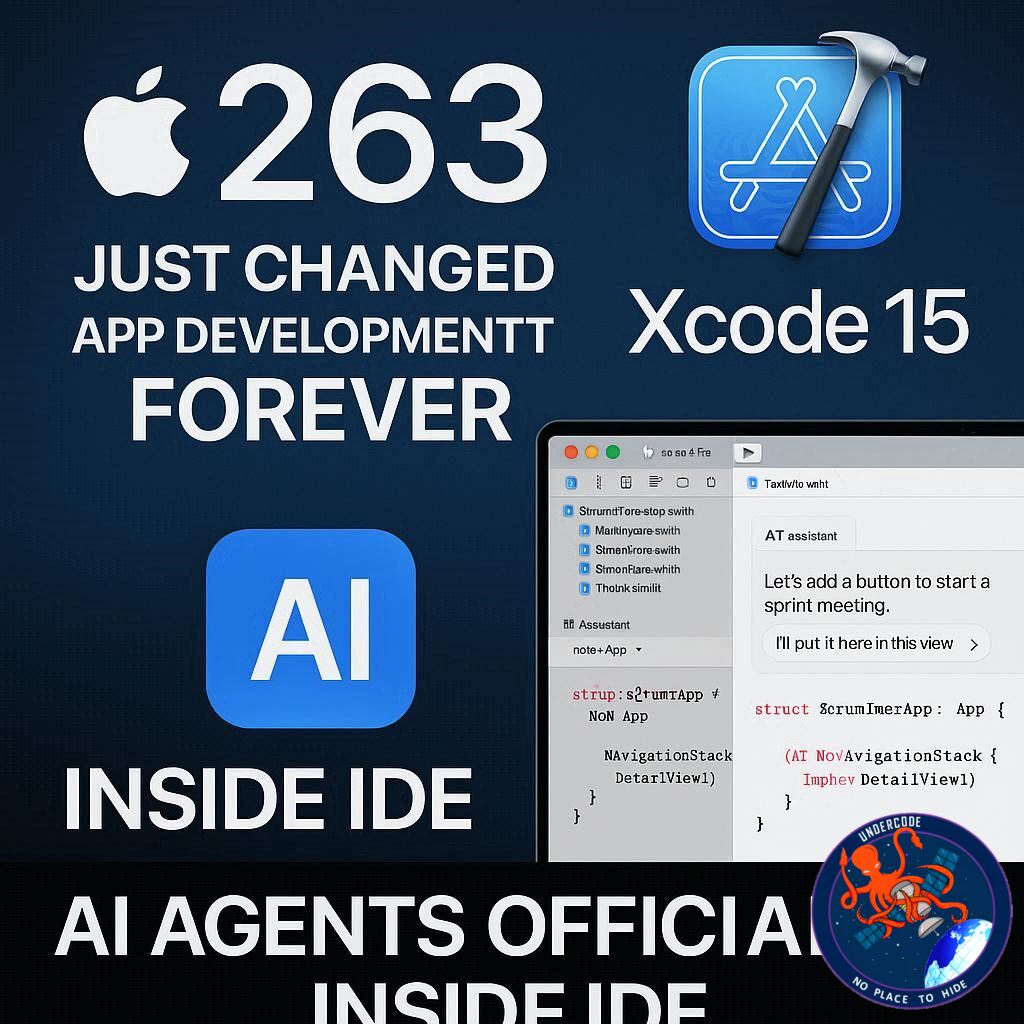
Apple has officially crossed a major threshold in developer tooling. With the rollout of Xcode 26.3, the company is no longer just experimenting with AI-assisted development—it is fully embracing agentic coding. This update allows developers to integrate advanced AI agents directly into the heart of Apple’s development environment, reshaping how apps are built, maintained, and evolved. For both newcomers and seasoned engineers, this release signals a clear shift: Xcode is becoming an active collaborator, not just a code editor.
Original Summary
Xcode 26.3 introduces native support for agentic coding tools, enabling developers to connect AI agents such as OpenAI’s Codex and Anthropic’s Claude Agent directly into their workflows. These agents can assist with a wide range of development tasks, from writing boilerplate code to making sweeping changes across an entire project by understanding documentation, file structures, and existing logic.
Apple explains that these agents are designed to collaborate across the full development lifecycle. They can search documentation, explore project hierarchies, modify settings, and even verify their own work by capturing Xcode Previews and iterating through builds, fixes, and refinements. Importantly, Xcode 26.3 exposes its agent interface through Anthropic’s Model Context Protocol (MCP), making it possible for other compatible AI tools—not just those from OpenAI or Anthropic—to integrate directly with Xcode.
While Apple emphasizes that AI agents do not replace the need for developers to understand their own code—especially for production apps—the response to the release candidate has been overwhelmingly positive. Developer Steve Troughton-Smith shared detailed experiences on Mastodon, describing projects built with minimal manual input and even full rewrites from Objective-C to Swift.
Demonstrations have also appeared on YouTube, including an official Apple demo hosted by Ken Orr, as well as a code-along session featuring Jerome Bouvard, a senior product manager for Apple’s developer tools. Overall, the update lowers the barrier to entry for iOS development while giving experienced developers powerful ways to accelerate repetitive or time-consuming tasks.
What Undercode Say:
Xcode 26.3 is not just another incremental update—it represents Apple’s most decisive move yet into AI-native development environments. By embedding agentic systems directly into Xcode, Apple is quietly redefining what “productivity” means for developers. Instead of autocomplete or simple code suggestions, these agents operate at a project-wide level, reasoning about structure, intent, and outcomes.
What stands out most is Apple’s strategic restraint. Unlike fully autonomous coding platforms, Xcode’s agents are positioned as collaborators rather than replacements. This aligns with Apple’s long-standing philosophy: powerful tools that amplify human expertise without removing human responsibility. In regulated ecosystems like the App Store, that balance matters.
The exposure of Xcode’s agent interface through MCP is also a subtle but critical signal. Apple is not locking developers into a single AI vendor. Instead, it is laying the groundwork for an ecosystem where multiple AI agents can compete, specialize, and evolve within Xcode itself. That openness could prove more disruptive than the features themselves.
For experienced developers, the real value lies in scale. Large refactors, language migrations, and documentation-driven updates are historically slow, error-prone processes. Agentic coding turns these into interactive, inspectable workflows. For beginners, the impact is even larger: the cognitive load of learning Apple’s frameworks, conventions, and tooling is dramatically reduced.
However, this shift also raises new expectations. As AI agents become standard, developers who ignore them may find themselves at a productivity disadvantage. At the same time, teams will need stronger review practices, clearer architectural principles, and deeper understanding to ensure that AI-generated changes remain correct, secure, and maintainable.
In short, Xcode 26.3 doesn’t just make development faster—it makes thinking at a higher level the default. Apple is betting that the future iOS developer is less of a typist and more of a system designer, guiding intelligent tools rather than fighting complexity line by line.
Fact Checker Results
Apple has officially confirmed agentic coding support in Xcode 26.3.
Integration with Codex and Claude Agent is documented and publicly demonstrated.
Developer reactions and demos cited originate from verifiable public sources.
Prediction
Agentic coding in Xcode will quickly become a baseline expectation rather than a novelty. Within the next year, Apple is likely to expand this system with deeper debugging autonomy, test generation, and UI-level reasoning. As competitors respond, AI-native IDEs will redefine development speed—and Xcode 26.3 will be remembered as the moment Apple fully committed to that future.
🕵️📝✔️Let’s dive deep and fact‑check.
References:
Reported By: 9to5mac.com
Extra Source Hub (Possible Sources for article):
https://www.quora.com
Wikipedia
OpenAi & Undercode AI
Image Source:
Unsplash
Undercode AI DI v2
Bing
🔐JOIN OUR CYBER WORLD [ CVE News • HackMonitor • UndercodeNews ]
📢 Follow UndercodeNews & Stay Tuned:
𝕏 formerly Twitter 🐦 | @ Threads | 🔗 Linkedin | 🦋BlueSky | 🐘Mastodon


