
Listen to this Post
Introduction: A Rising Tide of State-Level Cyber Threats
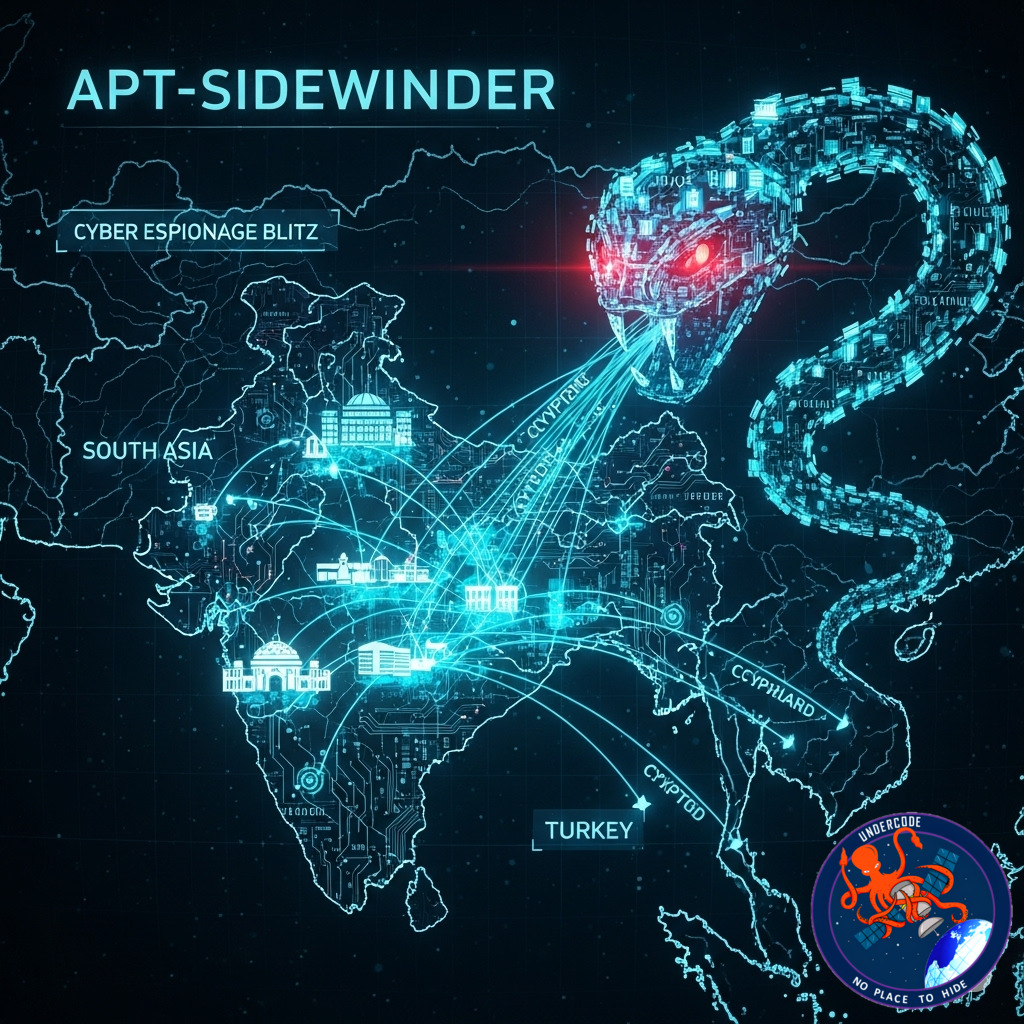
The digital battlefield is heating up, and the latest discovery shows just how advanced cyber espionage has become. APT Sidewinder, a notorious threat actor suspected to originate from South Asia, has unleashed a calculated and highly targeted campaign against government and military agencies in multiple countries. Using a blend of social engineering, phishing precision, and technical sophistication, this group has managed to compromise sensitive systems in defense and national security sectors. Their approach is not random; it is methodical, scalable, and designed to blend in with legitimate operations, making detection a challenge for even the most prepared organizations.
Global Reach of a Focused Attack
APT Sidewinder’s campaign is far from isolated. The operation spans Bangladesh, Sri Lanka, Turkey, Nepal, and Pakistan, with a clear emphasis on critical defense agencies. The attackers leverage weaponized documents and carefully crafted phishing pages, masquerading as official portals for ministries of defense and high-profile defense contractors. Among the impersonated entities are Bangladesh’s Directorate General of Defence Procurement (DGDP), Turkey’s ASELSAN and ROKETSAN, and Nepal’s Ministry of Defense.
The most alarming feature of this attack is the replication of government email portals, particularly Zimbra Web Client interfaces, which are hosted on legitimate services like Netlify and Pages.dev. This choice gives attackers the advantage of riding on trusted infrastructure, making it far harder for standard security filters to flag them as malicious.
Credentials entered on these counterfeit sites are silently funneled to attacker-controlled servers, including mailbox3-inbox1-bd.com and mailbox-inbox-bd.com, both linked to infrastructure hosted in Frankfurt, Germany. The technical backbone is centralized, using common PHP scripts such as /3456.php, /dgdp12.php, and /pol3.php to collect sensitive login details.
Investigators found that the phishing domains—over a dozen of them—were interconnected, all pointing to the same credential harvesting ecosystem. This coordinated design means Sidewinder can run simultaneous attacks across countries while managing all stolen data from a single command hub.
Security researchers warn that the group’s deployment model is scalable, adaptable, and persistent. They recommend urgent adoption of multi-factor authentication (MFA) for all externally accessible systems like webmail and VPNs, as well as enhanced DNS monitoring for domains mimicking official military or government services.
APT Sidewinder’s latest move is a stark reminder that cyber warfare is no longer a hidden battlefield; it is active, evolving, and striking at the core of national security infrastructures. Without immediate, proactive defenses, more agencies could find themselves compromised before the alarm even sounds.
What Undercode Say:
APT Sidewinder’s operations illustrate a textbook example of advanced persistent threat methodology: reconnaissance, infiltration, persistence, and data exfiltration. The group’s skill lies not only in technical execution but in psychological manipulation, exploiting the trust users place in official-looking communications.
From an operational standpoint, Sidewinder has demonstrated an exceptional understanding of cross-border targeting. By attacking multiple nations within a specific geopolitical sphere, they can destabilize regional defense coordination. Turkey, with its growing defense manufacturing capabilities, and South Asian nations, already dealing with tense political climates, represent high-value espionage targets.
Technically, the infrastructure reveals an organized command structure. Hosting phishing kits on reputable services like Netlify is a deliberate strategy to avoid early detection, while the reuse of Zimbra interfaces ensures familiarity to victims, lowering suspicion. The use of centralized credential harvesting endpoints not only reduces operational complexity but also allows rapid scaling—Sidewinder could theoretically double or triple the number of phishing domains overnight without reconfiguring their backend systems.
Their choice of POST endpoints (/dgdp12.php, /pol3.php, etc.) and the standardized HTML layouts suggests the use of a modular phishing framework. This is a dangerous development because it means new campaigns could be deployed in hours, targeting entirely different sectors with minimal additional setup.
The fact that their servers are hosted in Europe indicates a strategic attempt to blend into the global internet landscape. Hosting in neutral or distant jurisdictions complicates legal takedown efforts and delays attribution, allowing campaigns to remain active for longer.
From a defensive perspective, the attack underlines the importance of layered security. MFA is critical, but so is behavioral monitoring—looking for unusual login patterns, anomalous HTTP POST requests, and suspicious DNS lookups. Relying solely on static detection like blacklists is ineffective against such agile operations.
APT Sidewinder’s approach aligns with modern cyber-espionage trends, where the priority is stealth, persistence, and adaptability. This campaign also underscores the geopolitical implications of cyber threats: the targeting pattern suggests that the motive is not just intelligence gathering but potentially influencing regional power dynamics.
In the broader context, Sidewinder’s tactics may inspire copycat groups. The modular nature of their infrastructure lowers the barrier for other actors to replicate these attacks, amplifying the threat. Given the growing role of cyber operations in statecraft, we can expect more actors to follow this model—multi-target, cross-border campaigns with shared infrastructure and legitimate hosting services.
Ultimately, this campaign is a warning shot for governments worldwide. Defense is no longer about securing physical borders; it is about protecting digital entry points that could be exploited to undermine sovereignty from within.
🔍 Fact Checker Results:
✅ Confirmed targeting of Bangladesh, Sri Lanka, Turkey, Nepal, and Pakistan defense entities
✅ Verified use of Netlify-hosted phishing portals imitating government email systems
❌ No direct evidence linking APT Sidewinder to a specific state sponsor
📊 Prediction:
APT Sidewinder is likely to expand its operations to include Southeast Asian defense networks within the next 12 months. Given their modular phishing infrastructure, future campaigns will probably integrate AI-assisted lures and deepfake-based spear-phishing to further increase success rates. Without preemptive regional cooperation in cybersecurity, similar multi-country breaches will escalate in both frequency and impact.
🕵️📝✔️Let’s dive deep and fact‑check.
References:
Reported By: cyberpress.org
Extra Source Hub:
https://www.reddit.com/r/AskReddit
Wikipedia
OpenAi & Undercode AI
Image Source:
Unsplash
Undercode AI DI v2
🔐JOIN OUR CYBER WORLD [ CVE News • HackMonitor • UndercodeNews ]
📢 Follow UndercodeNews & Stay Tuned:
𝕏 formerly Twitter 🐦 | @ Threads | 🔗 Linkedin | 🦋BlueSky | 🐘Mastodon


