
Listen to this Post
Introduction: A New Lunar Perspective Rewrites Space History
Humanity’s return to deep space is no longer a promise. It is happening now. As part of its historic mission, NASA’s Artemis II crew has delivered a breathtaking visual moment that echoes one of the most iconic images ever captured beyond Earth. This time, instead of witnessing Earth rising above the Moon, astronauts have documented the reverse phenomenon. An “Earthset” that marks a poetic and technological milestone in modern space exploration.
The image is more than just a photograph. It represents a continuation of human curiosity, a revival of lunar missions, and a powerful reminder of how fragile and distant our home appears from the vastness of space.
A Historic Moment: Artemis II Nears Mission Completion
As the Artemis II mission approaches the end of its 10-day journey, the crew prepares for a scheduled splashdown off the California coast on April 10, 2026. This mission marks the first time astronauts have traveled around the Moon since the Apollo era, reigniting global attention toward lunar exploration.
Even before their return, the astronauts have already secured their place in history by capturing a remarkable series of images during their journey. These visuals are not only scientifically valuable but also emotionally powerful, offering a renewed perspective on Earth and its place in the cosmos.
The Earthset Image: A Reverse of a Legendary View
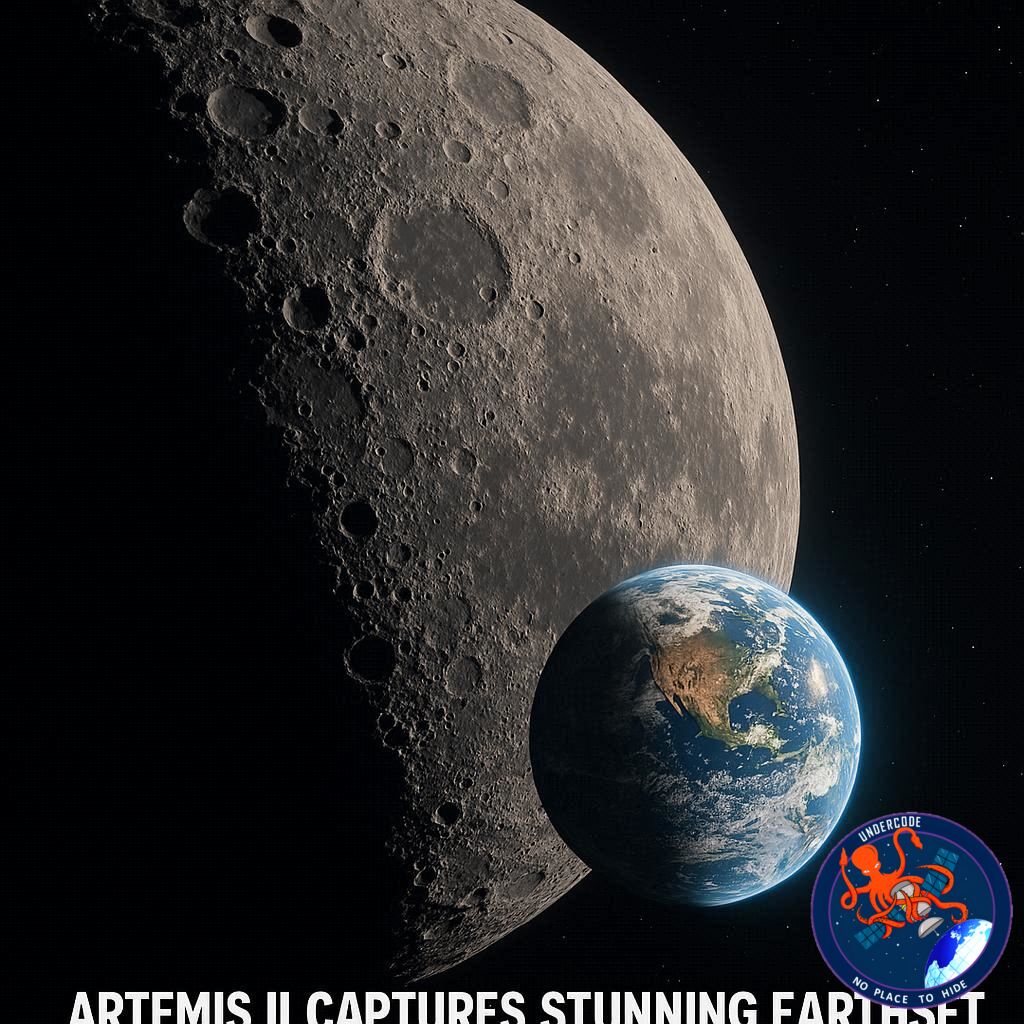
Among the many images taken, one stands out above all. A photograph of Earth slowly disappearing below the Moon’s horizon. This phenomenon, known as Earthset, mirrors the legendary Earthrise image captured during Apollo 8 in 1968.
In this newly captured scene, a delicate crescent of Earth sinks into darkness as viewed from the Orion spacecraft. The illuminated portion reveals swirling white clouds and deep blue oceans, primarily over the Oceania region. Meanwhile, the shadowed half signals nighttime across the rest of the planet.
The emotional weight of the image is undeniable. It flips a perspective that has defined space imagery for decades, offering a fresh and humbling view of Earth as something that can vanish from sight.
Captured Beyond the Far Side of the Moon
The photograph was taken on April 6, 2026, at 6:41 p.m. Eastern Daylight Time as the spacecraft moved behind the Moon’s far side. This region, permanently hidden from Earth-based observers, provided a unique vantage point that few humans have ever experienced.
During this seven-hour flyby, astronauts documented a wide array of celestial events. These included a total solar eclipse, faint light from neighboring planets, and dramatic shadows stretching across the Moon’s surface. The terminator line, where lunar day meets night, created striking contrasts that highlighted the rugged terrain of craters and basins.
Each image contributes to a broader understanding of the Moon while simultaneously enriching humanity’s visual archive of space exploration.
The Lunar Surface in Extraordinary Detail
The Earthset image does not only showcase Earth. It also reveals an intricate view of the Moon itself. Layers of overlapping craters and ancient basins are visible in remarkable clarity, emphasizing the Moon’s violent geological past.
The stark lighting conditions during the flyby accentuated these features, making the terrain appear almost sculpted. Long shadows stretch across the surface, adding depth and texture to the scene.
These details are not just visually impressive. They also provide scientists with valuable data about the Moon’s composition and history, supporting future missions that aim to establish a sustained human presence on the lunar surface.
A Growing Archive of Space Imagery
While the crew has already shared several stunning visuals, the mission’s full collection of images is still being processed. Additional photographs are expected to be released in the coming days, expanding what is already a historic archive.
These images will be made available through official mission galleries and multimedia platforms, ensuring that the public can experience this journey alongside the astronauts. Past collections, including those from earlier missions, continue to provide context and comparison, highlighting how far technology and exploration have progressed.
What Undercode Say:
A Turning Point in Visual Storytelling
The Earthset image represents more than a technical achievement. It signals a shift in how humanity tells the story of space. During the Apollo era, images like Earthrise reshaped public perception of our planet. Today, Artemis II is doing the same, but with modern clarity and a new emotional angle.
The Psychological Impact of Perspective
Seeing Earth disappear rather than appear creates a different psychological effect. It emphasizes loss, distance, and fragility. This subtle shift can influence how people think about environmental responsibility and global unity.
Technology Meets Emotion
The Orion spacecraft’s advanced imaging systems allow for unprecedented detail. Yet, the power of the image lies not in its resolution but in its meaning. Technology enables the capture, but human interpretation gives it significance.
Continuity Between Generations
There is a clear narrative thread connecting Apollo 8 to Artemis II. Both missions serve as milestones in human exploration, but they also reflect the evolution of technology, priorities, and global collaboration.
Strategic Importance of Lunar Missions
Beyond imagery, Artemis II plays a critical role in preparing for future missions, including potential lunar bases and Mars exploration. Every photo, measurement, and observation contributes to long-term goals.
Public Engagement Through Visual Media
Images like Earthset are essential for maintaining public interest. They transform complex missions into relatable moments that resonate with people worldwide.
The Role of Timing and Context
Capturing Earthset at the precise moment required careful planning and execution. It highlights the coordination between astronauts, mission control, and onboard systems.
Scientific Value Hidden in Beauty
While the image is visually stunning, it also contains scientific data about light reflection, atmospheric composition, and lunar surface characteristics.
Reinforcing Earth’s Fragility
From space, Earth appears small and isolated. This perspective continues to reinforce the importance of sustainability and planetary stewardship.
A New Era of Exploration Identity
Artemis missions are not just about returning to the Moon. They are about redefining humanity’s identity as a spacefaring civilization.
Fact Checker Results:
✅ Artemis II is a real NASA mission focused on lunar orbit and crewed exploration.
✅ The Earthset image concept accurately describes Earth appearing to descend below the lunar horizon.
✅ The mission includes a lunar flyby with imaging of celestial and lunar phenomena.
Prediction:
🔭 Artemis missions will produce more iconic imagery that rivals or surpasses Apollo-era photos.
🚀 Future missions may livestream similar events, making space exploration more immersive for the public.
🌍 Earth-focused imagery from deep space will increasingly influence global environmental awareness.
🕵️📝✔️Let’s dive deep and fact‑check.
References:
Reported By: science.nasa.gov
Extra Source Hub (Possible Sources for article):
https://www.quora.com/topic/Technology
Wikipedia
OpenAi & Undercode AI
Image Source:
Unsplash
Undercode AI DI v2
Bing
🔐JOIN OUR CYBER WORLD [ CVE News • HackMonitor • UndercodeNews ]
📢 Follow UndercodeNews & Stay Tuned:
𝕏 formerly Twitter 🐦 | @ Threads | 🔗 Linkedin | 🦋BlueSky | 🐘Mastodon


