
Listen to this Post
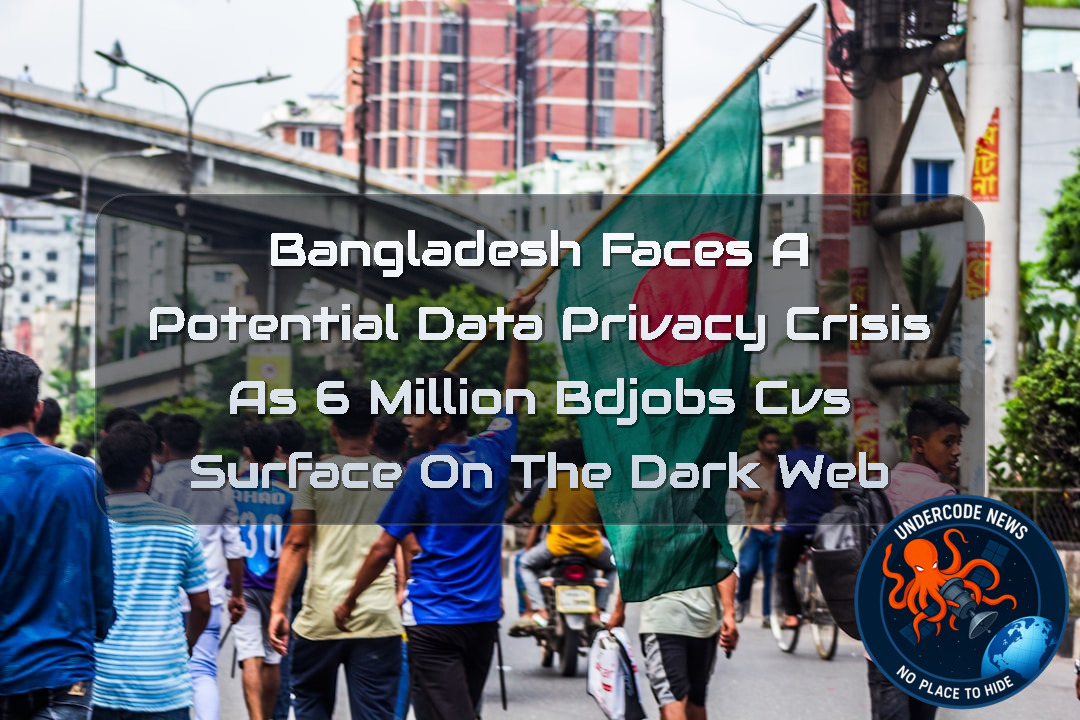
A Troubling Underground Listing
A potentially serious data exposure has emerged from Bangladesh’s underground cybercrime ecosystem, where a threat actor is advertising a database allegedly containing around 6 million CVs linked to BDJobs, one of the country’s major employment platforms.
According to the underground listing reported by Dark Web Intelligence, the seller claims the dataset consists of CV documents stored as PDF files. The alleged records reportedly contain names, telephone numbers, email addresses, physical addresses, academic backgrounds, professional experience, training histories, and other information commonly included in employment applications.
The seller is reportedly demanding $1,000 for the database and says access will be limited to only five buyers. A sample CV has also been posted as purported evidence that the dataset exists.
If authentic, this would be far more than an ordinary collection of leaked contact information. A CV can provide attackers with a detailed profile of an individual, including where that person studied, where they worked, what skills they possess, how they can be contacted, and sometimes where they live.
That combination can become extremely valuable ammunition for targeted cybercrime.
What Happened?
The reported incident centers on an underground forum listing in which a threat actor is offering approximately six million CVs allegedly associated with BDJobs.
The seller reportedly describes the material as a large collection of PDF files rather than a simple database containing isolated fields.
That distinction matters.
A structured database containing names and phone numbers is already valuable to criminals. A collection of complete CVs can be considerably more useful because each document may reveal a much broader picture of the victim.
The alleged dataset could therefore provide attackers with information that allows them to build convincing profiles of potential targets before initiating contact.
What Information Could Be Exposed?
According to the underground advertisement, the allegedly exposed information includes several categories of personal and professional data.
These reportedly include names, phone numbers, email addresses, physical addresses, educational qualifications, professional experience, training records, and other information contained within individual CVs.
CVs can also contain company names, job titles, employment dates, technical skills, certifications, languages, university information, and occasionally references or other identifying details.
When these pieces are combined, the resulting profile can become significantly more sensitive than any single data field would suggest.
Why CVs Are So Valuable to Cybercriminals
Criminals do not always need passwords to cause serious harm.
Personal information can be used to create believable stories.
An attacker who knows a
This is where leaked CVs become particularly dangerous.
The more an attacker knows about a target, the easier it becomes to make malicious communication appear legitimate.
Recruitment Scams Could Become More Convincing
One of the most obvious threats is recruitment fraud.
Attackers could potentially use information from legitimate CVs to contact job seekers with fake employment opportunities.
A criminal could reference a
The victim might then be directed toward a fraudulent application portal, asked to provide additional identity documents, instructed to install software, or pressured into paying supposedly legitimate recruitment fees.
The psychological advantage is simple: the attacker already knows something real about the victim.
Spear-Phishing Risks
The same information could also be used against employees and businesses.
Suppose an attacker identifies a person who works in finance, IT, procurement, administration, or senior management.
A message could be crafted specifically around that person’s professional role.
Instead of sending a generic phishing email, the attacker could create a message that appears to come from a recruiter offering a position that matches the victim’s experience.
The objective could be credential theft, malware delivery, remote-access installation, or theft of corporate information.
Corporate Impersonation Threats
Professional histories can also help criminals impersonate employees.
An attacker could potentially identify where someone works and what position they hold before contacting colleagues or business partners.
This creates opportunities for business email compromise, fake invoices, fraudulent recruitment approaches, and other forms of social engineering.
The leaked information does not have to contain corporate passwords to become a corporate security problem.
Sometimes the information needed to begin an attack is simply enough context to make a lie believable.
Identity Fraud Concerns
CVs can also contain enough personal information to support identity-related fraud.
Names, addresses, phone numbers, educational history, employment history, and other identifying details can potentially be combined with information obtained from separate breaches.
This is an important aspect of modern data theft.
Criminals rarely need one database to contain everything.
Instead, they can combine information from multiple sources until they have a detailed profile of a particular individual.
The $1,000 Price Tag
The reported asking price of approximately $1,000 is another interesting element of the listing.
For a dataset allegedly containing six million CVs, the asking price would be relatively small compared with the potential value of the information to organized cybercrime groups.
However, the price itself should not be interpreted as proof that the database is genuine.
Underground marketplaces regularly contain exaggerated listings, recycled databases, fabricated samples, and datasets whose origins are misrepresented.
The commercial language used by sellers is therefore part of the threat intelligence picture, not independent confirmation of authenticity.
Why the Five-Buyer Limit Matters
The seller reportedly claims that the dataset will be sold to only five buyers.
Such restrictions can be used as a marketing tactic in underground communities.
Scarcity can create pressure among potential buyers and encourage faster purchases before competitors acquire the same material.
At the same time, limiting the number of buyers could theoretically make it more difficult to track the dataset’s distribution.
If the information is authentic, however, restricting the sale to five buyers does not eliminate the risk of further redistribution.
A single buyer can copy digital information indefinitely.
The Sample CV
The seller reportedly published a sample CV as evidence.
Samples are frequently used in underground data markets to demonstrate that a seller possesses material matching the description.
But a sample does not automatically establish that the entire advertised dataset is authentic.
A genuine-looking sample could come from an older breach, a publicly available document, a previously leaked database, or another unrelated source.
The sample therefore provides an investigative lead, not definitive proof of the six-million-record figure.
The Most Important Question: Where Did the Data Come From?
The origin of the alleged dataset is ultimately more important than the seller’s headline number.
If the CVs genuinely originated from BDJobs systems, investigators would need to determine how the information was accessed and when the exposure occurred.
Possible explanations could include unauthorized access to an internal system, compromise of an application or database, abuse of legitimate access, an older breach being repackaged, or aggregation from multiple sources.
The listing alone does not establish which explanation is correct.
A Breach Can Be Older Than the Listing
One of the biggest misconceptions surrounding dark web listings is the assumption that the date of publication equals the date of compromise.
It does not.
A database can remain hidden for months or years before appearing for sale.
Threat actors may purchase, steal, trade, test, and eventually resell datasets long after the original incident occurred.
Consequently, the appearance of a BDJobs-related dataset on an underground forum does not by itself prove that a new intrusion occurred on August 24, 2026.
The Bangladesh Cybersecurity Context
Bangladesh’s growing digital economy has created an increasingly valuable environment for cybercriminals.
Employment platforms are particularly attractive because they naturally collect large quantities of personal information.
Job seekers voluntarily provide information that they would normally consider private, including their professional history, education, contact details, and career interests.
That makes recruitment databases especially attractive targets for criminals seeking information that can be converted into social engineering opportunities.
Why Job Seekers Should Pay Attention
People who have submitted CVs to online employment platforms should be cautious about unexpected recruitment messages.
A convincing job offer is not necessarily a safe job offer.
Unexpected messages should be checked independently, particularly when the sender asks for identity documents, payment, passwords, software installation, or access to an unfamiliar website.
Job seekers should also avoid assuming that a message is trustworthy simply because it contains accurate details about their career history.
If leaked information is being used by an attacker, accuracy may actually be part of the deception.
What Companies Should Watch For
Organizations should also consider the corporate implications.
Security teams can monitor for unusual recruitment-themed phishing campaigns, suspicious login attempts, newly registered domains resembling corporate brands, and targeted messages directed at employees whose professional information is publicly available.
Employees should understand that attackers can construct highly convincing messages from information that appears harmless when viewed individually.
Security awareness therefore needs to move beyond traditional advice about obvious phishing emails.
What Undercode Say:
A CV is not merely a document.
It is a compact identity profile.
It can describe where someone studied.
It can reveal where someone works.
It can expose professional ambitions.
It can provide direct communication channels.
It can identify technical skills.
It can reveal certifications.
It can connect a person to multiple organizations.
It can show career progression.
It can expose geographic information.
It can provide clues about seniority.
It can identify people who may have access to sensitive systems.
That makes employment data particularly attractive to social engineers.
The alleged six-million-CV figure should therefore not be viewed only as a large number.
The real security concern is the density of information contained inside each individual record.
A single CV could give an attacker enough information to start a highly targeted conversation.
A million CVs could provide an enormous targeting pool.
Six million would represent an extraordinary intelligence resource if the seller’s description is accurate.
The reported PDF format makes the situation even more interesting.
Documents preserve context.
A structured database might contain a name, email address, and telephone number.
A CV can explain the relationship between those details.
It can show an
That context helps attackers build believable narratives.
Recruitment fraud is an obvious attack path.
Corporate phishing is another.
Identity fraud represents another possibility.
Credential theft could follow from any of these approaches.
Attackers may also use the information for reconnaissance before targeting companies.
An
An
Technical certifications can indicate which technologies a person understands.
Job titles can suggest organizational authority.
Even career aspirations can become useful social-engineering material.
This is why data breaches increasingly function as intelligence operations.
The attacker does not simply steal information.
The attacker collects context.
Context creates credibility.
Credibility increases the chance that a victim will trust a malicious communication.
The reported $1,000 asking price is therefore less important than the potential downstream value.
A criminal group could potentially purchase the data and use it as an input into automated targeting campaigns.
Artificial intelligence could make that process even easier.
Large collections of CVs can theoretically be classified by profession, seniority, geography, technical specialization, and industry.
Attackers could then prioritize high-value targets.
That creates a dangerous connection between traditional data theft and modern automated social engineering.
The most important defensive lesson is that personal data should be treated as reusable attack material.
Once exposed, information can circulate indefinitely.
Changing a password can solve one problem.
Changing a name, university history, employment history, or professional background is considerably harder.
Organizations should therefore treat leaked personal information as a long-term security risk.
The BDJobs report also highlights why breach verification matters.
A threat actor can exaggerate a database.
A seller can combine old and new information.
A sample can be genuine while the larger database is misleadingly described.
Investigators need evidence about provenance, timestamps, record overlap, and technical indicators before drawing firm conclusions.
Until that work is completed, the underground listing should be analyzed carefully without allowing the seller’s marketing claims to become established facts.
But caution should not become complacency.
Even an unverified dataset can represent a serious warning.
The possibility of six million employment records circulating underground should encourage organizations and individuals to strengthen defenses against recruitment-themed social engineering.
The deeper lesson is uncomfortable.
Personal information does not need to include a password to become dangerous.
Sometimes the information that makes an attack possible is the information people voluntarily placed on a CV.
Claim: A threat actor is advertising approximately 6 million BDJobs CVs.
✅ The underground listing described in the source material advertises a dataset of approximately six million CVs allegedly associated with BDJobs.
Claim: The complete six-million-record dataset has been independently verified.
❌ The available report does not independently verify the database’s origin, size, authenticity, or whether it represents a new BDJobs compromise.
Claim: The alleged data could support targeted social engineering.
✅ This is technically plausible because CVs can contain detailed personal, educational, employment, and contact information that can be exploited for highly personalized attacks.
Prediction
(+1) Recruitment Fraud Will Become More Personalized
If the advertised data is authentic and distributed, attackers are likely to exploit professional information to make fake recruitment messages appear unusually credible.
Job seekers may receive offers referencing genuine employers, skills, universities, and previous positions.
Security awareness campaigns will increasingly need to address recruitment-themed phishing rather than focusing only on conventional banking or password scams.
(+1) Cross-Database Profiling Will Increase
Criminal groups can combine employment information with previously leaked datasets to construct richer profiles of individuals.
The value of the information may therefore increase after it is correlated with other breaches.
(-1) The Advertised Six-Million Figure May Not Represent a Single New Breach
The dataset could contain older information, aggregated records, duplicate entries, or material obtained from sources unrelated to a recent BDJobs intrusion.
The seller’s stated volume should therefore not be treated as independently established evidence.
Deep Analysis
Checking the Local Environment
Security teams investigating suspicious CV files should first preserve evidence rather than opening unknown documents directly.
file suspicious_cv.pdf
sha256sum suspicious_cv.pdf
stat suspicious_cv.pdf
These commands can establish the file type, cryptographic hash, and basic filesystem metadata.
Extracting Document Metadata
Forensic analysts can inspect PDF metadata without relying on a normal desktop PDF viewer.
exiftool suspicious_cv.pdf
pdfinfo suspicious_cv.pdf
Metadata may reveal creation software, timestamps, document properties, or other useful investigative indicators.
Searching Extracted Text
If analysts have a legally obtained sample dataset, text extraction can help identify recurring structures.
pdftotext suspicious_cv.pdf extracted.txt
grep -Ei "email|phone|address|education|experience" extracted.txt
This can help determine whether documents follow consistent formatting or contain unexpected fields.
Detecting Duplicate Documents
Large leaked datasets frequently contain duplicates.
A basic hashing workflow can identify identical files.
sha256sum .pdf | sort | uniq -w 64 -d
Duplicate analysis can help investigators distinguish between advertised record counts and unique documents.
Counting Files
If investigators have access to an authorized copy of the dataset, they can establish the number of files independently.
find . -type f -iname ".pdf" | wc -l
The result should not automatically be interpreted as the number of unique people because one person may have multiple CV versions.
Searching for Sensitive Information
Organizations performing controlled forensic analysis can identify potentially sensitive fields.
grep -RniE "email|phone|mobile|address|passport|national" extracted_data/
This should be performed only on data that investigators are authorized to process.
Building Indicators of Compromise
Security teams should preserve relevant hashes, domains, usernames, email addresses, and other technical indicators associated with the investigation.
sha256sum suspicious_cv.pdf
Hashes provide a stable way to identify the same file without repeatedly distributing its contents.
Monitoring Phishing Infrastructure
Organizations can also monitor suspicious domains and recruitment-themed campaigns.
dig suspicious-domain.example
whois suspicious-domain.example
These commands can provide basic DNS and registration information during an investigation, although domain registration data may be privacy-protected.
Protecting Employees
The defensive response should focus on reducing the value of leaked information.
sudo apt update
sudo apt upgrade
Keeping endpoints and security tooling updated is basic but important because social engineering often becomes more dangerous when combined with vulnerable systems.
Monitoring Authentication
Organizations should review authentication logs for unusual access patterns.
journalctl --since "24 hours ago" | grep -Ei "authentication|failed|ssh"
The exact logging architecture will vary by environment, but the principle remains the same: leaked personal information should trigger heightened monitoring rather than panic.
The Bigger Lesson
The alleged BDJobs dataset illustrates a broader transformation in cybercrime.
Criminals increasingly seek information that helps them understand people, not just machines.
Passwords provide access.
But personal histories provide trust.
That distinction is becoming increasingly important.
A criminal who knows nothing about a victim has to invent a convincing story.
A criminal who possesses a detailed CV may only need to reuse information the victim already recognizes as true.
That is what makes employment databases such attractive targets.
If the reported dataset is genuine, its greatest danger may not be the publication of six million names.
Its greatest danger could be the creation of millions of highly personalized opportunities for deception.
The cybersecurity industry has spent years teaching people not to click suspicious links.
The next challenge is teaching people that a message can look legitimate precisely because criminals already know something about them.
That is the uncomfortable reality of modern data exposure.
The information we voluntarily share to find work can eventually become information used against us.
For that reason, the alleged BDJobs incident deserves careful investigation, responsible verification, and serious attention from both cybersecurity professionals and the wider public.
▶️ Related Video (74% Match):
🕵️📝Let’s dive deep and fact‑check.
🎓 Live Courses & Certifications:
Join Undercode Academy for Verified Certifications
🚀 Request a Custom Project:
Secure, high-velocity infrastructure and disruptive technological engineering. Contact our engineering team for high-tier development and proprietary systems:
[email protected]
💎 Smart Architecture | 🛡️ Secure by Design | ⭐ Trusted by Thousands
References:
Reported By: x.com
Extra Source Hub (Possible Sources for article):
https://www.quora.com/topic/Technology
Wikipedia
OpenAi & Undercode AI
Image Source:
Unsplash
Undercode AI DI v2
🔐JOIN OUR CYBER WORLD [ CVE News • HackMonitor • UndercodeNews ]
📢 Follow UndercodeNews & Stay Tuned:
𝕏 formerly Twitter 🐦 | @ Threads | 🔗 Linkedin | 🦋BlueSky | 🐘Mastodon | 📺Youtube


