
Listen to this Post
Introduction
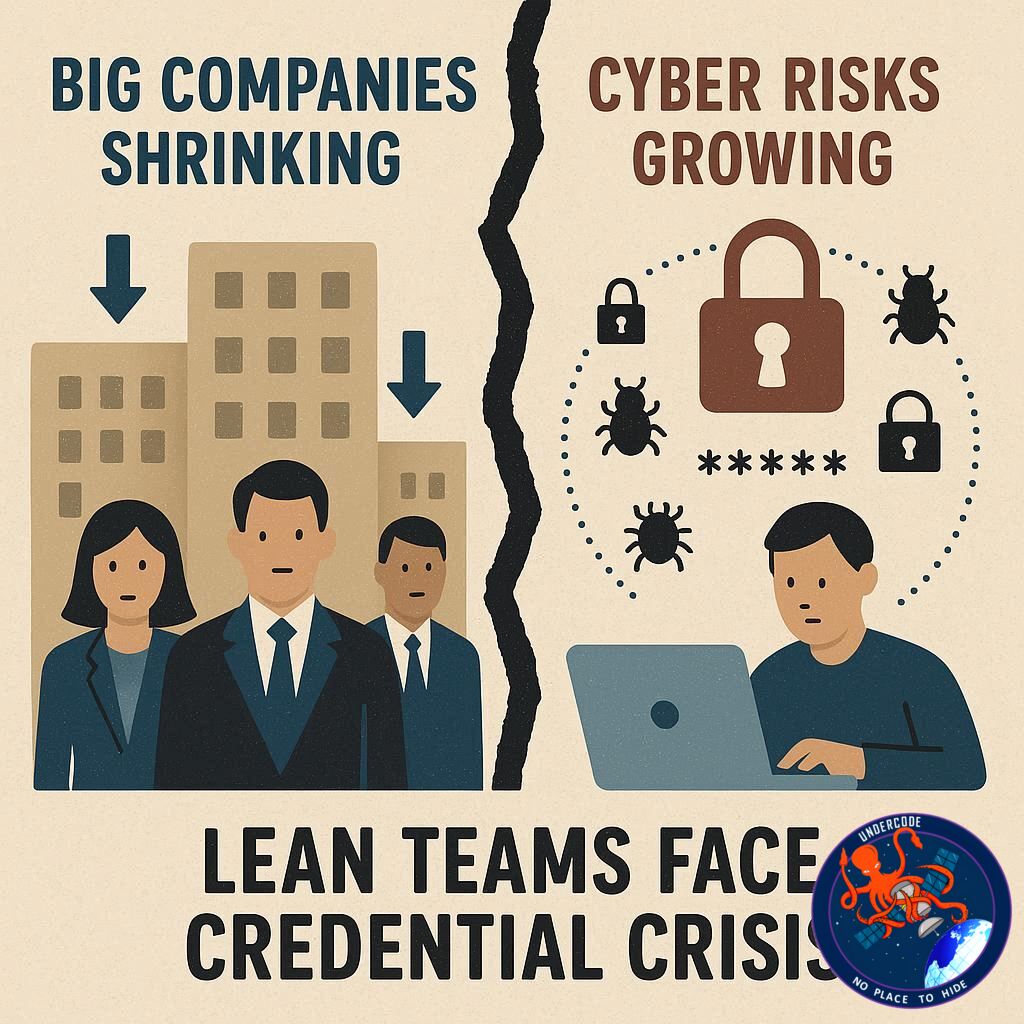
As major corporations trim their workforce, executives celebrate leaner operations and AI-driven efficiency. Yet, behind the glossy headlines lies a growing cybersecurity storm. Reduced headcounts mean stretched security teams, higher exposure to credential theft, and escalating costs for every preventable breach. In an era where “doing more with less” is the mantra, hardcoded secrets and unmanaged credentials have become a silent but costly threat.
Workforce Cuts: The New Corporate Badge of Honor
Big names like Wells Fargo, Bank of America, and Verizon have slashed employees dramatically in recent years. CEOs tout these reductions as operational wins, highlighting the efficiency and agility of smaller teams. But for security departments, fewer resources translate to longer response times, higher risk exposure, and skyrocketing remediation costs.
The Rising Credential Crisis 📊
Research from IBM shows that 86% of breaches involve stolen or compromised credentials, with an average containment time of 292 days. The financial impact is staggering: US organizations now face breach costs exceeding \$10 million, with credential-based incidents adding an extra \$750,000 premium. Manual management of secrets alone costs companies \$1.4 million annually, including wasted developer and analyst hours. Real-world examples, like Canva’s downtime caused by a single leaked secret, illustrate how one lapse can ripple across multiple teams.
Lean Teams, Bigger Risks
Reduced workforce sizes magnify cybersecurity challenges. With fewer staff, incident response times extend, and context-switching costs soar. Organizations harbor thousands of unmanaged secrets scattered across code repositories, CI/CD pipelines, Slack channels, and more. HashiCorp research indicates up to 40% of these secrets are high-risk, providing direct production access. One compromised API key can trigger widespread lateral movement, supply chain attacks, or ransomware deployment, as seen in the s1ngularity attack that exposed tens of thousands of credentials.
Strategic Response: Precision Over Volume ⚡
Effective secrets management is no longer just about detection. Without remediation, alerts overwhelm already stretched teams. Hardcoded secrets differ from standard vulnerabilities—they require understanding the broader infrastructure, permissions, and ownership before they can be safely rotated. Modern platforms prioritize the magnitude of exposure rather than simply identifying issues, providing actionable context to reduce false positives and wasted effort.
Cutting Remediation Time from Weeks to Hours ⏱️
Lean teams benefit from tools that:
Proactively detect potential leaks during commits and in existing code.
Assign clear ownership, ensuring responsible developers get context-rich notifications.
Provide informed decision-making, showing exactly what a secret unlocks and whether it remains active.
Integrate into workflows, offering automated secret revocation and pull-request-based fixes directly in version control systems.
ROI of Smart Remediation 💰
By pinpointing hardcoded secrets precisely, companies save developers hours of searching through codebases. Real-time remediation tracking allows security teams to maintain visibility without extra manual effort. This precision ensures downsized teams can uphold security posture while doing more with less.
What Undercode Say: Analytical Insights 🧩
Workforce optimization is a double-edged sword. While operational efficiency improves, cybersecurity exposure grows exponentially. Lean teams face stretched resources, higher context-switching costs, and prolonged incident resolution times. With thousands of unmanaged secrets scattered across diverse platforms, the probability of credential-based breaches is alarming.
The IBM research showing 86% of breaches involve credentials underscores the critical need for automated, context-aware solutions. Costly downtime, as seen in Canva’s case, illustrates the direct business impact beyond regulatory fines. Organizations are wasting millions annually on manual secret management, highlighting the inefficiency of reactive strategies.
Modern secrets management platforms mitigate these risks by focusing on exposure magnitude, ownership clarity, and workflow integration. By automating remediation and providing actionable context, these tools reduce false positives, improve developer efficiency, and shrink the financial burden of breaches.
The economic argument is compelling: targeted remediation reduces wasted labor costs (\~\$936,000/year) and analyst overhead (\~\$500,000/year). For lean teams, the ROI is immediate—faster incident resolution, minimized disruption, and better alignment between security and development priorities.
In a broader context, credential exposure directly threatens supply chains. A single compromised token can cascade into massive breaches, emphasizing the necessity for precision-based approaches rather than broad, reactive measures. Lean teams cannot afford to manage secrets manually; automation is now essential.
Fact Checker Results ✅❌
✅ 86% of security breaches involve stolen credentials (IBM research).
✅ Average containment time for breaches is 292 days.
❌ Manual secrets management costs over \$1.4 million annually in wasted labor—true across mid-to-large organizations, often underreported.
Prediction 🔮
As companies continue to downsize, credential-based breaches will increase unless automated, context-aware remediation platforms become standard. Lean teams that adopt proactive detection and precise remediation will see a significant reduction in downtime, breach costs, and operational disruption. Conversely, organizations relying on manual processes risk escalating multi-million-dollar incidents and cascading supply chain attacks.
🕵️📝✔️Let’s dive deep and fact‑check.
References:
Reported By: thehackernews.com
Extra Source Hub:
https://www.facebook.com
Wikipedia
OpenAi & Undercode AI
Image Source:
Unsplash
Undercode AI DI v2
🔐JOIN OUR CYBER WORLD [ CVE News • HackMonitor • UndercodeNews ]
📢 Follow UndercodeNews & Stay Tuned:
𝕏 formerly Twitter 🐦 | @ Threads | 🔗 Linkedin | 🦋BlueSky | 🐘Mastodon


