
Listen to this Post
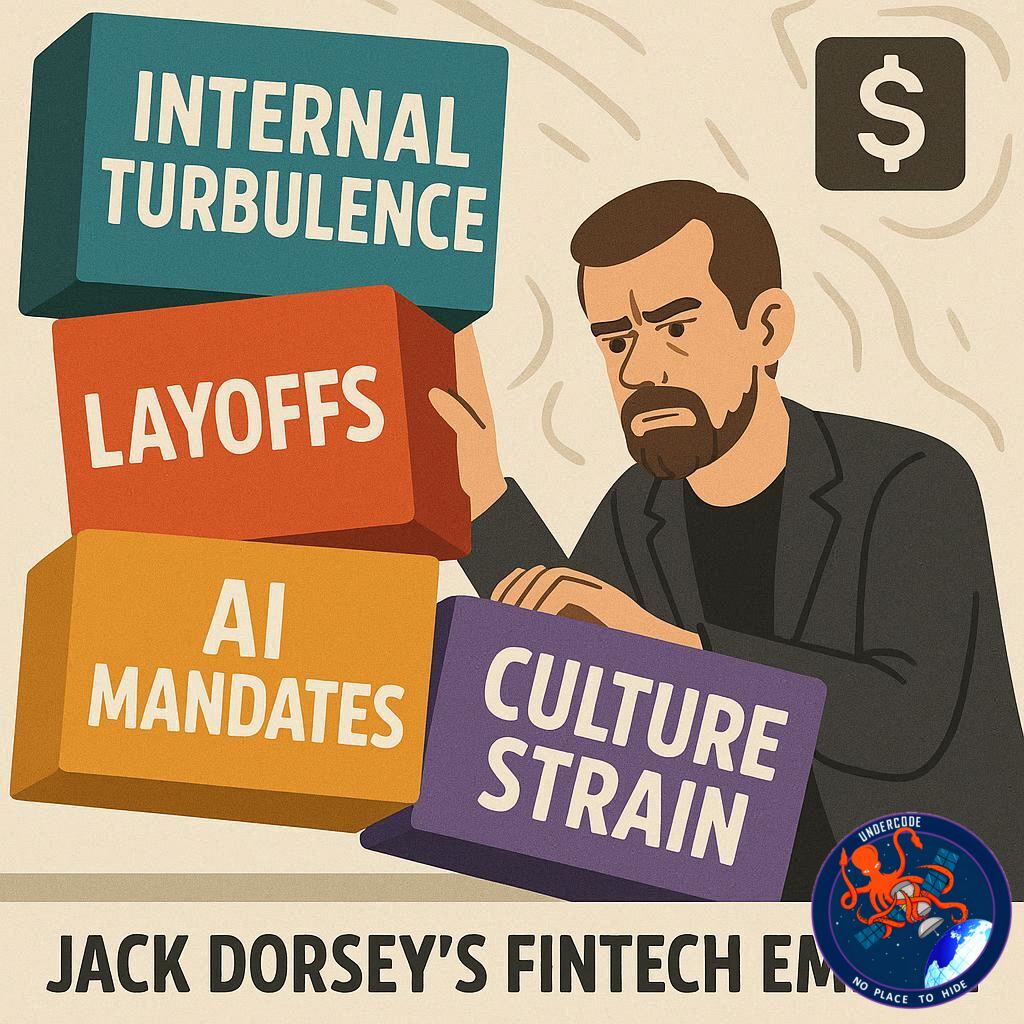
Introduction: A Fintech Giant Faces Internal Fractures
Block, the financial technology powerhouse founded by Jack Dorsey, has long marketed itself as a forward-thinking innovator behind Square and Cash App. Yet beneath the surface of product innovation and bold strategic messaging, anxiety appears to be spreading across its workforce. A fresh wave of layoffs, framed internally as performance-driven rather than cost-cutting, has left employees unsettled. Reports suggest morale is eroding, pressure is mounting, and mandatory AI adoption is intensifying tensions inside the company. What was once seen as a culture of empowerment is now being described by some insiders as uncertain and unstable.
Summary: Layoffs, Performance Pressure, and AI-Driven Workflows
Block employees are reportedly grappling with deteriorating workplace conditions following a significant round of layoffs. According to accounts from current and former staff, the company has begun reducing its workforce by as much as 10 percent, potentially impacting around 11,000 employees. Rather than announcing a single sweeping cut, management is said to be implementing reductions gradually over several weeks, with workers warned that the process could extend through the end of the month. This slow drip of uncertainty has reportedly amplified stress across teams.
Several employees who spoke anonymously described rising performance anxiety. They claim the company’s internal culture has shifted noticeably since hundreds of colleagues were let go earlier this month. Instead of clarity, many employees say they now face ambiguity about their job security, making long-term personal and financial decisions more difficult. Internal complaints shared during an all-hands meeting reportedly reflected deep dissatisfaction. One employee described morale as the lowest it had been in four years, warning that Block’s overarching culture was “crumbling.” Another expressed concern over not knowing whether their livelihood would be affected week to week.
Leadership messaging appears to have added another layer of tension. Arnaud Weber, Block’s engineering lead, reportedly sent an internal email stating that the layoffs were part of the 2025 performance cycle. He framed the departures as merit-based decisions tied to unmet role expectations and calibration standards, rather than as a cost-reduction strategy. However, several employees allegedly disagreed with this characterization, questioning whether the cuts were purely performance-driven.
The company has also intensified its emphasis on generative AI tools. Employees are reportedly required to submit weekly update emails to Dorsey, which are then summarized using AI systems. During the same all-hands meeting, Dorsey acknowledged recurring themes in these updates, including concerns about layoffs, rising performance anxiety, and tension between accelerating product delivery through AI adoption and maintaining engineering quality. Dorsey reportedly reiterated that a portion of the workforce had been “phoning it in” and encouraged broader AI usage to improve productivity, warning that failure to adapt could leave Block trailing competitors.
Not all employees appear convinced. One current staff member reportedly criticized what they described as top-down mandates to use large language models, arguing that effective tools should not require enforcement. The friction between leadership’s push for AI acceleration and employee skepticism now sits at the heart of Block’s internal debate.
The Performance Narrative: Accountability or Strategic Shield?
The decision to frame layoffs as performance-related rather than financially motivated is more than semantic. It shapes how remaining employees interpret the company’s direction. When job cuts are presented as cost-saving measures during challenging market conditions, workers may view them as cyclical. But when layoffs are described as merit-based, the message becomes personal. It implies that underperformance is widespread and that standards are tightening.
This approach can create a culture of hyper-surveillance. Employees may begin optimizing for optics rather than impact, focusing on measurable outputs instead of long-term innovation. If performance evaluations become associated with job survival, psychological safety can erode quickly.
AI Adoption as a Productivity Lever
Block’s increased reliance on generative AI reflects a broader trend across the tech sector. Companies are racing to integrate large language models into workflows to accelerate development cycles and reduce operational friction. Dorsey’s warning that Block could fall behind competitors without aggressive AI adoption signals strategic urgency.
However, rapid AI integration often collides with established engineering principles. Concerns about code quality, system integrity, and long-term maintainability are legitimate, particularly in financial services where reliability and compliance are paramount. Forcing adoption without organic buy-in may generate short-term efficiency gains but risks long-term technical debt.
Cultural Fallout: Morale and Uncertainty
Morale, according to employee accounts, appears to be one of the most immediate casualties. When layoffs are staggered over weeks, uncertainty becomes chronic rather than acute. Employees may spend more time speculating about their status than focusing on innovation. This prolonged ambiguity can quietly corrode trust.
Workplace culture is often invisible until it fractures. Once doubt spreads about leadership transparency or fairness in evaluation processes, rebuilding cohesion becomes exponentially harder. Financial technology firms rely heavily on high-skill engineers and product leaders who can easily migrate to competitors. A decline in morale may eventually translate into voluntary departures.
Leadership Messaging and Strategic Signaling
Dorsey’s reported comment that a sizable portion of the workforce had been disengaged sends a strong signal. On one hand, it reinforces a meritocratic standard. On the other, it risks alienating employees who perceive themselves as working under intense pressure. Publicly acknowledging performance concerns can motivate top performers, but it can also create a perception of blame during a period of instability.
The weekly email summaries powered by generative AI symbolize a hybrid management model: human input filtered through machine intelligence. While efficient, this method may feel impersonal to employees seeking reassurance and direct engagement.
What Undercode Say:
Block’s situation represents a classic intersection of three volatile forces: workforce reduction, performance recalibration, and AI acceleration. Each factor alone can disrupt a company’s internal stability. Combined, they create a structural shock.
Framing layoffs as performance-driven during a period of aggressive AI rollout introduces a psychological paradox. Employees may reasonably question whether underperformance is truly individual or partly the result of evolving expectations shaped by new technology. When workflows shift rapidly toward AI-assisted output, legacy performance benchmarks may become outdated almost overnight.
The staggered implementation of layoffs is particularly significant. Gradual reductions extend uncertainty, and uncertainty is one of the most corrosive forces in organizational psychology. Employees operate best when expectations are clear. When the criteria for survival appear fluid, even high performers can experience cognitive overload. That stress rarely produces better innovation.
The mandatory tone around AI adoption reveals strategic urgency. Block competes in an intensely competitive fintech landscape where speed matters. If AI can compress development cycles, the temptation to enforce adoption is understandable. Yet the skepticism voiced by at least one employee highlights a cultural truth: tools gain loyalty through demonstrated value, not directives. Engineers often resist mandates not because they reject progress, but because they fear compromising quality.
There is also reputational risk. Financial platforms handle sensitive user data and transactions. Any decline in engineering rigor could have outsized consequences. If AI-generated code introduces vulnerabilities or compliance gaps, the long-term cost could dwarf short-term productivity gains.
At the leadership level, Dorsey appears to be signaling a shift toward high-performance intensity. His message suggests that complacency will not be tolerated. That may resonate with investors seeking operational efficiency. However, execution depends on maintaining enough trust internally to prevent talent erosion.
The deeper question is whether Block is entering a disciplined optimization phase or experiencing a cultural contraction. If the performance narrative is credible and metrics are transparent, the company may emerge leaner and faster. If employees perceive inconsistency or misalignment between messaging and reality, morale could deteriorate further.
Ultimately, the fusion of layoffs and AI mandates tests an organization’s resilience. Companies that navigate such transitions successfully usually pair strategic clarity with empathetic communication. Without both, even visionary leadership can struggle to stabilize the workforce.
Fact Checker Results
✅ Reports confirm Block is conducting layoffs affecting up to 10% of its workforce and implementing them gradually.
✅ Internal communications framed the layoffs as performance-based within the 2025 evaluation cycle.
❌ There is no public evidence that AI adoption alone directly caused the layoffs.
Prediction
📊 Block is likely to double down on AI integration while tightening performance benchmarks across engineering teams.
📊 Short-term productivity metrics may improve, but employee retention rates could face pressure if morale continues to decline.
📊 Investor response may remain cautiously optimistic if cost efficiency aligns with sustained product innovation.
▶️ Related Video (76% Match):
🕵️📝✔️Let’s dive deep and fact‑check.
References:
Reported By: timesofindia.indiatimes.com
Extra Source Hub (Possible Sources for article):
https://www.digitaltrends.com
Wikipedia
OpenAi & Undercode AI
Image Source:
Unsplash
Undercode AI DI v2
Bing
🔐JOIN OUR CYBER WORLD [ CVE News • HackMonitor • UndercodeNews ]
📢 Follow UndercodeNews & Stay Tuned:
𝕏 formerly Twitter 🐦 | @ Threads | 🔗 Linkedin | 🦋BlueSky | 🐘Mastodon


