
Listen to this Post
Introduction
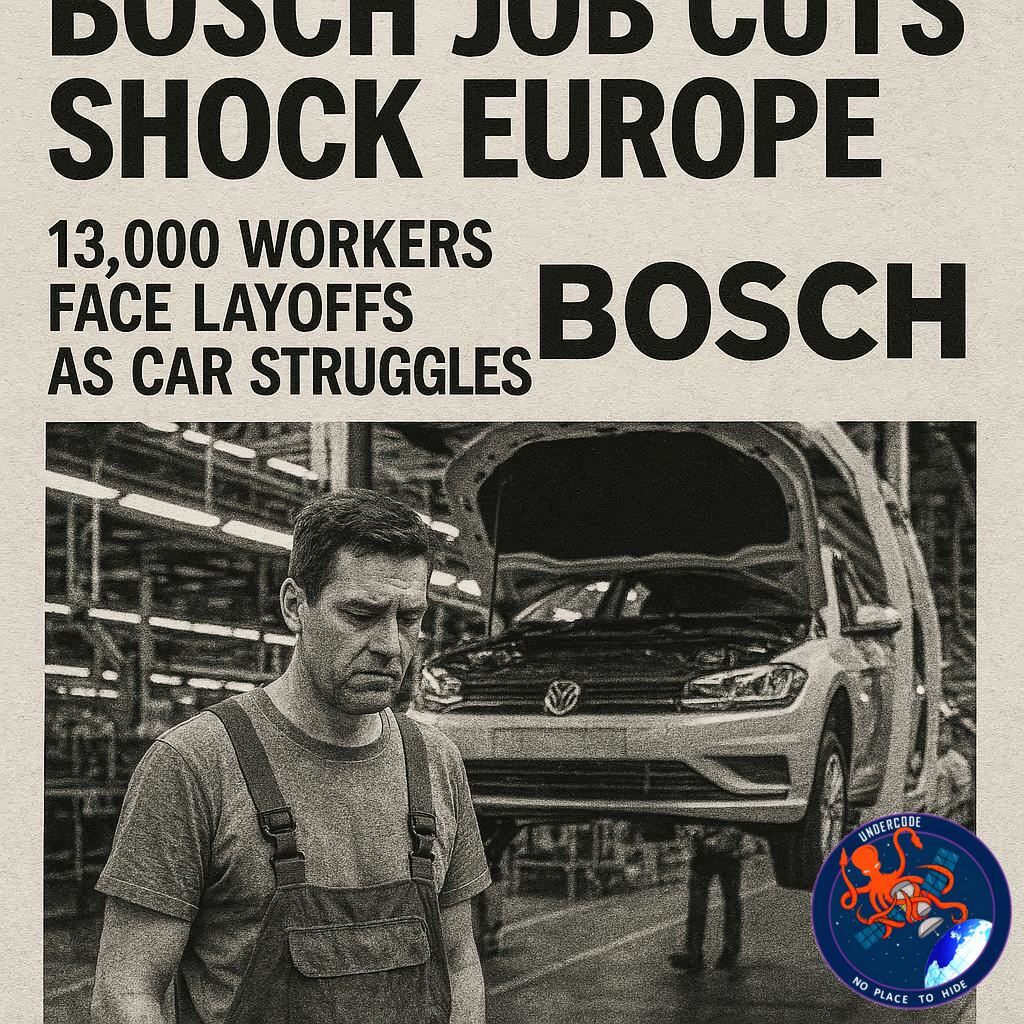
Germany’s engineering powerhouse Bosch has announced another wave of massive job cuts, sending shockwaves across Europe’s already fragile automotive industry. The company plans to slash around 13,000 jobs by 2030, a move aimed at saving €2.5 billion (approx. $2.7 billion) as the European car market faces one of its toughest crises in decades. This comes on top of several previous rounds of layoffs, underscoring the deep structural challenges facing Europe’s industrial backbone.
Bosch’s Struggle to Survive the Car Market Crisis
Bosch, known globally as a leader in auto-parts manufacturing, is under mounting pressure to cut costs amid falling demand, rising energy prices, and stiff competition from cheaper Chinese rivals. The latest layoffs represent roughly 3% of Bosch’s global workforce, with Germany bearing the brunt of the impact.
The Stuttgart region, where Bosch is headquartered, will be hardest hit. Facilities in Feuerbach and Schwieberdingen are expected to see thousands of positions eliminated. The company said it will begin talks with affected employees immediately, signaling the painful process ahead.
Bosch’s decision comes as the European car market faces sluggish demand, driven by a complex mix of factors. Automakers are squeezed by higher labor costs, surging energy prices, and tariffs on U.S. exports, which currently stand at 15%—a rate that was narrowly reduced from the originally threatened 27.5%.
Meanwhile, the industry’s transition to electric mobility is proving far from smooth. Uncertainty surrounding the EU’s carbon reduction targets and the rollback of government subsidies for electric vehicles (EVs) in several countries have weighed heavily on consumer demand.
Bosch is not alone in its struggles. Other auto giants such as Volkswagen, Volvo, Nissan, and Stellantis have all announced workforce reductions this year. With investment in manufacturing facilities also being scaled back, Bosch’s announcement paints a grim picture of an industry battling on multiple fronts.
The cuts also deal a political blow to German Chancellor Friedrich Merz, who is working to lure investment back into Germany’s industrial sector. His government has already taken drastic steps to stimulate growth, including amending the “debt brake” rule to allow higher defense spending and setting up a €500 billion ($540 billion) infrastructure fund. Despite these measures, Germany’s economy is expected to grow by just 0.2% this year following two years of contraction—a sign that recovery remains fragile.
In short, Bosch’s sweeping job cuts highlight both the severity of Europe’s automotive downturn and the daunting challenges that lie ahead for Germany’s economy.
What Undercode Say:
The Bosch layoffs reveal more than just a corporate downsizing strategy—they symbolize the struggles of an entire continent’s industrial might.
Economic Pressure Points
The European auto industry is in a bind. High wages and energy costs in Germany contrast sharply with cheaper production alternatives in Asia, especially China. This cost imbalance has left even industry leaders like Bosch vulnerable. When margins are squeezed, cutting jobs becomes the fastest way to save billions.
Political Fallout in Germany
The layoffs will likely test Chancellor Merz’s industrial revival plans. While his €500 billion investment fund sounds ambitious, the cuts at Bosch underline how difficult it will be to convince companies to expand operations in Germany rather than relocate elsewhere. This could spark debates over whether more aggressive subsidies or tax reforms are needed.
EV Transition Turbulence
Electric vehicles were once touted as the future, but the pace of adoption is slowing. With fewer subsidies and higher car prices, consumer appetite has weakened. Bosch, heavily tied to traditional combustion engines, faces a double blow: declining demand for conventional parts and uncertainty in EV growth. This transition gap is where thousands of jobs are being lost.
Impact on Workers and Communities
The regions of Feuerbach and Schwieberdingen will feel the brunt socially and economically. Job losses on this scale ripple beyond the company, affecting local businesses, housing markets, and even schools. The fear of industrial decline is deeply felt in German communities that once thrived on stable manufacturing jobs.
Wider Industrial Implications
Bosch’s move isn’t isolated—it’s part of a broader trend. European automakers are trimming costs, while non-European players like Nissan and Stellantis are also making similar moves. The global automotive industry is restructuring, and Europe risks losing its competitive edge if innovation and cost efficiency don’t improve quickly.
A Warning for the Future
If Europe cannot resolve its high-cost production model and reliance on subsidies, the auto industry could see more job cuts and relocations abroad. Bosch is a warning signal that Germany’s “industrial heartland” is weakening under global competition.
Fact Checker Results ✅❌
✅ Bosch confirmed the plan to cut 13,000 jobs by 2030.
✅ The move aims to save €2.5 billion as Europe’s car market struggles.
❌ Claims that EV demand is booming in Europe are misleading—data shows declining subsidies have slowed growth.
🔮 Prediction
The European auto industry will likely enter a deeper restructuring phase over the next five years. Bosch may shift more production outside Germany to cheaper markets, while political pressure will mount on the German government to introduce stronger industrial policies. If the EV transition accelerates again, companies that survive the current storm may emerge leaner, more innovative, and globally competitive—but the path will be marked by painful layoffs and economic uncertainty.
🕵️📝✔️Let’s dive deep and fact‑check.
References:
Reported By: www.euronews.com
Extra Source Hub:
https://www.stackexchange.com
Wikipedia
OpenAi & Undercode AI
Image Source:
Unsplash
Undercode AI DI v2
🔐JOIN OUR CYBER WORLD [ CVE News • HackMonitor • UndercodeNews ]
📢 Follow UndercodeNews & Stay Tuned:
𝕏 formerly Twitter 🐦 | @ Threads | 🔗 Linkedin | 🦋BlueSky | 🐘Mastodon


