
Listen to this Post
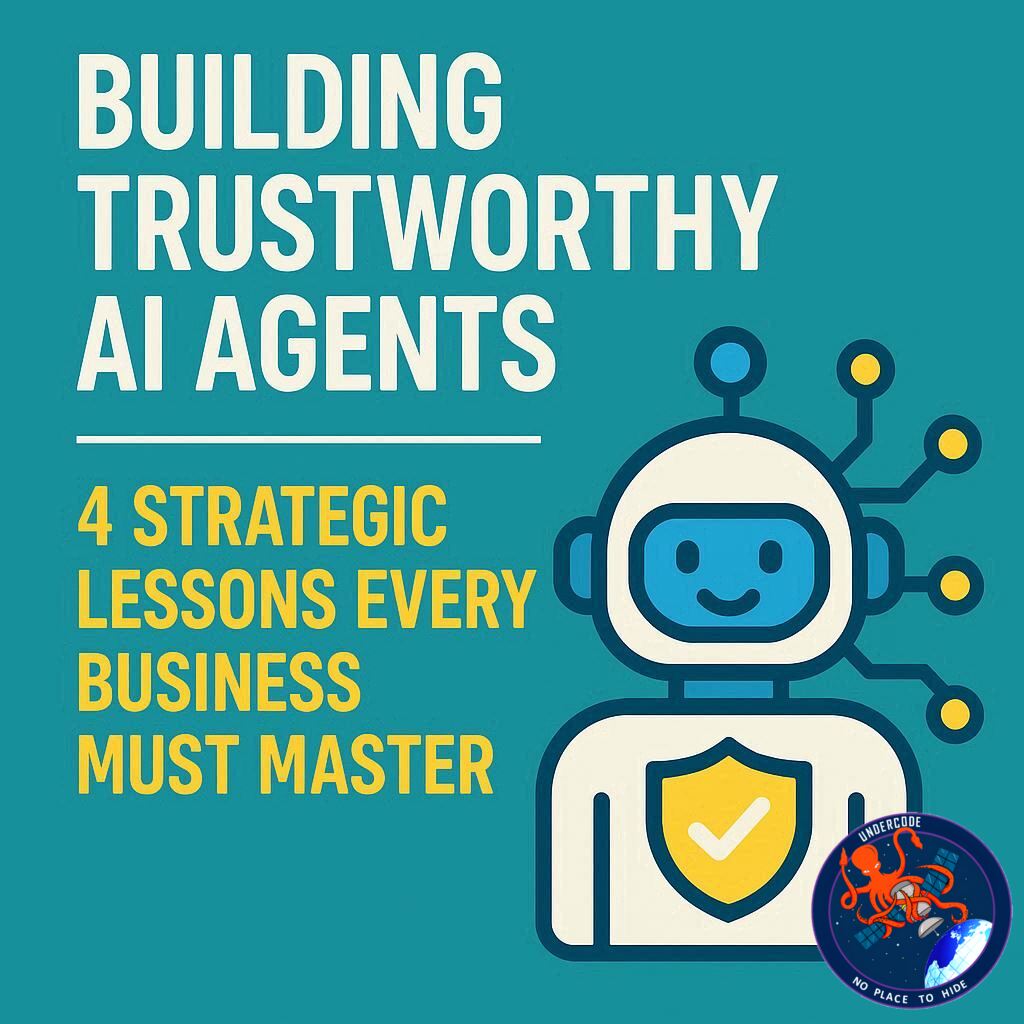
Introduction: The Shift Toward Agent-Driven Workflows
Artificial intelligence is no longer limited to chatbots or automation scripts. A new wave of AI agents is quietly transforming how businesses operate, make decisions, and deliver value. These agents act more like digital collaborators than tools, capable of reasoning, planning, and executing complex workflows. As organizations race to adopt this technology, one critical question emerges: how can businesses actually trust these AI systems? The answer lies not in hype, but in disciplined strategy, thoughtful design, and continuous evaluation.
The Rise of AI Agents Across Modern Enterprises
AI agents are rapidly becoming embedded in nearly every professional domain. Whether through ready-made enterprise tools or custom-built solutions powered by large language models, companies are exploring new ways to integrate these systems into daily operations. Their ability to synthesize data, automate reasoning, and assist decision-making is reshaping productivity standards. However, this transformation is not automatic. Businesses must actively define how to leverage these agents in ways that align with their goals and risk tolerance.
Core Insights and Industry Practices
One of the most compelling perspectives on building reliable AI agents comes from industry leaders working at the intersection of machine learning and enterprise software. Organizations are no longer relying solely on external AI models; instead, they combine proprietary data, internal expertise, and advanced algorithms to create more context-aware systems. This hybrid approach allows businesses to deliver specialized insights that generic AI tools cannot replicate.
At the heart of this evolution is a shift in how expertise is delivered. Traditionally, professional knowledge was embedded in software interfaces. Today, that same expertise is increasingly delivered through AI agents that interact dynamically with users. These agents can analyze information, generate insights, and even propose strategies in ways that resemble human reasoning.
Several real-world applications highlight this transformation. AI-powered research tools now assist legal professionals by scanning vast databases and summarizing relevant case law. Advanced research agents can go even further, simulating the thought process of experienced analysts to provide strategic recommendations. These innovations demonstrate the growing capability of AI agents to move beyond simple automation into high-value cognitive tasks.
From these developments, four key lessons have emerged for building trustworthy AI systems. The first is the importance of measurement. Businesses must clearly define what success looks like and establish rigorous evaluation frameworks. This includes using public benchmarks, developing internal performance metrics, and incorporating human feedback to validate results. Without proper measurement, even the most advanced AI system cannot be trusted.
The second lesson focuses on collaboration. AI agents are not standalone entities; they are part of a broader ecosystem involving designers, engineers, and end users. Creating a shared understanding between humans and AI systems is essential. This requires intuitive interfaces, transparent processes, and close collaboration between technical and non-technical teams.
The third lesson emphasizes leveraging proven capabilities. AI agents should not be expected to do everything independently. Instead, they should be connected to existing tools and workflows that have already been validated. By decomposing complex systems into modular components, businesses can extend the capabilities of AI agents while maintaining reliability.
Finally, organizations must look beyond their internal boundaries. Building trustworthy AI requires collaboration with industry peers, academic institutions, and research communities. By sharing knowledge and learning from others, companies can improve transparency, explainability, and overall system performance. This broader perspective is especially important when aiming for near-perfect accuracy, which is often required in high-stakes industries like law, finance, and compliance.
What Undercode Say: The Real Challenge Behind Trustworthy AI
The conversation around AI agents often sounds optimistic, but the underlying reality is far more complex. Trust is not a feature that can be added at the end of development. It is a continuous process that must be engineered into every layer of the system.
One of the most overlooked challenges is the gap between performance metrics and real-world reliability. Many AI systems perform well in controlled environments but fail when exposed to unpredictable inputs. This is where human-in-the-loop validation becomes essential. It acts as a safeguard against blind reliance on automated outputs.
Another critical issue is the illusion of intelligence. AI agents can produce highly convincing responses, but that does not mean they truly understand context. Businesses that treat these systems as fully autonomous risk making flawed decisions based on incomplete reasoning. The smarter approach is to view AI agents as augmentations of human intelligence rather than replacements.
Collaboration, while frequently discussed, is often poorly implemented. Simply placing designers and engineers in the same room does not guarantee alignment. What truly matters is creating feedback loops where insights from user experience directly influence model development. This iterative cycle is what transforms a functional AI system into a reliable one.
The idea of leveraging proven capabilities also reveals a deeper strategic insight. Companies that succeed with AI are not those chasing the most advanced models, but those effectively integrating AI into their existing infrastructure. The real competitive advantage lies in orchestration, not invention.
Looking beyond the firewall introduces another layer of complexity. Collaboration with external organizations can accelerate innovation, but it also raises concerns around data privacy, intellectual property, and competitive positioning. Businesses must strike a balance between openness and control.
Perhaps the most important takeaway is the pursuit of accuracy. Moving from 90% to 99.9% reliability is exponentially more difficult than initial development. This final stretch requires not only better models but also better processes, better data, and better human oversight. It is in this margin where trust is truly built or broken.
In reality, the future of AI agents will not be defined by their capabilities alone, but by how well organizations manage their limitations. Companies that acknowledge these limitations and design around them will ultimately lead the market.
Fact Checker Results
✅ AI agents are increasingly used across industries for complex workflows and decision support
✅ Human oversight remains a critical component for ensuring AI reliability and trust
❌ AI agents are not yet capable of fully autonomous, error-free decision-making in all scenarios
Prediction
📊 Businesses will shift from experimenting with AI agents to building fully integrated agent ecosystems
📊 Trust metrics and explainability standards will become mandatory in enterprise AI adoption
📊 Companies that prioritize human-AI collaboration will outperform those relying solely on automation
▶️ Related Video (86% Match):
🕵️📝✔️Let’s dive deep and fact‑check.
References:
Reported By: www.zdnet.com
Extra Source Hub (Possible Sources for article):
https://www.quora.com/topic/Technology
Wikipedia
OpenAi & Undercode AI
Image Source:
Unsplash
Undercode AI DI v2
Bing
🔐JOIN OUR CYBER WORLD [ CVE News • HackMonitor • UndercodeNews ]
📢 Follow UndercodeNews & Stay Tuned:
𝕏 formerly Twitter 🐦 | @ Threads | 🔗 Linkedin | 🦋BlueSky | 🐘Mastodon


