
Listen to this Post
Introduction
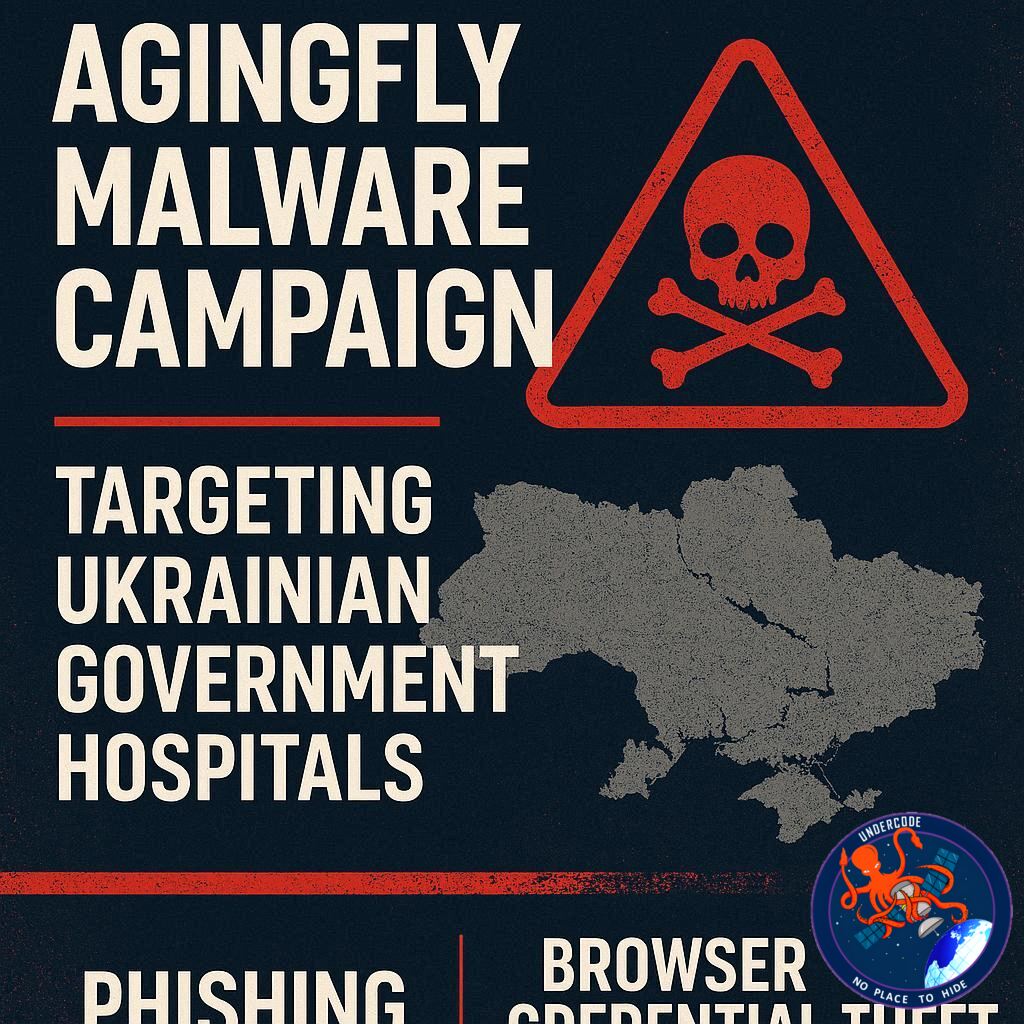
A new cyber espionage campaign has been uncovered by Ukraine’s national cyber defense authority CERT-UA, revealing a highly sophisticated malware operation targeting government institutions, healthcare organizations, and potentially elements linked to the Defense Forces. The attack cluster, identified as UAC-0247, introduces a new malware family called AgingFly. This campaign demonstrates an evolving blend of phishing tactics, browser data theft, remote access tooling, and modular malware design. Its structure reflects a shift toward more adaptive and stealth-driven cyber operations that prioritize long-term access and credential harvesting over immediate disruption.
Campaign Overview and Infection Chain Summary
The AgingFly cyber campaign begins with carefully crafted phishing emails that impersonate humanitarian aid providers. These messages are designed to appear legitimate and socially relevant, increasing the likelihood of user interaction. Victims are directed to download a malicious archive, which is either hosted on a compromised legitimate website using cross-site scripting techniques or on a fake AI-generated webpage designed to mimic trusted sources. Once the archive is opened, the infection process begins immediately through a Windows shortcut file. This LNK file abuses the Windows HTA handler to silently retrieve and execute remote code. During execution, a decoy form is displayed to distract the user while the malware establishes persistence via scheduled tasks. A secondary executable then injects shellcode into a legitimate system process, making detection more difficult. The malware operates through multiple stages, using encrypted communication channels to avoid interception. A PowerShell-based component known as SILENTLOOP enables command execution, configuration updates, and retrieval of command-and-control information from Telegram channels or backup infrastructure. The primary objective of the attackers appears to be credential theft, particularly browser-stored data. Tools such as ChromElevator are used to extract cookies and saved passwords from Chromium-based browsers, while ZAPiDESK targets sensitive data stored in desktop messaging applications like WhatsApp for Windows. The attackers also conduct reconnaissance using tools like RustScan, Ligolo-ng, and Chisel, indicating preparation for lateral movement across networks. CERT-UA identifies AgingFly as a modular C backdoor capable of executing commands, capturing screenshots, logging keystrokes, and exfiltrating files. Unlike traditional malware, its functionality is not fully embedded in the initial payload. Instead, it dynamically retrieves and compiles components from its command server directly on the infected system, making it highly adaptable and difficult to analyze. This design significantly reduces the static footprint of the malware while increasing its operational flexibility. CERT-UA has advised organizations to block execution of LNK, HTA, and JavaScript files as a preventative measure against the initial infection vector. Security researchers also emphasize the importance of multi-layered protection strategies, as credential theft attacks increasingly rely on bypassing browser-based and session-based security mechanisms.
What Undercode Say:
The AgingFly campaign reflects a clear evolution in cyber intrusion tactics where phishing is no longer the final step but merely the entry point into a broader attack ecosystem.
The use of humanitarian aid themes shows deliberate psychological targeting, exploiting trust during periods of crisis and institutional vulnerability.
The infection chain is designed for stealth, using LNK shortcuts and HTA abuse to bypass traditional email and attachment filtering systems.
The decoy form mechanism indicates an understanding of user behavior, ensuring victims remain unaware while the malware executes in the background.
Persistence through scheduled tasks demonstrates a standard but effective technique for maintaining long-term access within compromised systems.
The inclusion of encrypted communications and Telegram-based command retrieval shows reliance on resilient and decentralized infrastructure.
SILENTLOOP’s PowerShell execution layer highlights how attackers are increasingly leveraging native Windows tools to avoid detection.
Credential harvesting remains the primary objective, with a strong focus on browser-stored cookies and saved passwords.
ChromElevator’s ability to decrypt Chromium-based data shows targeting of modern browsing environments where users store critical authentication sessions.
The targeting of WhatsApp for Windows via ZAPiDESK suggests expansion beyond browsers into personal communication platforms.
Reconnaissance tools like RustScan indicate preparation for network-wide visibility rather than isolated system compromise.
Ligolo-ng and Chisel usage confirm tunneling and lateral movement capabilities, enabling attackers to traverse segmented environments.
The modular nature of AgingFly allows dynamic code retrieval, making static detection significantly more difficult for defenders.
By compiling components on the infected machine, the malware reduces forensic traces left in traditional malware samples.
This approach also allows attackers to modify capabilities in real time without redistributing new payloads.
Such flexibility suggests a professional threat actor with a strong operational security model.
The targeting of government and healthcare sectors indicates high-value intelligence gathering objectives.
The possible exposure of Defense Forces personnel increases the strategic sensitivity of the campaign.
CERT-UA’s mitigation advice focuses on blocking initial execution vectors rather than relying solely on post-infection detection.
The campaign reinforces the growing importance of endpoint hardening against script-based and shortcut-based attacks.
Overall, AgingFly represents a shift toward modular, cloud-assisted malware ecosystems that blur the line between local infection and remote execution services.
It demonstrates how modern cyber threats prioritize persistence, stealth, and adaptability over simple payload deployment.
The use of multiple fallback channels ensures resilience even if parts of the infrastructure are disrupted.
This makes containment significantly more complex for traditional security architectures.
The campaign underscores the need for behavioral detection rather than signature-based defenses alone.
Organizations with weak endpoint policies remain the most vulnerable targets in such operations.
Human interaction remains the weakest link, as phishing continues to successfully initiate complex intrusion chains.
The blending of social engineering with advanced post-exploitation tooling defines the modern threat landscape seen in AgingFly.
It is not just malware deployment, but a full lifecycle intrusion framework designed for sustained access and intelligence extraction.
Fact Checker Results
✔ CERT-UA has reported phishing-based intrusion chains targeting Ukrainian institutions
✔ AgingFly is described as a modular C backdoor with credential theft capabilities
❌ No verified evidence that consumer antivirus alone can fully prevent this type of multi-stage attack
Prediction
AgingFly-style campaigns are likely to expand further into hybrid phishing ecosystems combining AI-generated phishing pages and automated malware delivery systems.
Future variants will likely increase reliance on dynamic code compilation and cloud-hosted command infrastructure to evade detection.
Defensive strategies will shift more heavily toward behavioral analytics and real-time endpoint isolation to counter these evolving threats.
🕵️📝✔️Let’s dive deep and fact‑check.
References:
Reported By: www.bitdefender.com
Extra Source Hub (Possible Sources for article):
https://stackoverflow.com
Wikipedia
OpenAi & Undercode AI
Image Source:
Unsplash
Undercode AI DI v2
Bing
🔐JOIN OUR CYBER WORLD [ CVE News • HackMonitor • UndercodeNews ]
📢 Follow UndercodeNews & Stay Tuned:
𝕏 formerly Twitter 🐦 | @ Threads | 🔗 Linkedin | 🦋BlueSky | 🐘Mastodon


