
Listen to this Post
Introduction
India’s space ambitions have reached another defining milestone. Chandrayaan-3, the landmark lunar mission developed by the Indian Space Research Organisation (ISRO), has received the highly respected 2026 Goddard Astronautics Award from the American Institute of Aeronautics and Astronautics (AIAA). The recognition highlights not only India’s technological progress but also the mission’s historic achievement of reaching one of the Moon’s most scientifically valuable regions.
Chandrayaan-3 captured global attention in 2023 when it successfully performed a soft landing near the Moon’s south pole, an accomplishment no nation had previously achieved. Now, years later, that mission continues earning international recognition for its contribution to lunar science, exploration strategy, and future human space ambitions.
Chandrayaan-3 Receives International Recognition
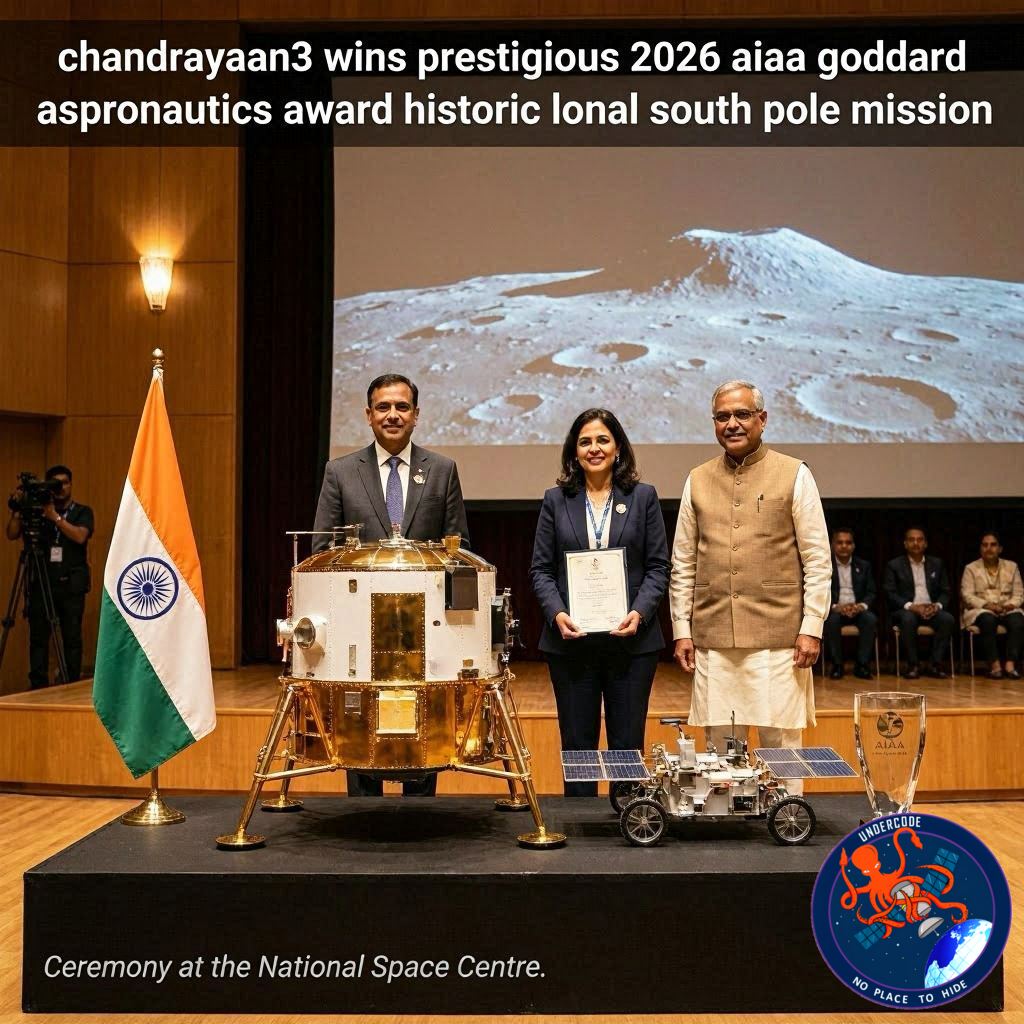
India’s Chandrayaan-3 lunar mission has officially been honored with the 2026 Goddard Astronautics Award, one of the highest distinctions in astronautics awarded by the American Institute of Aeronautics and Astronautics (AIAA). The award ceremony took place in Washington DC on May 21 during the AIAA ASCEND 2026 Conference.
The recognition celebrates a mission that fundamentally changed lunar exploration history. On August 23, 2023, Chandrayaan-3 successfully landed near the Moon’s south polar region, becoming the first spacecraft ever to achieve a controlled soft landing in that challenging location.
The Moon’s south pole has attracted growing international attention because scientists believe it contains critical resources and geological information that could shape future human exploration efforts. Before Chandrayaan-3, surface-level exploration of that region remained unachieved.
The mission delivered scientific observations and important lunar data that could support future crewed Moon missions. Researchers also identified key chemical elements within south polar lunar soil, strengthening theories that local resources may someday help sustain long-term human operations and manufacturing capabilities beyond Earth.
The award was accepted on behalf of ISRO by India’s Ambassador to the United States, His Excellency Vinay Kwatra.
During his remarks at the conference, Ambassador Kwatra highlighted Prime Minister Narendra Modi’s Space Vision 2047 initiative. The roadmap outlines India’s long-term goals in deep space exploration, commercial space expansion, and human spaceflight development.
He also emphasized stronger cooperation between India and the United States across governments, private industries, and scientific institutions. Space collaboration has increasingly become an important dimension of the strategic partnership between both nations.
The Goddard Astronautics Award represents the highest recognition granted by AIAA for exceptional achievements in astronautics. The award can honor either individuals or entire teams whose work advances aerospace science and engineering.
Team awards include formal contributor recognition, though only a limited number of representatives may officially accept the honor during ceremonies.
The award itself carries historical importance. It was established by Mrs. Goddard to honor Robert H. Goddard, one of modern rocketry’s foundational pioneers.
Robert Goddard’s early experiments involving liquid-fueled rocket engines helped establish the technological foundations that eventually enabled modern space exploration. His work transformed theoretical rocket science into practical engineering.
The award took its current form in 1975 when AIAA expanded selection criteria and evolved its earlier Goddard Award into a broader recognition honoring major achievements throughout astronautics.
For India, Chandrayaan-3’s recognition reflects years of engineering effort, scientific planning, and technological development that positioned the nation among the world’s leading space powers.
The mission not only demonstrated advanced landing capability but also reinforced India’s growing influence in shaping humanity’s next chapter in space exploration.
What Undercode Say:
Chandrayaan-3’s success carries importance beyond national pride. The mission highlights a larger transformation happening inside global space exploration. Space activity is no longer dominated by a small group of traditional powers. Countries like India are increasingly becoming major innovation leaders capable of executing highly sophisticated missions with efficient budgets.
One of Chandrayaan-3’s most remarkable aspects was cost effectiveness. ISRO has repeatedly demonstrated an ability to develop ambitious space programs with financial efficiency that often surprises international observers.
Landing near the Moon’s south pole was not merely symbolic. The region represents one of the most strategically valuable targets in modern lunar exploration. Scientists believe permanently shadowed craters may contain water ice deposits, which could eventually provide drinking water, breathable oxygen, and hydrogen fuel for future lunar bases.
This changes the Moon from being a destination into becoming infrastructure.
Global space agencies increasingly view lunar exploration as preparation for deeper missions toward Mars and beyond. Any country establishing expertise in lunar operations today gains long-term strategic advantages.
Chandrayaan-3 also strengthened India’s international standing within commercial aerospace markets.
Private investment in India’s space ecosystem has accelerated rapidly over recent years. Successful government missions often create confidence among investors, startups, and international partners.
Recognition from organizations like AIAA sends another signal to global markets: India’s space technology capabilities are internationally respected.
The Space Vision 2047 roadmap further indicates India is planning for sustained expansion rather than isolated mission success.
Human spaceflight programs, deep space probes, commercial launch systems, and international cooperation initiatives collectively suggest a long-term strategy.
The growing collaboration between India and the United States could become especially important.
Modern space exploration increasingly depends on partnerships. Missions are becoming more expensive, technically demanding, and scientifically complex.
Cross-border cooperation allows countries to combine strengths rather than duplicate efforts.
Another important takeaway involves lunar resource utilization.
Future Moon missions may depend heavily on “in-situ resource utilization,” meaning astronauts use local materials instead of transporting everything from Earth.
Chandrayaan-3’s findings regarding lunar soil composition contribute to that larger scientific objective.
The mission also demonstrated engineering resilience.
India’s Chandrayaan-2 mission encountered setbacks during its landing attempt in 2019. Instead of slowing progress, lessons learned from that experience directly strengthened Chandrayaan-3.
That pattern reflects a broader reality across aerospace history.
Space exploration advances through iteration, refinement, and persistence.
International recognition arriving years after the landing proves that mission impact extends far beyond launch dates and headlines.
Scientific missions create value over decades.
Data continues producing discoveries.
Technology developments influence future programs.
Engineering experience builds institutional strength.
Chandrayaan-3 represents more than a lunar landing.
It reflects how emerging space powers are reshaping global exploration and building the foundations for humanity’s long-term presence beyond Earth.
Fact Checker Results
✅ Chandrayaan-3 became the first mission to achieve a soft landing near the Moon’s south pole in August 2023.
✅ The Goddard Astronautics Award is one of AIAA’s highest honors recognizing major astronautics achievements.
✅ Chandrayaan-3 contributed scientific observations relevant to future lunar exploration and resource studies.
Prediction
🚀 India’s lunar achievements will likely accelerate investment into its commercial space industry over the coming decade.
🌕 International competition around lunar south pole exploration is expected to intensify as more nations pursue long-term Moon infrastructure.
📈 Recognition such as the Goddard Astronautics Award may strengthen India’s role as a major global space exploration leader heading toward 2047.
🕵️📝Let’s dive deep and fact‑check.
References:
Reported By: www.deccanchronicle.com
Extra Source Hub (Possible Sources for article):
https://www.instagram.com
Wikipedia
OpenAi & Undercode AI
Image Source:
Unsplash
Undercode AI DI v2
Bing
🔐JOIN OUR CYBER WORLD [ CVE News • HackMonitor • UndercodeNews ]
📢 Follow UndercodeNews & Stay Tuned:
𝕏 formerly Twitter 🐦 | @ Threads | 🔗 Linkedin | 🦋BlueSky | 🐘Mastodon | 📺Youtube


