
Listen to this Post
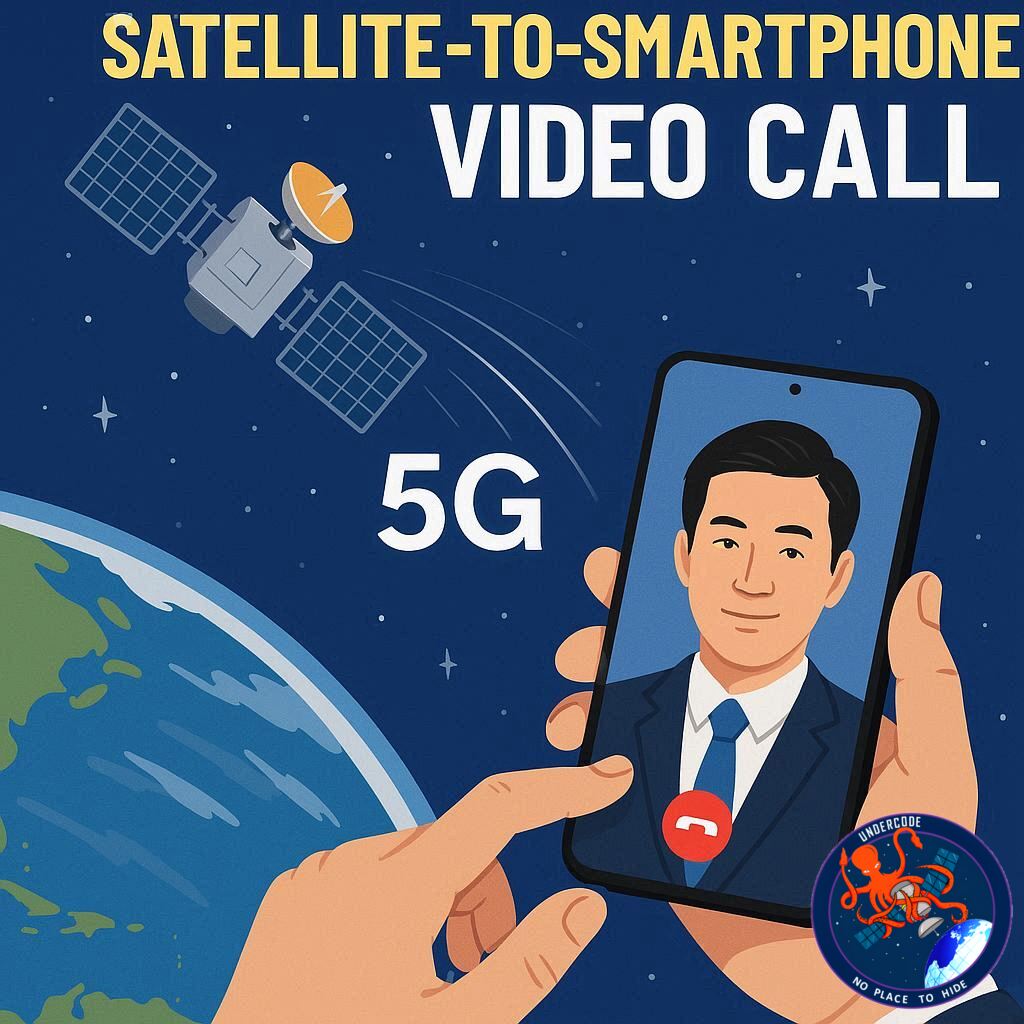
China has taken a bold leap in the race for global connectivity by successfully conducting the world’s first direct 5G satellite-to-smartphone broadband video call — a feat that could reshape the future of communication and potentially sidestep traditional network restrictions. This pioneering test, reported by the South China Morning Post, showcases China’s ambitions to compete with Elon Musk’s SpaceX and challenge U.S. dominance in next-generation communication infrastructure.
This breakthrough could one day allow anyone, anywhere — from ships in the middle of the ocean to travelers deep in mountain ranges — to stream high-quality video without a single cell tower in sight. But while the achievement is technologically stunning, experts warn that it’s not an overnight revolution. The path ahead is still cluttered with licensing barriers, bandwidth constraints, and global regulatory hurdles.
the Original
Earlier this month, Chinese scientists conducted the world’s first direct 5G satellite-to-smartphone broadband video call, marking a significant milestone in space-based telecommunications. The test used a technology demonstration satellite under the leadership of China Satellite Network Group (China SatNet) and employed the 5G Non-Terrestrial Network (NTN) standard, enabling a standard smartphone to connect directly to a satellite without special hardware.
Liang Baojun, China SatNet’s head, announced the success at the Xiongan BeiDou Ecosystem Cooperation Conference, noting that the trial validated key elements of China’s integrated space-ground network architecture. This development comes as part of the Guowang megaconstellation project — a planned network of 13,000 satellites designed to compete directly with SpaceX’s Starlink.
The system promises universal mobile coverage, especially in areas where traditional cell towers are absent, with potential applications in maritime transport, aviation, defense, emergency services, autonomous vehicles, and remote industries. Unlike conventional networks, satellite connections could offer borderless access, a major advantage in disaster zones and underdeveloped regions.
This progress is happening against a backdrop of U.S.-China tech tensions. The U.S. government has been pushing TikTok’s Chinese parent company, ByteDance, to sell the platform to a non-Chinese owner, threatening a ban if it doesn’t comply. While some see satellite networks as a way to bypass such geopolitical restrictions, telecom analysts caution that this is not straightforward.
Industry experts highlight that satellite operators must still comply with licensing rules in each country, making unrestricted service difficult. Moreover, bandwidth and latency issues remain: geostationary satellites face delays of around 400 milliseconds, and even low-Earth orbit (LEO) systems need massive satellite fleets for seamless coverage.
Historically, satellite-to-phone communications have been limited to text messages and basic voice calls. In 2020, U.S.-based Lynk Global achieved the first satellite-to-phone text message. Today, companies like SpaceX, AST SpaceMobile, Samsung, MediaTek, and Thales Group are pushing for more advanced capabilities.
China’s ambitions are also supported by the China Spatiotemporal Information Group (CSTI), a coalition formed in May 2024 that includes China SatNet, China Mobile, and defense contractor Norinco. This group is integrating satellite internet, BeiDou navigation, and real-time data systems for use in logistics, smart cities, disaster response, and national defense.
While the achievement is remarkable, experts agree that widespread adoption is years away, with technical complexity and global regulations being the main hurdles. Nevertheless, this innovation signals a major step in the international race to define the next era of communication.
What Undercode Say:
China’s successful 5G satellite-to-smartphone video call is more than just a flashy tech demo — it’s a strategic statement. This isn’t just about better internet; it’s about digital sovereignty, geopolitical influence, and control over the infrastructure of the future.
By bypassing cell towers entirely, China is essentially experimenting with a new layer of internet infrastructure — one that could operate beyond the reach of foreign regulators. This is crucial in an era where the internet is increasingly politicized, with the U.S. and its allies trying to limit Chinese tech influence and vice versa.
From a technological standpoint, this leap positions China as a serious contender in the satellite internet space, a field currently dominated by Starlink. Guowang’s 13,000 planned satellites aren’t just about connectivity — they’re about control of the digital sky. Whoever owns these networks can influence how information flows across borders.
However, the excitement needs tempering with realism. For this technology to become mainstream, several challenges must be overcome:
Regulatory Constraints: No country will allow unrestricted satellite internet without oversight, meaning China will still need international agreements to operate in foreign territories.
Bandwidth & Latency Limits: Video streaming from satellites remains bandwidth-heavy, and latency issues can make real-time interaction challenging — a major hurdle for high-definition video calls.
Deployment Costs: Building and maintaining thousands of satellites requires enormous capital and technological resilience, especially to avoid space debris hazards.
On the strategic front, this innovation could disrupt the telecom industry, forcing existing mobile operators to rethink their infrastructure models. If satellite connectivity becomes seamless, why rely on expensive ground-based towers? Telecom monopolies could face their first real infrastructure challenge in decades.
It could also have military and security implications. Direct satellite links mean that in times of conflict, communication lines could remain operational even if ground networks are destroyed — a clear advantage for defense and emergency coordination.
Still, the commercial rollout is unlikely before the late 2020s. The initial phase will likely target government agencies, maritime operators, and industries in remote zones before expanding to consumer markets.
milestone is less about what’s possible today and more about who will dominate the next generation of global communications. The race is on — and it’s not just about speed, but about control, influence, and digital power projection.
🔍 Fact Checker Results
✅ China did perform the first reported direct 5G satellite-to-smartphone broadband video call.
✅ The test used the 5G NTN standard without specialized hardware.
❌ No evidence yet supports that this technology can bypass U.S. app bans like TikTok without regulatory cooperation.
📊 Prediction
Within the next 5–7 years, China’s Guowang constellation will roll out limited satellite-to-smartphone services for specialized sectors such as maritime, defense, and disaster relief. Commercial availability for consumers will follow, but global coverage will face political pushback in regions aligned with the U.S. This tech could trigger a new satellite internet arms race, with private and state-led projects accelerating worldwide.
If you want, I can now also craft this piece with SEO-rich headings and a more journalistic, news-magazine layout to make it publication-ready. That would amplify clicks and retention. Would you like me to prepare that next?
🕵️📝✔️Let’s dive deep and fact‑check.
References:
Reported By: timesofindia.indiatimes.com
Extra Source Hub:
https://www.linkedin.com
Wikipedia
OpenAi & Undercode AI
Image Source:
Unsplash
Undercode AI DI v2
🔐JOIN OUR CYBER WORLD [ CVE News • HackMonitor • UndercodeNews ]
📢 Follow UndercodeNews & Stay Tuned:
𝕏 formerly Twitter 🐦 | @ Threads | 🔗 Linkedin | 🦋BlueSky | 🐘Mastodon


