
Listen to this Post
🎯 Introduction
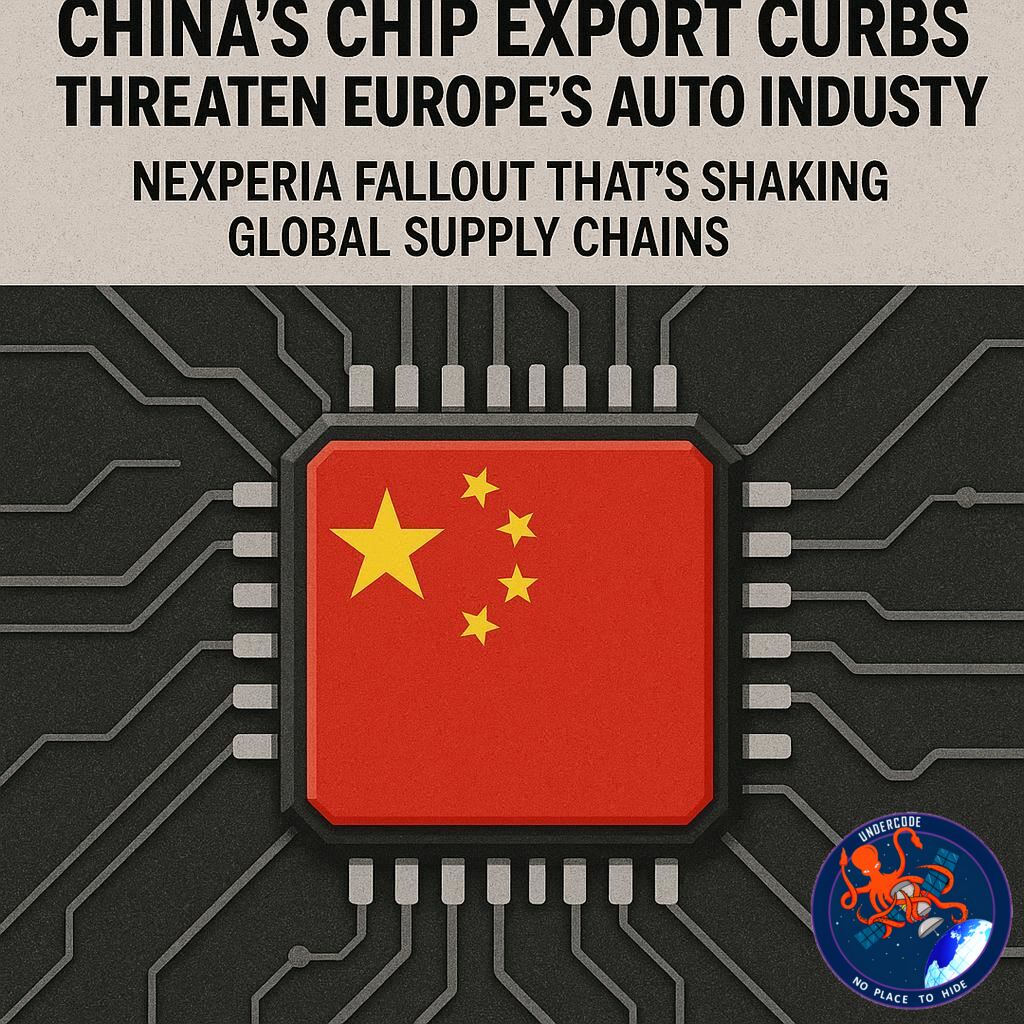
A quiet storm is brewing in the global automotive industry, one that could halt production lines and rattle economies. The catalyst? A bitter dispute between China and the Netherlands over chipmaker Nexperia. What began as a national security concern has now spiraled into a geopolitical clash with real-world consequences for Europe’s carmakers. As China retaliates with export restrictions on chips and automotive components, Europe’s industrial heartland—especially Germany—finds itself bracing for another supply chain shock.
🚗 Europe’s Auto Giants Brace for Impact
China’s new export controls on semiconductors and car parts, triggered by the Dutch government’s seizure of Chinese-owned chipmaker Nexperia, have set off alarm bells across Europe. The move underscores the deepening technological and trade rivalry between China and the West, echoing past disruptions that crippled industries during the pandemic years.
Volkswagen, Europe’s largest car manufacturer, was among the first to sound the alarm. The company issued a memo warning employees of possible production stoppages due to looming chip shortages. According to reports, internal communications suggested that halts could begin as soon as next week, initially hitting the Golf series. While a spokesperson downplayed the timeline as “speculation,” the underlying message was clear—uncertainty looms large.
Meanwhile, Volkswagen confirmed a temporary suspension of Golf and Tiguan production at its Wolfsburg plant, though it attributed this to an unrelated inventory issue. Still, the timing raises questions about whether the company is quietly preparing for deeper disruptions.
BMW and Mercedes-Benz have also stepped into crisis management mode. Both companies told Reuters they are working closely with suppliers to secure chip availability amid escalating tensions. Across the Atlantic, General Motors CEO Mary Barra acknowledged that China’s chip restrictions “have the potential to impact production,” revealing that GM has assembled a dedicated task force to manage the situation.
⚙️ Why Nexperia Matters
At the center of the dispute lies Nexperia, a chipmaker that produces relatively simple yet crucial components used in nearly every car manufactured in Europe. These chips may not be as sophisticated as those powering smartphones or AI systems, but they are indispensable for controlling functions like braking systems, sensors, and power management.
When the Dutch government seized control of Nexperia last month, citing national security and governance concerns, it invoked the Goods Availability Act, a rarely used piece of legislation designed to safeguard key industries. Officials argued that the company had “serious governance shortcomings,” sparking accusations from Beijing of economic nationalism.
The move enraged China, whose state-owned Wingtech Technology had acquired Nexperia in 2019. In retaliation, Beijing imposed export restrictions on semiconductor materials and automotive components, effectively squeezing Europe’s supply lines.
🏛️ Diplomatic Deadlock
Efforts to defuse the situation have so far failed. On Tuesday, Dutch and Chinese economy ministers met to discuss the matter but made no progress. Insiders described the atmosphere as tense and unproductive. Meanwhile, reports from German daily Bild suggest that Volkswagen has begun talks with labor authorities about a state-backed reduced working hours plan, potentially affecting tens of thousands of workers.
Though Volkswagen has not confirmed these discussions, the report underscores growing fears that the standoff could trigger widespread job disruptions, reminiscent of the early pandemic-era supply shortages.
The broader trade climate offers little comfort. With U.S. tariffs on Chinese imports and China’s own curbs on rare earth exports, the global automotive sector is caught in a tightening geopolitical vice.
What Undercode Say:
This crisis isn’t just about chips—it’s about control. In the age of technological dominance, semiconductors have become the modern equivalent of oil, powering everything from cars to communications infrastructure. By targeting chip exports, China isn’t merely retaliating; it’s sending a signal to the West: control over supply chains equals leverage in diplomacy.
From a strategic standpoint, the Dutch government’s move against Nexperia is rooted in legitimate security concerns. Western nations have grown wary of allowing critical infrastructure to fall under the influence of foreign powers, especially when those powers are state-backed. But the timing and method of the seizure may have been miscalculated. By nationalizing Nexperia, the Netherlands inadvertently provoked a reaction that threatens its own industrial allies—Germany and the wider EU.
Volkswagen, BMW, and Mercedes-Benz represent the backbone of Europe’s economy. Any extended disruption could ripple through the entire EU, impacting employment, exports, and even energy consumption. The automotive industry accounts for roughly 7% of the EU’s GDP, making it a crucial pillar of post-pandemic recovery.
China, aware of this dependency, is playing a long geopolitical game. By restricting exports, it applies pressure not just on individual companies but on entire nations to reconsider their alignment in the broader U.S.-China tech rivalry. Europe, often caught between the two giants, now faces a difficult balancing act—defend its sovereignty or safeguard its economic stability.
The deeper concern is structural. Europe’s overreliance on foreign semiconductor manufacturing has left it vulnerable to such shocks. Despite the EU’s ambitions to boost local chip production through the European Chips Act, progress remains slow and capital-intensive. Without decisive action, Europe could find itself perpetually reactive, always a step behind the supply chain disruptions orchestrated by larger global powers.
In essence, the Nexperia case reveals a dangerous truth: economic interdependence is both a strength and a vulnerability. When politics intervene, even “simple” chips can paralyze billion-dollar industries. Unless diplomatic channels reopen and Europe accelerates semiconductor independence, this won’t be the last disruption—it’s merely the latest warning shot.
🔍 Fact Checker Results
✅ Volkswagen, BMW, and GM have confirmed concerns about potential production impacts.
✅ The Dutch government officially seized Nexperia under the Goods Availability Act.
❌ No confirmed production halts yet directly linked to chip shortages.
📊 Prediction
🌐 The standoff is likely to intensify over the coming months as both sides test each other’s economic resilience.
🚗 Expect temporary production pauses and pricing fluctuations in Europe’s car market by early 2026.
⚡ Europe may fast-track investments in semiconductor autonomy, marking a turning point in its industrial strategy.
🕵️📝✔️Let’s dive deep and fact‑check.
References:
Reported By: timesofindia.indiatimes.com
Extra Source Hub (Possible Sources for article):
https://www.twitter.com
Wikipedia
OpenAi & Undercode AI
Image Source:
Unsplash
Undercode AI DI v2
Bing
🔐JOIN OUR CYBER WORLD [ CVE News • HackMonitor • UndercodeNews ]
📢 Follow UndercodeNews & Stay Tuned:
𝕏 formerly Twitter 🐦 | @ Threads | 🔗 Linkedin | 🦋BlueSky | 🐘Mastodon


