
Listen to this Post
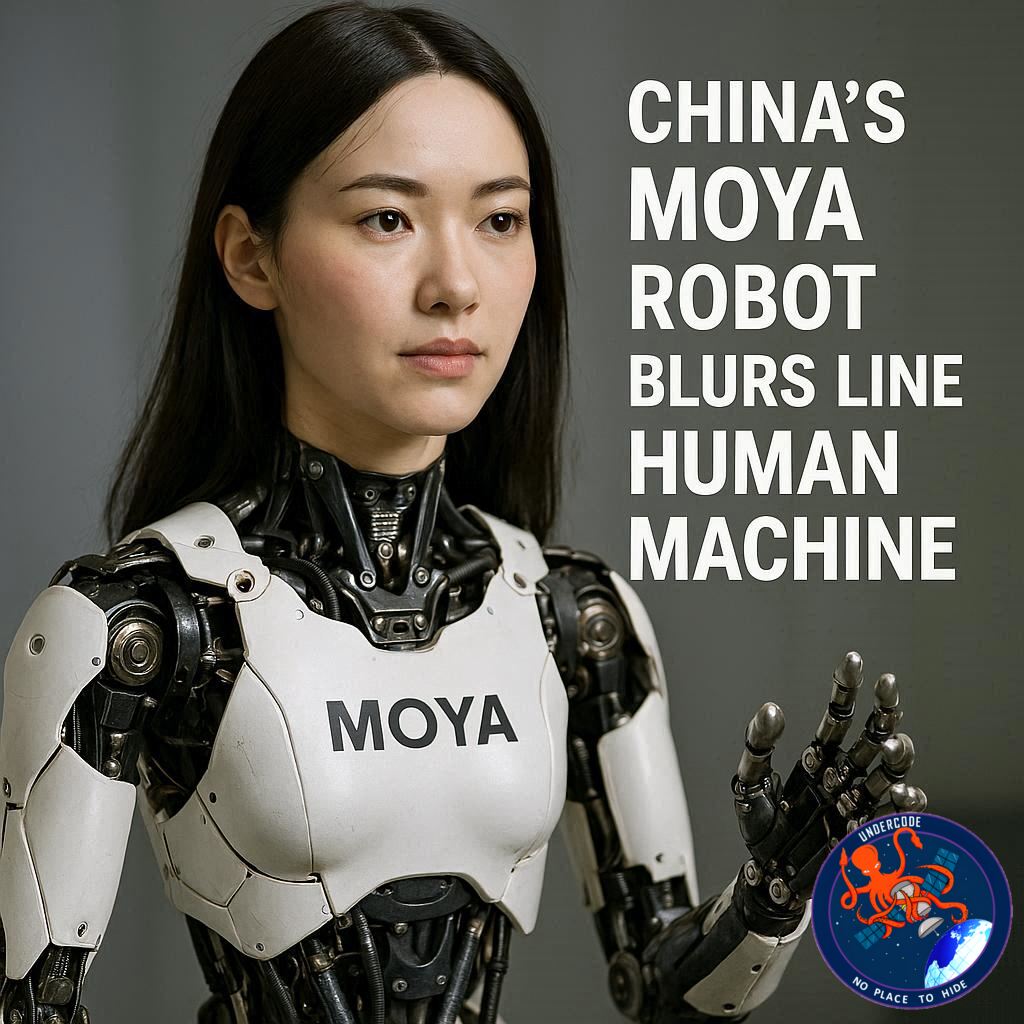
A New Era of Emotional Robotics Emerges from Shanghai
In a world where humanoid robots are no longer confined to science fiction, China has taken a bold step forward. Shanghai-based robotics company DroidUp, also known as Zhuoyide, has unveiled Moya — a humanoid robot described as the world’s first fully biomimetic embodied intelligent machine. Unlike industrial robots designed for repetitive mechanical tasks, Moya is engineered for something far more intimate: human connection.
With its lifelike skin temperature, fluid gait, and ability to express subtle emotions, Moya doesn’t just look human — it behaves in ways that challenge our perception of what machines can be. The unveiling has sparked global curiosity and debate, positioning China at the forefront of emotionally intelligent robotics.
A Robot Built to Mirror Humanity
Moya stands at 1.65 meters tall and weighs just 32 kilograms, closely resembling the proportions of an adult human. Its exterior design goes beyond cosmetic realism. The robot’s skin maintains a temperature between 32 and 36 degrees Celsius, mimicking the warmth of human touch — a subtle but powerful detail in social interaction.
Its movement system is powered by an upgraded Walker 3 chassis and lightweight lattice-structured artificial “muscles.” According to DroidUp, Moya’s walking pattern achieves 92 percent similarity to natural human gait. The result is smooth, fluid movement that avoids the stiff mechanical motion commonly associated with humanoid machines.
But Moya’s realism doesn’t stop at physical design. The robot is equipped with advanced embodied artificial intelligence capable of perceiving, reasoning, and interacting in real time within dynamic environments. This allows Moya to respond naturally during conversations, adapt to surroundings, and maintain contextual awareness.
Demonstrations shared by the South China Morning Post and Shanghai Media Group show Moya smiling, winking, nodding, maintaining eye contact, and even reproducing subtle facial micro-expressions. These capabilities create interactions that feel strikingly human, blurring the psychological boundary between machine and person.
Designed for Emotional Engagement, Not Industry
Unlike many humanoid robots that focus on manufacturing or logistics, Moya is specifically tailored for emotionally driven roles. DroidUp envisions the robot being deployed in elder care facilities, educational environments, and commercial spaces where human interaction is central.
Its modular design allows customization of appearance, making it adaptable to various service settings. Whether as a companion for seniors, a learning assistant in classrooms, or a brand ambassador in retail environments, Moya is positioned as a socially intelligent presence rather than a mechanical worker.
This shift signals a broader evolution in robotics — from automation toward emotional integration.
The Uncanny Valley Debate
Moya’s extraordinary realism has sparked mixed reactions online. Some observers find its near-human qualities unsettling, invoking the “uncanny valley” phenomenon — the discomfort people feel when something appears almost, but not entirely, human.
Others see Moya as a milestone moment in technological progress. To them, this is not unsettling but revolutionary — proof that embodied AI has reached a new threshold.
Scheduled for market launch in late 2026, Moya is expected to carry a starting price of approximately ¥1.2 million (around $160,000). With this ambitious release, China reinforces its commitment to leading the next generation of socially intelligent machines.
What Undercode Say:
Emotional Robotics Is the Real Battlefield
The unveiling of Moya highlights a crucial shift in the robotics industry. The future competition is no longer just about speed, strength, or industrial efficiency. It is about emotional intelligence.
Robots that can lift heavy objects are valuable. Robots that can interpret human emotion, maintain eye contact, and respond with empathy — that is an entirely different level of technological influence.
China’s investment in embodied AI suggests a long-term strategy. Emotional robotics will likely become central in aging societies, especially in countries facing labor shortages in healthcare and education. Moya is not just a product; it is a signal.
Embodied AI Is More Than Chatbots in a Body
Many AI systems today exist as software — chatbots, voice assistants, or backend algorithms. Moya represents embodied AI, meaning intelligence integrated into a physical form capable of interacting with the real world.
This matters because physical presence changes perception. A humanoid robot that can move naturally and display micro-expressions can build trust differently than a screen-based assistant.
If Moya’s AI truly performs real-time reasoning in dynamic environments, it suggests China is accelerating development beyond simple scripted responses toward contextual intelligence.
The Psychological Impact Will Be Massive
The biggest disruption may not be technological — it may be psychological.
When machines begin to mimic warmth, gaze, and emotional nuance, human attachment patterns shift. Elder care robots that simulate empathy could improve mental well-being. But they could also blur emotional boundaries between authentic and artificial relationships.
This is where the uncanny valley debate becomes more than aesthetic discomfort. It becomes ethical.
Are we prepared for machines that can convincingly express care?
Market Strategy Reflects Premium Positioning
At roughly $160,000 per unit, Moya is clearly positioned as a high-end technology. This pricing suggests early adoption will focus on institutions rather than individual households.
However, history shows that robotics costs decline over time. If mass production scales and prices drop, emotionally intelligent humanoids could become common in public spaces within a decade.
China’s 2026 launch timeline aligns with broader national ambitions to dominate AI and robotics manufacturing globally.
A Glimpse Into Post-Industrial Society
Moya represents a philosophical transition. We are entering an era where machines are not only tools but social participants.
The question is no longer “Can robots work for us?”
It is becoming “Can robots live among us?”
That distinction changes everything.
Fact Checker Results
✅ Moya is reported to be 1.65 meters tall and weigh 32 kilograms, with a skin temperature between 32–36°C.
✅ DroidUp claims 92% similarity to natural human gait using the upgraded Walker 3 chassis.
✅ Projected release is late 2026 with a starting price around ¥1.2 million (~$160,000).
Prediction
🤖 By 2030, emotionally intelligent humanoid robots will begin appearing in high-end elder care facilities across Asia.
📈 China will accelerate commercialization of embodied AI to strengthen its global robotics leadership.
⚖️ Ethical frameworks around emotional robotics will become a major international policy debate.
🕵️📝✔️Let’s dive deep and fact‑check.
References:
Reported By: www.deccanchronicle.com
Extra Source Hub (Possible Sources for article):
https://www.medium.com
Wikipedia
OpenAi & Undercode AI
Image Source:
Unsplash
Undercode AI DI v2
Bing
🔐JOIN OUR CYBER WORLD [ CVE News • HackMonitor • UndercodeNews ]
📢 Follow UndercodeNews & Stay Tuned:
𝕏 formerly Twitter 🐦 | @ Threads | 🔗 Linkedin | 🦋BlueSky | 🐘Mastodon


