
Listen to this Post
Introduction
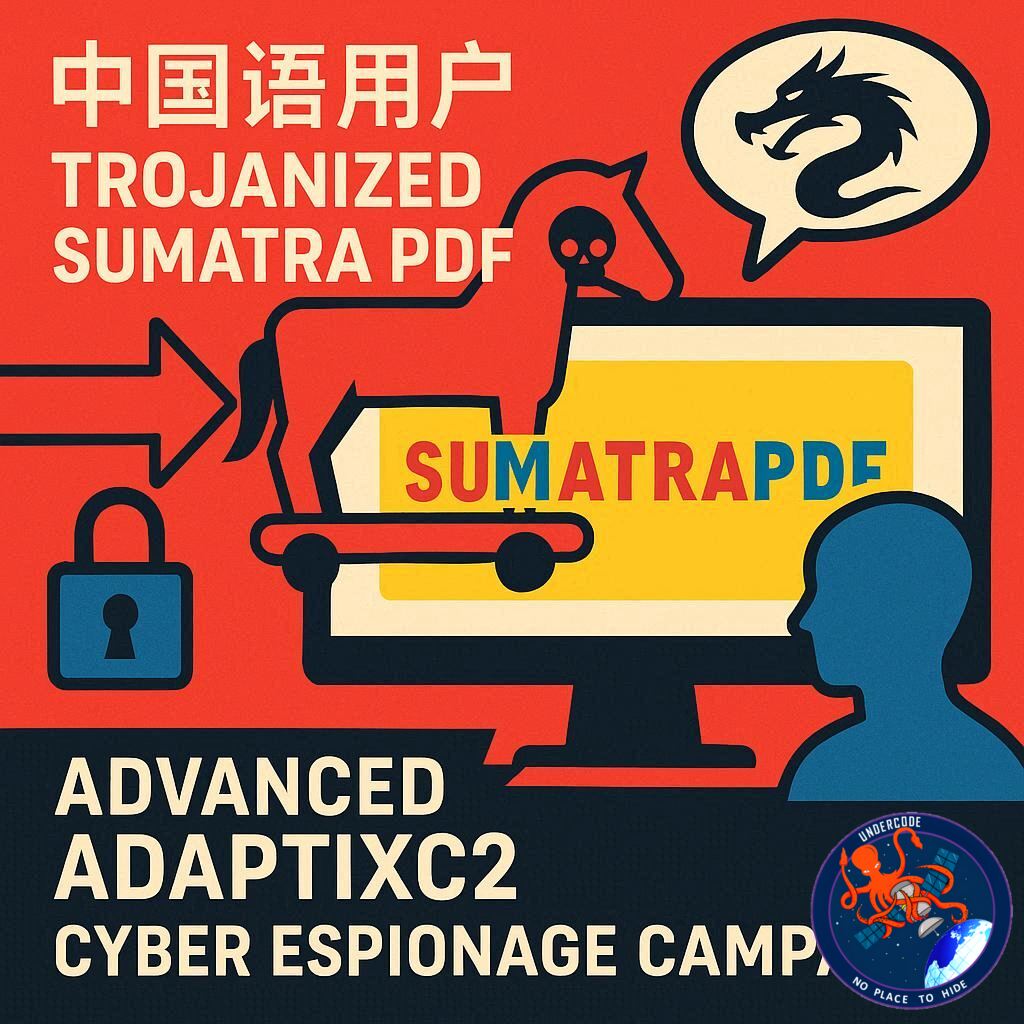
A new and highly sophisticated cyber espionage campaign is targeting Chinese-speaking individuals across East Asia, using a weaponized version of the popular SumatraPDF reader as its initial infection vector. The attackers deploy advanced post-exploitation tools, including the AdaptixC2 Beacon agent, and later abuse Microsoft Visual Studio Code (VS Code) tunnels to maintain stealthy remote access to compromised systems. Security researchers have linked the operation with high confidence to the well-known advanced persistent threat group Tropic Trooper, also tracked as APT23, Earth Centaur, KeyBoy, and Pirate Panda. This group has a long history of cyber espionage campaigns dating back over a decade, primarily focused on Taiwan, Hong Kong, and neighboring regions. The latest operation demonstrates an evolution in their tactics, particularly their shift toward modern developer tools and legitimate cloud platforms to conceal malicious activity.
the Cyber Attack Campaign
The attack begins with a carefully crafted ZIP archive distributed to victims, often disguised as military-themed or sensitive document collections designed to attract attention and encourage execution. Inside the archive is a trojanized version of SumatraPDF, a legitimate open-source PDF reader that has been modified to act as the initial malware loader.
Once executed, the malicious PDF reader displays a decoy document to avoid suspicion while simultaneously initiating hidden malicious activity in the background. At the same time, it retrieves encrypted shellcode from a remote staging server, which is used to deploy the AdaptixC2 Beacon post-exploitation agent.
This process is facilitated by a modified loader known as TOSHIS, a variant of the Xiangoop malware family, which has previously been associated with Tropic Trooper operations. Historically, Xiangoop-based tools have been used to deploy well-known frameworks such as Cobalt Strike Beacon and Merlin from the Mythic framework.
The TOSHIS loader enables a multi-stage infection chain. It ensures the victim sees only a harmless PDF while the real payload executes covertly. Once AdaptixC2 is deployed, it establishes command and control communication through GitHub, which is abused as an unconventional C2 infrastructure.
The malware periodically connects to GitHub repositories controlled by attackers, retrieving instructions and sending back data from the compromised system. This makes detection significantly more difficult, as GitHub traffic blends into normal developer activity.
The attackers then perform victim profiling. If the infected system is deemed valuable, the operation escalates. At this stage, the attackers deploy Microsoft Visual Studio Code and configure VS Code tunnels to establish secure remote access channels into the compromised environment.
In some cases, additional trojanized applications are installed to further conceal malicious presence and maintain persistence. The infrastructure supporting the operation also includes a staging server previously linked to Tropic Trooper activity, which has been observed hosting both Cobalt Strike Beacon and a custom backdoor known as EntryShell.
Researchers noted that the group has shifted away from older frameworks such as Mythic Merlin and Cobalt Strike Beacon in favor of the newer AdaptixC2 framework, signaling a tactical evolution aimed at improving stealth and resilience against detection systems.
What Undercode Say:
The campaign highlights a clear evolution in state-aligned cyber espionage techniques.
Trojanized legitimate software remains one of the most effective infection vectors in targeted attacks.
By weaponizing SumatraPDF, attackers exploit user trust in widely used open-source tools.
The use of military-themed lures suggests strong intelligence-gathering objectives.
This is consistent with long-running espionage operations in East Asia.
The multi-stage infection chain significantly reduces the chances of early detection.
Displaying a decoy PDF while executing payloads is a classic but still effective deception method.
The introduction of AdaptixC2 shows a shift toward modern, modular C2 frameworks.
Using GitHub for command and control is particularly notable.
It allows malicious traffic to blend with legitimate developer workflows.
This technique complicates traditional network-based detection systems.
The use of TOSHIS and Xiangoop variants shows continuity in Tropic Trooper tooling evolution.
The group demonstrates strong operational maturity by reusing and upgrading past malware components.
VS Code tunnels being abused is a concerning trend in enterprise security.
Attackers are increasingly leveraging developer tools as stealth backdoors.
This reduces reliance on traditional malware infrastructure.
Victim profiling before escalation indicates a selective intelligence operation rather than mass infection.
Only high-value targets are further exploited, improving operational efficiency.
The reuse of staging infrastructure tied to past campaigns strengthens attribution confidence.
It suggests persistent long-term infrastructure investment by the threat actor.
The shift away from Cobalt Strike may indicate increased detection of that tool globally.
AdaptixC2 likely offers better customization and stealth features.
The integration of multiple payload stages improves flexibility of attack execution.
Each stage reduces forensic visibility of the previous one.
The campaign reflects hybrid use of open-source and custom-built tools.
It also shows increasing reliance on legitimate platforms for malicious purposes.
Security teams must now monitor developer ecosystems more closely.
Traditional endpoint detection may struggle against such blended threats.
The attack demonstrates how espionage groups adapt quickly to defensive improvements.
Overall, this is a mature, stealth-oriented cyber espionage operation with strategic targeting.
It reinforces the trend of advanced threat actors abusing trusted software ecosystems for infiltration.
Fact Checker Results
✔ Attribution to Tropic Trooper is consistent with historical targeting patterns in East Asia
✔ Use of GitHub and VS Code tunnels aligns with modern APT stealth techniques
✔ No conflicting intelligence reported across major cybersecurity analyses
Prediction
Cyber espionage groups will likely increase abuse of developer tools like GitHub, VS Code, and cloud CI/CD platforms.
Future campaigns may further reduce custom malware in favor of legitimate software repurposing.
Detection will increasingly depend on behavioral analysis rather than signature-based security systems.
🕵️📝✔️Let’s dive deep and fact‑check.
References:
Reported By: thehackernews.com
Extra Source Hub (Possible Sources for article):
https://www.digitaltrends.com
Wikipedia
OpenAi & Undercode AI
Image Source:
Unsplash
Undercode AI DI v2
Bing
🔐JOIN OUR CYBER WORLD [ CVE News • HackMonitor • UndercodeNews ]
📢 Follow UndercodeNews & Stay Tuned:
𝕏 formerly Twitter 🐦 | @ Threads | 🔗 Linkedin | 🦋BlueSky | 🐘Mastodon


