
Listen to this Post
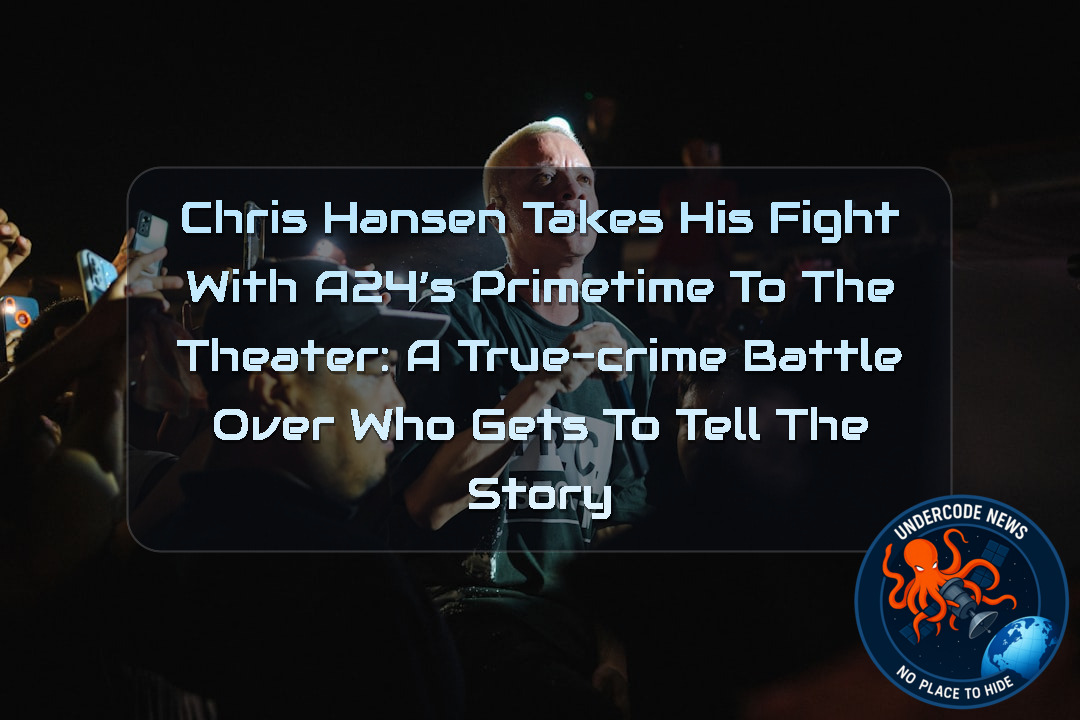 A Movie About a Real Controversy Is Now Creating One of Its Own
Few true-crime stories have remained as culturally recognizable as Chris Hansen’s work on To Catch a Predator. Years after the original television series became a defining piece of early reality-crime television, Hansen is once again stepping into the spotlight, this time because Hollywood is telling a dramatized version of the story that made him famous.
The twist is almost surreal.
Rather than quietly watching A24’s upcoming film Primetime arrive in theaters, Hansen has reportedly purchased advertisements that will run before every screening of the movie, turning the theater itself into another stage for the ongoing dispute.
His message is not simply an advertisement for his own streaming service. It is also a carefully positioned reminder that the real events behind the movie involved actual people, actual investigations, legal consequences, and tragedies that cannot necessarily be captured by a Hollywood screenplay.
And that creates a fascinating question: when a filmmaker dramatizes a controversial real-life story, who gets to define what is true?
Hansen Returns With a Familiar Line
According to reporting from The Hollywood Reporter,
“I’m going to need everyone in the theater to take a seat right over there.”
The setup immediately evokes the imagery that made Hansen one of the most recognizable faces in television’s predator-sting era.
But instead of confronting a suspect, Hansen uses the moment to promote his own true-crime streaming platform, TruBlu.
The QR Code Turns the Theater Into a Marketing Funnel
The advertisement reportedly continues with Hansen warning viewers that online platforms have created even more places where disturbing crimes can occur.
He then directs viewers toward TruBlu, with a QR code appearing on screen.
The strategy is clever because the audience watching Primetime is already there because of an interest in the story surrounding Hansen and his investigations.
Instead of treating the film as an isolated entertainment product, Hansen’s campaign attempts to redirect that curiosity toward his own platform.
What Is TruBlu?
TruBlu is a true-crime streaming network co-founded and co-owned by Hansen.
The service focuses on undercover operations, investigative reporting, crime documentaries, and related programming.
That makes the timing particularly significant.
People arriving at theaters to watch a fictionalized portrayal of Hansen’s career are being given an immediate alternative: watch the real Hansen conduct investigations and tell stories through his own platform.
In other words, the marketing campaign is not simply saying, “Watch my service.”
It is implicitly asking audiences to compare Hollywood’s version of Hansen with Hansen’s version of Hansen.
Hansen Apparently Wanted a Sharper Attack
The advertisement could have been even more confrontational.
According to The Hollywood Reporter,
That wording ultimately disappeared from the final advertisement.
The reason, according to the report, was concern about potential backlash from A24.
That small change is revealing.
It suggests Hansen and his team wanted to draw a very clear line between the historical events and the movie, but ultimately chose a less directly antagonistic message.
A24’s Film Takes Creative Liberties
Primetime is not being presented as a conventional documentary.
The movie is a dramatization inspired partly by a 2007 Esquire article written by Luke Dittrich.
That article examined the story of Texas District Attorney Bill Conradt, who became the target of one of Hansen’s predator stings and later died by suicide.
The subject matter therefore goes considerably deeper than the familiar television image of Hansen confronting predators on camera.
It involves questions about journalism, law enforcement, television entertainment, public humiliation, ethics, tragedy, and the consequences of turning real investigations into mass entertainment.
Robert Pattinson Plays Chris Hansen
One of the
Pattinson is an actor whose career has repeatedly moved between blockbuster filmmaking and unconventional dramatic projects.
His portrayal of Hansen therefore gives Primetime an opportunity to reinterpret the television personality through a cinematic lens.
But it also creates another layer of separation between reality and dramatization.
Audiences are not watching Hansen.
They are watching Pattinson play a fictionalized cinematic interpretation of Hansen.
That distinction matters enormously when the subject himself is still alive, active, and publicly commenting on the production.
Hansen Declined an Early Screening
The disagreement became more serious when Hansen revealed that he had declined an opportunity to see the film before release.
During an interview with Fox News, Hansen claimed that A24 wanted him to sign what he described as an extremely restrictive agreement before viewing the movie.
He said the proposed agreement involved rights concerning his name, image, brand, and potential legal rights connected with the film.
Hansen questioned why he should accept those conditions simply to watch a movie about his own life and career.
Who’s Going to Sign Something Like That?
Hansen’s objection was straightforward.
From his perspective, being asked to sign an agreement before seeing a dramatization about himself raised obvious concerns about what he might be surrendering.
He also claimed that other people had been able to see the film without signing the same type of agreement.
That apparently made the situation even more frustrating for him.
Hansen ultimately left without watching the movie.
Sources Close to A24 Dispute
There is, however, another side to the story.
Sources close to the situation reportedly told The Hollywood Reporter that Hansen was not being asked to surrender broad rights to his identity.
Instead, they characterized the requested agreement as a standard nondisclosure agreement designed to prevent spoilers and protect A24’s intellectual property.
That is a dramatically different interpretation.
Hansen described the agreement as potentially affecting his rights.
A24’s side reportedly describes it as ordinary confidentiality protection.
Without seeing the actual agreement, outside observers cannot independently determine which characterization best reflects its precise language.
Why the Dispute Matters
The disagreement is bigger than one actor, one host, or one movie.
It represents a recurring problem in entertainment: how do filmmakers tell real stories when the people portrayed in those stories disagree with the interpretation?
Hollywood has been dramatizing real events for decades.
Names are changed.
Scenes are reconstructed.
Timelines are compressed.
Characters are combined.
Motivations are imagined.
Dialogue is invented.
All of those techniques can make a movie more compelling.
But they can also create a version of history that feels authentic while containing substantial fictional material.
The Based on a True Story Problem
There is a psychological difference between watching a documentary and watching a dramatic film based on real events.
A documentary generally asks the viewer to believe that the footage and testimony represent evidence.
A dramatic film asks the viewer to emotionally experience a version of events.
That difference becomes particularly important when the story involves living people.
The audience may remember the cinematic portrayal more vividly than the historical record.
For Hansen, that appears to be one reason the dispute matters.
The
Primetime has an unusual storytelling problem.
The central figure is not a historical personality who exists only in archival footage.
Hansen is still here.
He can respond.
He can criticize the movie.
He can promote his own interpretation.
And now he can potentially reach audiences immediately before they watch the film.
That makes the marketing campaign unusually powerful.
Hansen Is Fighting for the Narrative
The theater advertisements can be interpreted as a battle over narrative ownership.
A24 controls the movie.
Robert Pattinson controls the performance.
The filmmakers control the screenplay and editing.
But Hansen controls his own platform.
TruBlu gives him a direct channel to audiences without needing Hollywood’s permission.
That changes the traditional power balance.
The Theater Becomes Part of the Story
There is something almost cinematic about
Imagine buying a ticket to see an actor portray Chris Hansen, sitting down in a theater, and then seeing the real Chris Hansen appear on screen before the movie begins.
It creates a strange collision between reality and fiction.
The real person appears to say, essentially: before you watch their version of me, hear mine.
That is an extremely effective marketing concept.
A24 May Have Created an Unintended Competitor
A24’s decision to make a movie about Hansen naturally generates renewed interest in Hansen himself.
That means every article about Primetime, every interview about the film, and every conversation about its accuracy can potentially drive attention toward TruBlu.
The movie becomes free publicity for the person it dramatizes.
Hansen’s advertising strategy takes that effect one step further by placing his message directly in front of the movie’s target audience.
The Ethics Are Complicated
The story behind Primetime is particularly sensitive because it involves the death of Bill Conradt.
That means this
Real people suffered real consequences.
The events raise difficult questions about how investigations were conducted, how television audiences consumed them, and where the line between journalism and entertainment should be drawn.
A dramatic movie has to navigate that territory without pretending the underlying controversies never existed.
True Crime Has Always Walked a Dangerous Line
True crime is one of
Audiences are fascinated by investigations, mysteries, criminals, investigators, courtroom battles, and the psychology behind extraordinary events.
But the people inside those stories are often not fictional characters.
They are victims, suspects, families, investigators, journalists, lawyers, and communities.
When Hollywood transforms those experiences into entertainment, disagreements about accuracy are almost inevitable.
The Hansen Controversy Is Perfectly Timed
The timing could hardly be more interesting.
The modern entertainment ecosystem is increasingly dominated by streaming platforms, social media personalities, podcasts, YouTube investigations, and independent creators.
A traditional studio can no longer completely control the public conversation surrounding a movie.
If someone dislikes a
Hansen’s TruBlu platform demonstrates exactly how that new media environment works.
A Battle Between Two Versions of Reality
At its core, Primetime creates two competing narratives.
One is the Hollywood narrative.
It is carefully scripted, performed, edited, scored, and distributed by a major entertainment company.
The other is
It comes directly from the person who lived the public portion of the story and now has his own media platform.
Neither automatically becomes the complete truth simply because it comes from one side.
The audience has to recognize that both are constructed narratives.
Why Viewers Should Be Careful
The most responsible way to watch Primetime is to treat it as a dramatic interpretation rather than a historical transcript.
A compelling performance does not prove that a scene happened exactly as shown.
A dramatic confrontation does not establish that the dialogue was real.
A movie’s emotional impact does not automatically establish historical accuracy.
That distinction is essential whenever entertainment recreates controversial real-world events.
The Power of a Hollywood Interpretation
At the same time, dismissing the film simply because Hansen dislikes it would also be too simplistic.
Filmmakers have the right to interpret complicated historical events.
A dramatization can explore questions that a conventional documentary might avoid.
It can examine motivations, consequences, ethical conflicts, and uncomfortable contradictions.
The important question is whether audiences understand where documented history ends and dramatic invention begins.
The Real Winner May Be the Audience
There is an unexpected upside to this controversy.
The dispute may encourage people to investigate the original events rather than accepting a single cinematic version.
Someone who watches Primetime may search for the original Esquire article.
Another viewer may watch
Someone else may investigate the Conradt case.
That is potentially more valuable than simply arguing over whether the movie is “accurate.”
A Strange Full-Circle Moment
Hansen became famous by placing himself at the intersection of hidden cameras, television entertainment, crime investigations, and public exposure.
Now, decades later, he finds himself on the other side of the camera.
Hollywood is observing him.
An actor is portraying him.
A studio is dramatizing his professional history.
And Hansen is responding by creating his own production inside the very theater where audiences are preparing to watch the dramatization.
The irony is difficult to miss.
September 25 Could Become More Than a Movie Release
Primetime is scheduled to arrive in theaters on September 25, 2026.
By then, the controversy surrounding the film may become almost as interesting as the movie itself.
The debate over accuracy, dramatization, privacy, storytelling rights, and Hansen’s relationship with A24 could generate significant attention during the theatrical run.
And every conversation about the movie potentially gives Hansen another opportunity to promote his own interpretation.
Deep Analysis
Why the Advertising Strategy Is So Unusual
Buying advertising before screenings is normal.
Buying advertising before every screening of a movie about yourself, however, is an entirely different strategy.
Hansen is effectively targeting an audience that has already demonstrated interest in his story.
That makes the campaign unusually efficient.
Contextual Advertising at Its Most Aggressive
Traditional advertising often depends on demographic targeting.
This campaign does not need sophisticated targeting.
The theater itself performs the targeting.
Anyone sitting down to watch Primetime is already interested in the subject.
That means
Narrative Interruption
The advertisement also functions as a narrative interruption.
The audience expects to see a movie.
Instead, they first see the actual person being portrayed.
That creates an immediate psychological contrast between the real Hansen and Pattinson’s interpretation.
Search Behavior Could Amplify the Effect
Viewers who see the QR code may scan it immediately.
Others may search for Hansen online after the screening.
Either way, the movie creates demand for
This is an example of how modern entertainment can generate secondary attention outside the original product.
The Streaming Advantage
Traditional television personalities depended on networks.
Modern media personalities can build their own distribution channels.
TruBlu gives Hansen a direct relationship with viewers.
That makes a dispute with a studio considerably less risky than it might have been twenty years ago.
Hollywood No Longer Controls the Entire Narrative
The internet has fundamentally changed celebrity disputes.
A studio can release a statement.
The subject can release a video.
Fans can debate both sides.
Journalists can investigate the claims.
Creators can produce reaction videos.
The narrative becomes decentralized almost instantly.
The NDA Dispute Shows Why Language Matters
The disagreement over the alleged NDA is particularly important.
There is a major difference between an agreement that restricts disclosure of spoilers and one that transfers or limits rights over someone’s name, image, or legal claims.
Those are not interchangeable concepts.
Without reviewing the document itself, audiences should be cautious about treating either characterization as definitively proven.
The Legal Questions Are Separate From the Creative Questions
Hansen can dislike the movie without having a legal claim against it.
Likewise, a studio can legally produce a dramatization while still facing criticism about its artistic choices.
Copyright, publicity rights, defamation, privacy, and First Amendment issues can become complicated very quickly when real people are portrayed in fictionalized stories.
The exact legal situation depends heavily on jurisdiction and the facts.
Commands for Researchers Investigating the Story
For journalists, researchers, and technically minded readers, basic command-line tools can help organize publicly available reporting.
Search the Web Archive of Local Research
curl -L "https://example.com/article" -o article.html
This can be useful when working with a publicly accessible webpage that you have permission to retrieve.
Extract Visible Text
python -m pip install beautifulsoup4
Then a simple Python workflow can parse HTML:
Run
from bs4 import BeautifulSoup
with open("article.html", "r", encoding="utf-8") as f:
soup = BeautifulSoup(f, "html.parser")
text = soup.get_text("
", strip=True)
print(text)
Search a Local Research Folder
grep -Rni "Chris Hansen" ./research/
This can help identify every local document mentioning Hansen.
Compare Multiple Sources
grep -RniE "A24|Primetime|TruBlu|NDA|Conradt" ./research/
Researchers can then manually compare claims rather than relying on a single article.
Technology Can Help Fact-Check, But It Cannot Decide History
Automated tools can locate names, dates, contradictions, and repeated claims.
They cannot automatically determine whether a dramatized scene represents historical truth.
That still requires primary sources, documentation, interviews, court records where appropriate, and careful journalistic judgment.
The Bigger Media Lesson
The Hansen situation demonstrates something increasingly important about modern entertainment.
A film is no longer the end of a story.
It is the beginning of a conversation.
The people portrayed in a production can respond immediately.
The audience can investigate immediately.
And competing platforms can use the controversy to build their own audiences.
A24’s Position Is Also Understandable
From the
A film nearing theatrical release contains plot points, performances, production choices, and other material that studios generally do not want publicly disclosed before release.
An NDA can therefore be a standard part of screening arrangements.
The important issue is not simply whether an NDA existed, but what its actual terms required.
Hansen’s Position Is Also Understandable
From
If he genuinely believed the agreement affected his rights beyond ordinary confidentiality, refusing to sign would be a rational choice.
That disagreement does not automatically prove wrongdoing by either side.
The Public Is Left in the Middle
The audience is ultimately left with competing accounts.
Hansen says one thing.
Sources close to the production say another.
The movie will present its own interpretation.
The original historical record will provide another layer.
The challenge is separating all four.
The Most Interesting Part May Be What Happens After Release
Once Primetime reaches theaters, viewers will begin comparing what they saw with what they know about Hansen’s career.
That could produce new criticism, new reporting, and potentially new public discussion about the original events.
In that sense, the movie could reopen a story that has never entirely disappeared from American popular culture.
This Is Bigger Than Chris Hansen
The controversy touches a much larger question.
Who owns a
Can Hollywood transform
Does a famous person deserve more control over a fictionalized portrayal?
How much creative freedom should filmmakers have?
And how much responsibility does a studio have when real people and real tragedies form the foundation of a screenplay?
There are no easy answers.
The Theater Campaign Is a Strategic Masterstroke
Regardless of one’s opinion about the controversy, Hansen’s marketing strategy is difficult to ignore.
He has found a way to place himself directly in front of the audience immediately before they watch an actor portray him.
That is not merely advertising.
It is narrative positioning.
And in the attention economy, positioning can be everything.
The Most Important Question
Perhaps the most revealing question is not whether Hansen likes Primetime.
It is whether audiences can watch the movie, recognize its dramatic nature, and still take the underlying real-world events seriously.
If they can, the controversy may ultimately serve a useful purpose.
It may remind audiences that behind every “true story” label are real people whose lives cannot always be compressed into a two-hour screenplay.
What Undercode Say:
The Real Conflict Is About Control
The most fascinating aspect of this story is not the advertisement itself.
It is the fight over who controls the interpretation of Hansen’s legacy.
Hollywood Has the Camera
A24 has the filmmaking machinery.
It has actors, writers, directors, editors, cinematographers, marketers, and theatrical distribution.
That infrastructure gives the studio enormous narrative power.
Hansen Has the Platform
But Hansen has something increasingly valuable: direct access to an audience.
Through TruBlu and social media, he does not need a traditional television network to respond.
He can publish his own version whenever he wants.
The QR Code Is More Important Than It Looks
The QR code is not merely a promotional device.
It symbolizes the transition from traditional media to platform-based media.
The viewer moves directly from the theater to Hansen’s digital ecosystem.
The Advertisement Creates a Psychological Anchor
Seeing the real Hansen immediately before watching Pattinson portray him can influence how viewers interpret the performance.
The audience now has a fresh image of the real person in mind.
That can make every dramatic choice feel more artificial.
This Could Benefit Both Sides
Paradoxically, controversy can help the film.
People become curious.
Curiosity creates searches.
Searches generate coverage.
Coverage creates awareness.
Awareness sells tickets.
Hansen Also Benefits
Hansen gets exposure to a highly targeted audience.
People interested enough to buy tickets for Primetime are precisely the people most likely to be interested in true-crime programming.
That makes the campaign commercially logical.
A24 Gets Free Publicity
A24 also benefits from the controversy.
The disagreement gives journalists another reason to cover the movie.
That keeps Primetime in cultural conversations before release.
The Conradt Story Makes Everything More Sensitive
The underlying tragedy prevents this from being treated as a simple celebrity feud.
A real death sits at the center of the story.
That should encourage viewers to approach the film with more skepticism and seriousness.
Dramatization Is Not Documentation
A movie can communicate emotional truth without reproducing factual events perfectly.
That distinction is critical.
A scene can be dramatically effective while still being historically inaccurate.
Audiences Often Forget That Difference
Once viewers become emotionally invested in a film, fictionalized scenes can feel like memories.
That is one of the most powerful effects of cinema.
It is also one of the biggest risks of dramatizing real events.
Pattinson’s Performance Will Shape Perception
Robert
That is a significant cultural development.
Actors can sometimes become more memorable than the real people they portray.
Hansen Understands the Power of Image
His entire career was built around television imagery.
He knows that presentation matters.
Therefore, responding to a cinematic portrayal through another visual production is perfectly consistent with the media world that made him famous.
The Advertisement Is Almost Meta-Cinema
The real Hansen appears before a fictional Hansen.
That is almost a movie about the movie.
The boundary between reality and performance becomes part of the entertainment itself.
The NDA Dispute Needs Evidence
Claims about legal agreements should not be accepted solely because one side makes them.
The actual document would be much more informative.
Without it, observers should distinguish allegations from verified facts.
Standard NDAs Are Common
Studios routinely use confidentiality agreements around unreleased projects.
That alone is not suspicious.
The controversy depends on what Hansen was actually asked to agree to.
The Marketing Campaign Is Highly Targeted
Unlike broad television advertising, the campaign reaches a self-selected audience.
Every viewer has already demonstrated interest in the story.
That is extremely valuable advertising real estate.
The Campaign Also Builds TruBlu
Even viewers who never subscribe immediately may now recognize the platform.
Brand awareness can have long-term value.
This Is the Streaming Era in Action
A television personality can now own the platform through which he answers Hollywood.
That was much harder during the original To Catch a Predator era.
Media Power Has Become Fragmented
Studios still have enormous resources.
But individuals now have distribution tools that were once reserved for corporations.
That makes public disputes more dynamic.
Controversy Is No Longer Contained
A disagreement that once might have appeared in a magazine interview can now spread across social platforms within hours.
Every side can publish.
Every side can respond.
The Audience Becomes the Judge
Viewers will ultimately decide which interpretation feels credible.
But emotional reactions should not replace historical research.
The Film Could Trigger Renewed Investigation
A new generation may discover the original controversies through Primetime.
That could lead people toward archival reporting and historical sources.
That Could Be the Best Outcome
If the movie encourages deeper examination rather than passive consumption, it can become more than entertainment.
It can become an entry point into a complicated chapter of media history.
Hansen’s Strategy Shows Confidence
Someone who buys advertisements directly against a film about himself is clearly unwilling to disappear quietly into the background.
He wants to participate in the conversation.
A24’s Film Still Has Creative Value
The existence of disagreement does not automatically invalidate the movie.
Filmmakers can explore difficult questions precisely because they are not producing a conventional documentary.
The Audience Needs Context
The strongest viewers will understand that multiple versions of the story can exist simultaneously.
The movie can be a work of art.
Hansen’s account can be a personal perspective.
Historical reporting can provide additional evidence.
The Real Story Is Probably More Complicated
Most major real-world controversies do not fit neatly into heroes and villains.
That is especially true when journalism, entertainment, law enforcement, ethics, and tragedy overlap.
The Marketing War Could Continue After Release
Hansen’s response may not end when the movie opens.
Reviews, interviews, social posts, and additional TruBlu content could keep the dispute alive.
The Film Could Become More Famous Because of the Fight
Ironically, the controversy may make Primetime more culturally significant than it would have been otherwise.
People love stories about stories.
The Theater Ads Are a Brilliant Conversation Starter
Whatever viewers think about
And memorable marketing is often effective marketing.
The Final Lesson Is About Narrative Ownership
In the modern media landscape, telling
The subject can answer.
The audience can investigate.
And competing platforms can challenge the official version.
Undercode’s Bottom Line
Primetime is shaping up to be more than a movie about Chris Hansen.
It is becoming a real-time demonstration of how Hollywood, streaming platforms, personal branding, and historical storytelling collide.
And perhaps the most ironic part is that Hansen, the man famous for putting people under the spotlight, now finds himself fighting to control what that spotlight reveals.
Prediction
(+1) The Controversy Will Increase Interest in Primetime
The dispute between Hansen and A24 is likely to generate additional curiosity before the September 25 release.
People who had never heard of the movie may discover it because of the controversy.
(+1) TruBlu Could Receive a Significant Attention Boost
The theater campaign places Hansen’s streaming service directly in front of an unusually relevant audience.
Even a modest conversion rate could make the campaign valuable beyond immediate publicity.
(+1) Hansen Will Continue Promoting His Own Version
It would be surprising if Hansen stopped responding once the movie arrives.
Interviews, commentary, social media posts, and TruBlu programming could extend the conversation.
(+1) Audiences Will Debate Accuracy
Expect discussions about which scenes are based on documented events and which are dramatic inventions.
That debate could become one of the film’s biggest sources of online attention.
(-1) The Controversy Could Overshadow the Film
If the disagreement becomes too dominant, audiences may focus more on the behind-the-scenes dispute than on the filmmaking itself.
That could make Primetime difficult to evaluate strictly as a movie.
(-1) Historical Nuance Could Be Lost
The more the conversation becomes a battle between “Hansen’s version” and “Hollywood’s version,” the greater the risk that the complicated history underneath both gets reduced to a simple argument.
(+1) The Story Could Renew Interest in the Original Events
The strongest long-term outcome would be audiences using the movie as a starting point for researching the actual history behind it.
That could lead to renewed attention toward the reporting, investigations, and ethical questions that inspired the film.
✅ Chris Hansen Is Connected to TruBlu
The article accurately identifies TruBlu as a true-crime-focused streaming platform associated with Hansen. Its programming centers on investigations, undercover operations, documentaries, and related crime content.
✅ Primetime Is Scheduled for September 25, 2026
The supplied article states that A24’s Primetime, starring Robert Pattinson as Chris Hansen, is scheduled for a theatrical release on September 25, 2026.
✅ The Film Draws From Real Events
The story accurately presents Primetime as a dramatized project inspired in part by Luke Dittrich’s 2007 Esquire reporting concerning Bill Conradt and the predator-sting operation.
❌ The NDA Claims Cannot Be Treated as Settled Fact
Hansen and sources close to A24 reportedly offered materially different descriptions of the agreement he was asked to sign. Without the actual document, claims that he was required to surrender particular rights should be treated as disputed rather than conclusively established.
✅ The Advertisement’s Strategy Is Consistent With the Reported Story
The supplied report describes Hansen purchasing advertising connected with screenings of Primetime and using the campaign to promote TruBlu. The unusual strategy is central to the story and explains why the dispute has attracted attention.
⚠️ Hollywood Dramatization Should Not Be Confused With Documentary Evidence
The film is a dramatization, meaning audiences should not assume every scene, conversation, or characterization represents a literal reconstruction of historical events. The distinction between documented fact and cinematic interpretation will be particularly important when the movie reaches theaters.
▶️ Related Video (66% Match):
🕵️📝Let’s dive deep and fact‑check.
🎓 Live Courses & Certifications:
Join Undercode Academy for Verified Certifications
🚀 Request a Custom Project:
Secure, high-velocity infrastructure and disruptive technological engineering. Contact our engineering team for high-tier development and proprietary systems:
[email protected]
💎 Smart Architecture | 🛡️ Secure by Design | ⭐ Trusted by Thousands
References:
Reported By: www.ign.com
Extra Source Hub (Possible Sources for article):
https://www.instagram.com
Wikipedia
OpenAi & Undercode AI
Image Source:
Unsplash
Undercode AI DI v2
🔐JOIN OUR CYBER WORLD [ CVE News • HackMonitor • UndercodeNews ]
📢 Follow UndercodeNews & Stay Tuned:
𝕏 formerly Twitter 🐦 | @ Threads | 🔗 Linkedin | 🦋BlueSky | 🐘Mastodon | 📺Youtube


