
Listen to this Post
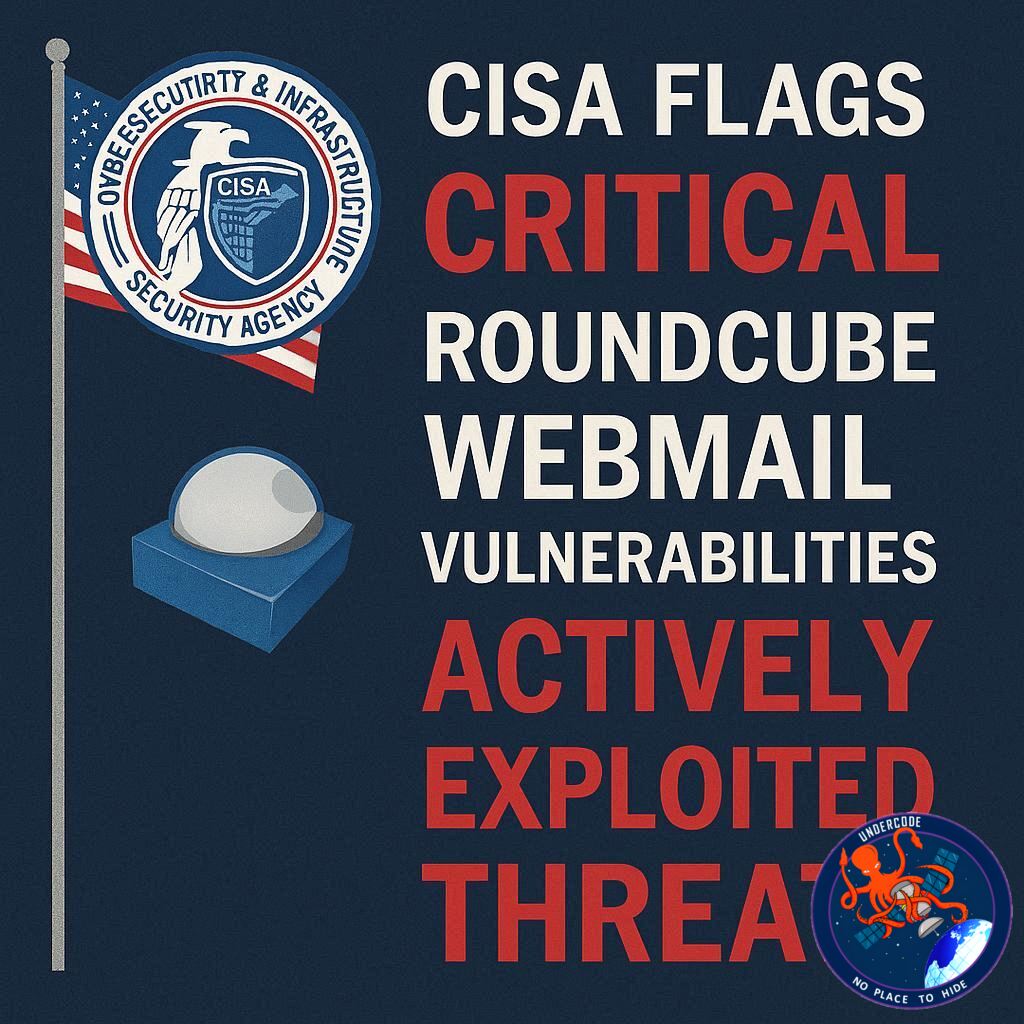
A Decade-Old Flaw Resurfaces as a National Cybersecurity Priority
The U.S. Cybersecurity and Infrastructure Security Agency has formally added two serious Roundcube Webmail vulnerabilities to its Known Exploited Vulnerabilities catalog, signaling that these flaws are not theoretical risks but active threats. The move places urgent pressure on federal agencies and private organizations to patch their systems before attackers gain further ground. Roundcube, widely deployed across hosting environments and enterprise email systems, now finds itself once again at the center of global cyber espionage concerns.
CISA Expands the Known Exploited Vulnerabilities Catalog with Roundcube Flaws
CISA’s inclusion of the Roundcube vulnerabilities in the KEV catalog underscores the severity of the situation. The catalog tracks vulnerabilities that are actively exploited in the wild and pose significant risks to government and enterprise infrastructure. When a flaw lands on this list, remediation becomes mandatory for federal agencies under Binding Operational Directive 22-01. This is not merely advisory guidance; it is a compliance requirement designed to reduce systemic cyber risk across federal networks.
CVE-2025-49113: Remote Code Execution via PHP Object Deserialization
The most alarming vulnerability added is CVE-2025-49113, a deserialization of untrusted data flaw that enables remote code execution. According to the advisory published by the National Institute of Standards and Technology, the issue stems from improper validation of the _from parameter in a specific Roundcube script. By manipulating this parameter, authenticated attackers can trigger PHP object deserialization, ultimately executing arbitrary code on the target server.
This flaw affects Roundcube versions before 1.5.10 and 1.6.x before 1.6.11. It remained undiscovered for more than a decade, a sobering reminder that legacy code can conceal high-impact weaknesses for years. The vulnerability was identified by Kirill Firsov, founder and CEO of FearsOff, who revealed that its reach could extend to over 53 million hosts at the time of discovery. Given Roundcube’s integration with hosting control panels such as cPanel, Plesk, ISPConfig, and DirectAdmin, the attack surface is vast.
A Platform Frequently Targeted by Advanced Threat Groups
Roundcube has long been a favored target for state-sponsored hacking groups. Advanced persistent threat actors such as APT28 and Winter Vivern have previously exploited weaknesses in the platform to harvest login credentials and intercept sensitive communications. Webmail systems are high-value assets in cyber espionage operations because they provide direct access to internal conversations, attachments, and authentication tokens.
The repeated targeting of Roundcube demonstrates a strategic focus by adversaries on email infrastructure, which often acts as both a communication hub and a pivot point for broader network compromise. Unpatched systems, particularly those belonging to government agencies, diplomatic missions, or defense contractors, represent attractive targets.
Positive Technologies Confirms Exploit Reproduction
Researchers from Positive Technologies have confirmed that they successfully reproduced the CVE-2025-49113 exploit in a controlled environment. This technical validation reinforces concerns that the vulnerability is practical and weaponizable. Security experts strongly advise immediate updates to patched versions 1.6.11 or 1.5.10 LTS to mitigate the risk.
When researchers publicly reproduce exploits, it typically accelerates adversarial interest. Proof-of-concept availability often shortens the timeline between disclosure and widespread exploitation.
CVE-2025-68461: Cross-Site Scripting via SVG Animation Tag
The second vulnerability added to the KEV catalog is CVE-2025-68461, a cross-site scripting flaw. This issue affects Roundcube versions before 1.5.12 and 1.6 before 1.6.12. The vulnerability arises from improper handling of the animate tag within SVG documents, allowing attackers to inject malicious scripts into webmail sessions.
Cross-site scripting vulnerabilities may appear less dramatic than remote code execution flaws, but in a webmail context they can be devastating. Attackers can hijack user sessions, capture authentication cookies, or manipulate displayed content. In targeted attacks, XSS can serve as the first step in a larger compromise chain.
Federal Agencies Ordered to Patch by March 10, 2026
Under Binding Operational Directive 22-01, Federal Civilian Executive Branch agencies are required to remediate the listed vulnerabilities by March 10, 2026. The directive reflects the federal government’s structured approach to vulnerability management, prioritizing flaws that are actively exploited.
Private sector organizations are also urged to review the KEV catalog and address these vulnerabilities within their own infrastructure. While not legally bound by the directive, failure to patch leaves organizations exposed to credential theft, espionage, and ransomware operations.
What Undercode Say:
The addition of these Roundcube vulnerabilities to the KEV catalog reveals something deeper than a routine patch cycle. It exposes a structural weakness in how organizations manage long-standing software components that quietly power critical communication systems. Email remains the backbone of enterprise operations, yet webmail platforms often receive less security scrutiny than perimeter defenses or endpoint protection systems.
CVE-2025-49113 is particularly troubling because of its longevity. A deserialization flaw persisting for over a decade suggests that legacy code review practices were insufficient, and that many organizations depend on software without conducting continuous security auditing. When such vulnerabilities are discovered, the immediate focus shifts to patching, but the broader question concerns supply chain trust and software lifecycle management.
Roundcube’s prevalence across hosting panels magnifies the risk. Many small and medium-sized enterprises rely on bundled webmail solutions provided by hosting companies. In such environments, patch management may depend on the hosting provider rather than the end organization. This layered dependency creates uncertainty about accountability. If one link in the chain delays updates, thousands of downstream users remain exposed.
The involvement of threat groups like APT28 signals geopolitical implications. State-sponsored actors prioritize platforms that yield intelligence value. Webmail systems grant insight into policy discussions, procurement negotiations, and internal strategy. A single compromised mailbox can reveal network diagrams, password reset links, or confidential attachments that unlock further intrusion opportunities.
The XSS flaw, while technically less severe than remote code execution, highlights another recurring weakness: client-side input validation failures. Attackers increasingly chain lower-severity vulnerabilities with social engineering to escalate access. A malicious SVG embedded in a targeted phishing email could silently execute within the victim’s webmail interface, bypassing traditional email filtering mechanisms.
CISA’s structured vulnerability catalog demonstrates progress in coordinated cyber defense, yet enforcement deadlines extending into 2026 illustrate the bureaucratic complexity of patching at scale. Large agencies operate legacy systems, custom integrations, and strict change management protocols. Rapid patch deployment is rarely simple, particularly when updates risk breaking mission-critical services.
There is also the question of detection versus prevention. Once vulnerabilities are publicly acknowledged and reproduced, threat actors often automate exploitation. Organizations that delay patching may find themselves targeted by opportunistic scanning bots rather than sophisticated espionage teams. In the modern threat landscape, exposure time directly correlates with breach probability.
Another dimension worth noting is the growing exploitation of authenticated vulnerabilities. CVE-2025-49113 requires authentication, which suggests attackers may combine it with credential stuffing or phishing to gain initial access. In practice, this means that organizations must reinforce multi-factor authentication and monitor abnormal login behavior alongside patching.
The broader cybersecurity lesson centers on resilience. Software vulnerabilities are inevitable. What determines impact is response speed, monitoring capability, and layered defense strategy. Roundcube’s case demonstrates how a widely deployed, open-source platform can become a focal point for global threat activity if patch adoption lags behind disclosure.
Ultimately, this development reinforces a simple truth: communication infrastructure is strategic infrastructure. When email systems are compromised, operational integrity, national security, and corporate reputation are all at stake.
Fact Checker Results
✅ CISA added CVE-2025-49113 and CVE-2025-68461 to the Known Exploited Vulnerabilities catalog.
✅ CVE-2025-49113 enables remote code execution through PHP object deserialization in vulnerable versions.
✅ Federal agencies must remediate listed vulnerabilities under Binding Operational Directive 22-01 by the stated deadline.
Prediction
🔮 Increased scanning and automated exploitation attempts targeting unpatched Roundcube servers are likely in the coming months.
📈 Organizations that delay updates may experience credential theft campaigns leveraging both RCE and XSS vectors.
🛡️ Broader adoption of proactive vulnerability management frameworks will accelerate as governments tighten compliance enforcement.
▶️ Related Video (88% Match):
🕵️📝✔️Let’s dive deep and fact‑check.
References:
Reported By: securityaffairs.com
Extra Source Hub (Possible Sources for article):
https://www.digitaltrends.com
Wikipedia
OpenAi & Undercode AI
Image Source:
Unsplash
Undercode AI DI v2
Bing
🔐JOIN OUR CYBER WORLD [ CVE News • HackMonitor • UndercodeNews ]
📢 Follow UndercodeNews & Stay Tuned:
𝕏 formerly Twitter 🐦 | @ Threads | 🔗 Linkedin | 🦋BlueSky | 🐘Mastodon


