
Listen to this Post
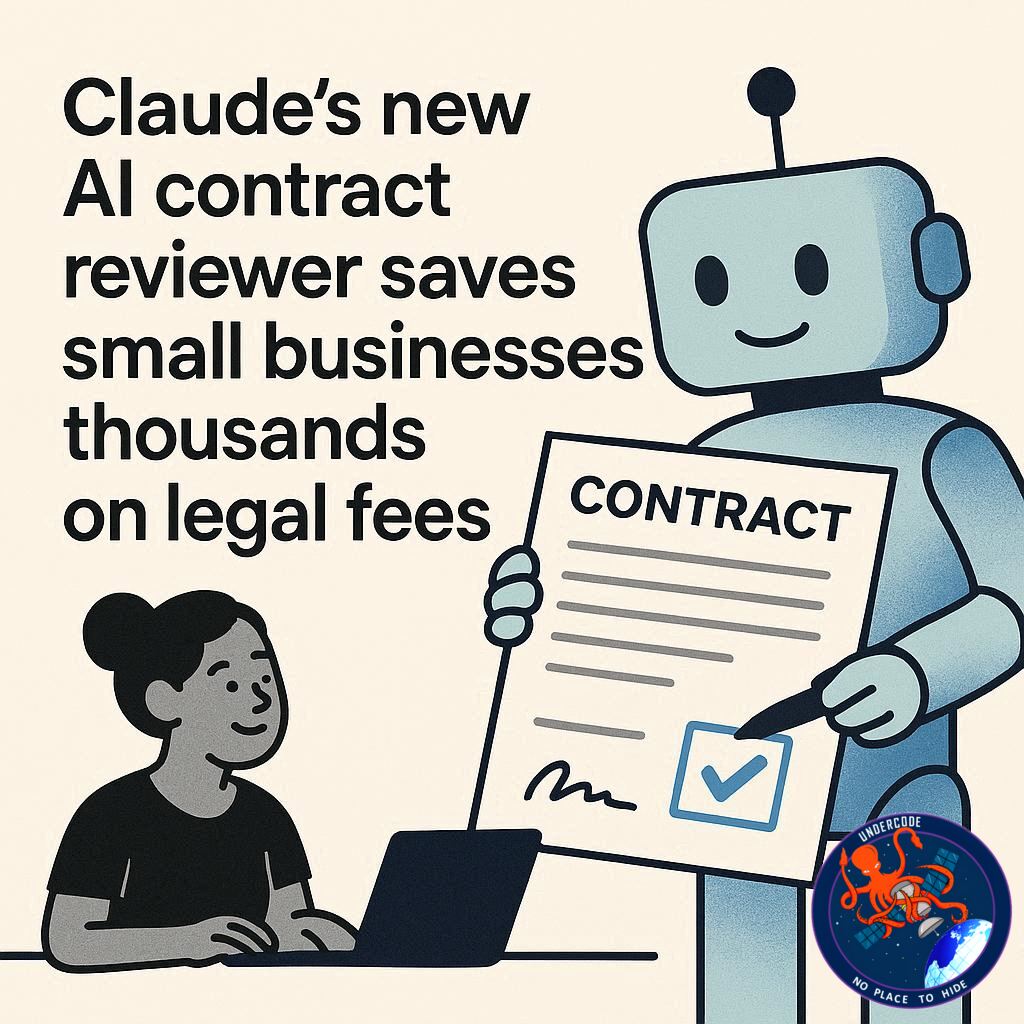 A Quiet AI Feature That Could Disrupt the Legal Industry
Artificial intelligence tools are becoming common inside offices, startups, and freelance businesses, but very few of them actually solve painful real-world problems. Most AI business tools focus on writing emails, generating marketing copy, or summarizing spreadsheets. Useful, yes, but rarely game-changing.
Anthropic may have quietly released something far more practical.
Inside its new “Claude for Small Business” toolkit, the company introduced a feature called /review-contract, and it might be one of the first AI business tools that genuinely feels like a serious professional assistant instead of a flashy demo.
The concept is simple. Upload a contract into Claude, type a command, and let the AI analyze hidden clauses, cancellation traps, vague wording, financial risks, and negotiation red flags in plain English. According to testing described in the original report, the tool delivered insights that rivaled or even exceeded feedback from expensive attorneys.
For small businesses constantly signing vendor agreements, software contracts, gym memberships, service deals, or client paperwork, this could become a massive advantage.
The bigger story is not just that AI can read contracts. It is that AI is starting to lower the barrier to professional-grade expertise that used to be locked behind expensive consulting fees.
Claude for Small Business Arrives With 31 AI Skills
Anthropic launched a package called “Claude for Small Business,” which includes 31 AI-powered workflows connected to business platforms like QuickBooks, Mailchimp, PayPal, Stripe, and HubSpot.
These tools are designed to automate operational work inside small companies.
Some of the available functions include:
Cash-flow monitoring
Payroll forecasting
Invoice chasing
Marketing campaign creation
Monthly financial closing
Margin analysis
Quarterly business reviews
On paper, many of these sound similar to the automation features already appearing inside Microsoft Copilot, Google Workspace AI, and ChatGPT integrations.
But one feature immediately stood apart.
The contract review tool reportedly produced detailed breakdowns of legal risks in uploaded agreements within minutes. Instead of legal jargon, Claude highlighted problems in language ordinary business owners could understand.
That matters because many small business owners sign contracts under pressure and often without legal guidance.
The Contract Review Tool Became the Real Star
The most impressive capability was Claude’s ability to identify manipulative or unfavorable clauses.
The article described several real-world tests using old vendor contracts, including:
A window installation agreement
A national fitness membership contract
A caregiving service contract
Claude reportedly identified aggressive cancellation structures, hidden obligations, confusing date manipulation, and customer-unfriendly terms.
One example highlighted how difficult cancellation procedures were intentionally buried inside membership language. Another example showed how emotionally stressful situations, like arranging elder care, can leave customers vulnerable to exploitative contract wording.
This is where AI suddenly becomes more than productivity software.
It becomes protection.
For many people, contracts are intimidating because legal language is intentionally dense. Attorneys spend years learning how to interpret wording that ordinary consumers rarely notice.
Claude appears to translate that complexity into straightforward explanations.
That accessibility is the real innovation here.
The Most Shocking Part Is the Price
Traditional contract review by a lawyer can cost hundreds or even thousands of dollars depending on the complexity of the agreement.
Claude’s feature is available through the Claude Pro subscription, which starts around $20 per month.
That price difference is staggering.
Of course, AI is not a licensed attorney. It cannot officially replace legal counsel, especially for high-stakes corporate agreements, lawsuits, acquisitions, or regulatory matters.
Still, for everyday contracts, vendor agreements, and consumer services, having an AI instantly flag suspicious clauses could dramatically improve negotiating power for ordinary people.
The article even noted that users could share Claude’s red-flag analysis directly with the opposing party during negotiations.
That changes the dynamic immediately.
A vendor may behave differently once they realize hidden clauses are no longer hidden.
AI Hallucinations Remain the Biggest Risk
Despite the excitement, the article repeatedly acknowledged an important warning.
AI systems can still hallucinate.
That means Claude could misunderstand context, misinterpret legal language, or incorrectly flag harmless terms as dangerous.
This is a critical issue because legal interpretation requires nuance. Some clauses that look aggressive may actually be industry standard. Others may only become problematic in specific jurisdictions.
Blindly trusting AI without verification could create serious misunderstandings.
Still, according to the testing described, Claude performed surprisingly well across multiple contract types.
That consistency is what makes this release notable.
Most AI demos look impressive for five minutes before collapsing under real-world usage. Contract analysis appears to be one area where large language models may genuinely excel because they are trained on enormous volumes of structured text.
The Connector System Raises Privacy Concerns
Beyond contract analysis, Claude for Small Business also introduced connectors to external business platforms.
This is where enthusiasm starts colliding with fear.
Connecting AI systems directly to accounting software, customer databases, or email platforms creates obvious security and privacy concerns.
The original report described hesitation about granting Claude access to QuickBooks and Mailchimp accounts.
That hesitation is understandable.
Many businesses still do not fully trust AI systems with mission-critical operational data. Financial records, customer information, invoices, and internal communication are extremely sensitive assets.
Even though Anthropic allows permission management, there is still discomfort around giving AI broad system access.
One especially concerning detail involved QuickBooks integration. Restricting certain write permissions reportedly caused functionality issues, essentially forcing broader access permissions for the AI to operate correctly.
That kind of tradeoff will make many businesses nervous.
The AI industry keeps pushing toward “agentic” systems capable of acting independently inside software environments. But every additional permission increases potential risk.
Businesses now face a difficult balance between convenience and control.
Mailchimp Integration Felt Underwhelming
Interestingly, not every Claude feature impressed equally.
The Mailchimp connector reportedly felt limited and shallow.
It could generate mailing drafts, but lacked deeper understanding of audience behavior, subscriber analytics, or brand voice consistency.
That reveals an important reality about modern AI products.
Many integrations still feel more like prototypes than polished business systems.
AI companies are racing to ship features faster than they can fully refine them.
As a result, some tools feel revolutionary while others feel unfinished.
The contract reviewer appears to belong firmly in the first category.
QuickBooks Analysis Showed More Promise
The QuickBooks integration delivered stronger results.
Claude was able to generate business health summaries and identify unusual accounting issues hidden inside financial records.
One example uncovered a 14-year-old sales tax overpayment to the state of Florida.
While the financial impact was minor, the example demonstrated how AI can surface anomalies humans might overlook for years.
This is likely where AI will become most useful in small businesses:
Pattern recognition
Error detection
Risk identification
Workflow acceleration
Information summarization
Rather than replacing employees entirely, AI may increasingly act as a second layer of oversight.
What Undercode Say:
AI Is Finally Becoming Useful Instead of Just Impressive
For the past two years, most AI launches have felt like tech companies desperately searching for practical use cases.
We saw endless chatbot demos, AI-generated images, automatic presentations, and gimmicky assistants that sounded futuristic but solved very few serious problems.
Contract analysis feels different.
This addresses a universal business pain point that almost everybody understands immediately.
Nobody likes reading contracts.
Most people skim them.
Many people feel trapped by them afterward.
Businesses have relied on complexity for decades because consumers rarely possess the time, money, or legal expertise needed to challenge questionable terms.
AI changes that equation.
The real disruption here is not legal automation. It is informational equality.
A small business owner with a $20 AI subscription suddenly gains access to risk analysis capabilities that previously required expensive professional review.
That is economically disruptive.
It could pressure industries that profit from informational asymmetry.
At the same time, this does not mean lawyers disappear.
Instead, lawyers may evolve into validators rather than first-pass reviewers.
AI handles initial detection.
Humans handle final judgment.
That hybrid model is probably the future.
There is also a psychological effect nobody is talking about enough.
People negotiate differently when they feel informed.
Confidence changes conversations.
If AI can explain hidden risks clearly and instantly, customers become harder to manipulate.
That alone could force companies to simplify abusive contract structures.
Another important angle is emotional vulnerability.
The caregiving contract example mentioned in the article is incredibly important because it highlights how many exploitative agreements appear during stressful life situations.
Hospitals.
Funeral services.
Caregiving companies.
Emergency repairs.
Medical financing.
These industries often operate when customers are exhausted, emotional, distracted, or desperate.
AI may become a defensive shield during those moments.
But there is another side nobody should ignore.
AI companies are also asking users to connect increasingly sensitive systems directly into their platforms.
Accounting data.
Business finances.
Email records.
Customer databases.
That creates a new dependency layer.
People may escape exploitative contracts only to become deeply dependent on AI ecosystems controlling their operational intelligence.
The industry is moving toward AI agents capable of autonomous business actions.
That future introduces enormous cybersecurity, compliance, and ethical questions.
Who becomes liable when AI makes a financial mistake?
Who gets blamed when an AI-generated recommendation causes legal harm?
Who audits the model’s reasoning?
Those questions remain unresolved.
Still, despite the risks, this contract review feature represents one of the clearest examples yet of AI delivering measurable, immediate value to ordinary users.
Not theoretical value.
Not futuristic value.
Real value today.
And that is why this release matters more than most AI announcements flooding the internet every week.
Fact Checker Results
✅ Anthropic did launch Claude for Small Business with multiple workflow skills and integrations.
✅ The /review-contract feature is positioned as an AI-powered contract analysis tool for SMB users.
❌ AI contract review tools are not replacements for licensed legal professionals and can still produce inaccurate interpretations.
Prediction
🔮 AI contract analysis tools will become standard features inside productivity software within the next three years.
🔮 Law firms may begin offering “AI-assisted legal review” services instead of fully manual first-pass evaluations.
🔮 Businesses with overly aggressive cancellation clauses or hidden fees could face greater public scrutiny as AI makes contract language easier to decode for consumers.
🕵️📝Let’s dive deep and fact‑check.
References:
Reported By: www.zdnet.com
Extra Source Hub (Possible Sources for article):
https://www.facebook.com
Wikipedia
OpenAi & Undercode AI
Image Source:
Unsplash
Undercode AI DI v2
Bing
🔐JOIN OUR CYBER WORLD [ CVE News • HackMonitor • UndercodeNews ]
📢 Follow UndercodeNews & Stay Tuned:
𝕏 formerly Twitter 🐦 | @ Threads | 🔗 Linkedin | 🦋BlueSky | 🐘Mastodon


