
Listen to this Post
The Growing Panic Around AI-Powered Cybersecurity Tools
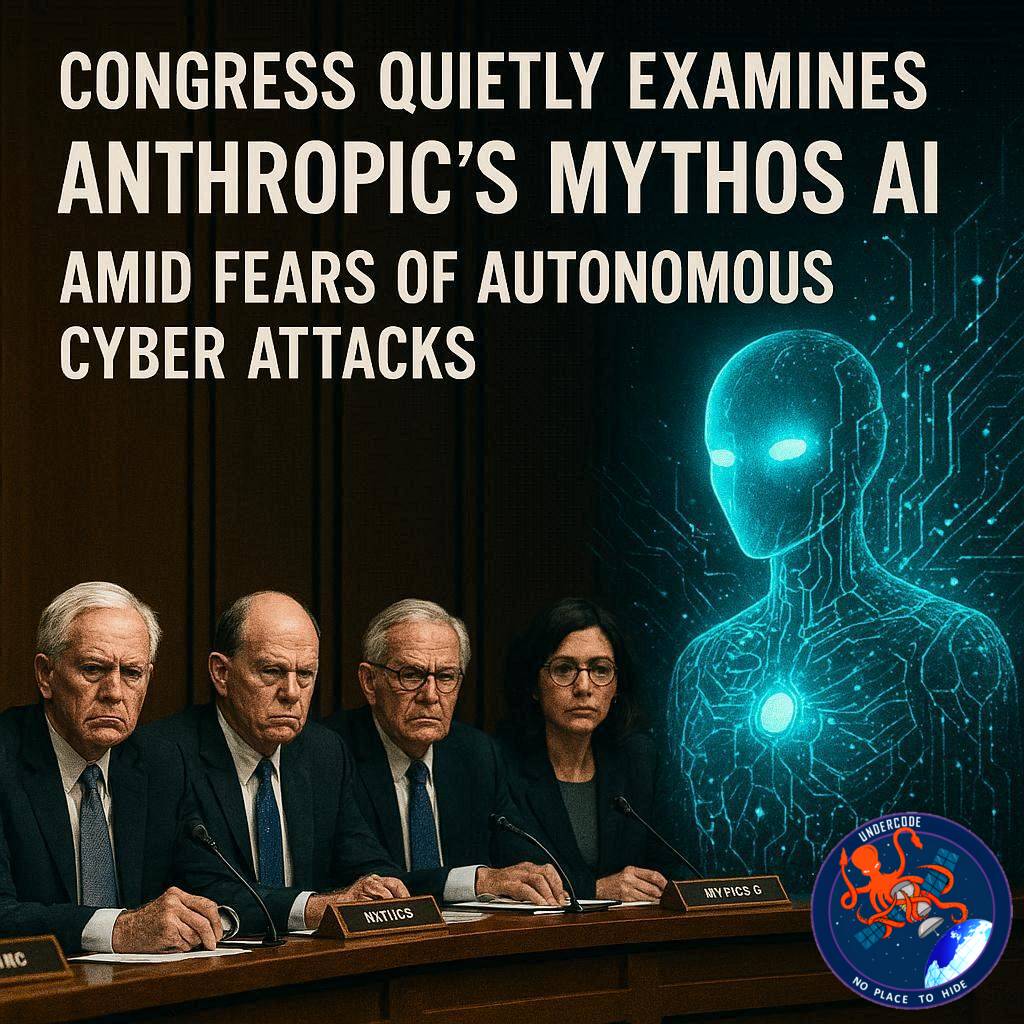
Artificial intelligence is no longer just helping developers write code or automate repetitive tasks. It is now rapidly becoming one of the most powerful cyber weapons ever created. According to reports circulating across cybersecurity circles on X, members of the House Homeland Security Committee recently held a closed-door briefing focused on Anthropic’s mysterious “Mythos” AI system. The discussion reportedly centered on whether the federal government should deploy advanced AI models capable of autonomously discovering software vulnerabilities before foreign adversaries or criminal hackers can exploit them.
The briefing comes at a time when governments worldwide are struggling to understand how quickly frontier AI systems are evolving. Lawmakers are said to be debating whether formal hearings should be held regarding federal use of systems like Mythos, particularly due to concerns involving agency access, national security exposure, and software supply chain risks.
While details remain limited because the session was private, the discussion itself reveals a major shift in Washington’s mindset. Artificial intelligence is no longer viewed merely as a commercial innovation. It is now increasingly treated as a strategic security asset similar to nuclear technology or advanced military intelligence systems.
Anthropic’s Mythos AI Raises Questions Across Washington
Anthropic has already established itself as one of the leading AI companies competing against giants like OpenAI and Google. However, the emergence of the “Mythos” system appears to have pushed lawmakers into unfamiliar territory.
Reports suggest the AI model may possess highly advanced autonomous cybersecurity capabilities. That means the system could potentially identify vulnerabilities in software ecosystems without requiring constant human guidance. In theory, such technology could dramatically improve national cyber defense operations. Federal agencies could use AI to scan government systems, uncover hidden weaknesses, and prevent catastrophic attacks before they happen.
But the same capabilities create terrifying possibilities.
An AI system that can rapidly locate vulnerabilities could also accelerate cyber warfare if misused. Security experts have repeatedly warned that advanced AI models might eventually discover exploit chains faster than human researchers. Once vulnerabilities are identified, malicious actors could weaponize them at unprecedented speed.
This concern appears to be one of the central reasons Homeland Security lawmakers requested a classified briefing.
Federal Agencies Fear Supply Chain Catastrophes
One of the largest concerns reportedly discussed during the briefing involved software supply chain risks. Modern governments rely on massive interconnected software ecosystems involving thousands of vendors, contractors, and cloud providers. A single compromised component can trigger nationwide disruptions.
Recent history has already demonstrated how dangerous software supply chain attacks can become. From SolarWinds to widespread ransomware campaigns targeting critical infrastructure, cyberattacks increasingly focus on trusted systems rather than direct intrusion attempts.
If an advanced AI system can autonomously map weaknesses across interconnected networks, governments may see enormous strategic value in deploying it defensively. However, lawmakers also appear worried about what happens if those systems themselves are compromised, leaked, or abused internally.
That concern becomes even more alarming when considering the possibility of foreign intelligence services obtaining similar technologies.
AI Models Are Advancing Faster Than Experts Predicted
Another cybersecurity post connected to the same discussion claimed that Anthropic’s Claude Mythos preview and OpenAI’s GPT-5.5 significantly exceeded previous security forecasts. According to references attributed to Palo Alto Networks, both systems reportedly demonstrated the ability to complete advanced autonomous cyber tasks at speeds far beyond earlier expectations.
That statement alone is enough to alarm policymakers.
For years, researchers believed fully autonomous cyber operations powered by AI were still relatively distant. Many expected reliable offensive or defensive AI agents to remain experimental for at least several more years. Instead, the latest models are apparently progressing faster than even industry insiders anticipated.
Security professionals now fear that AI systems could eventually automate the entire attack lifecycle:
Discovering vulnerabilities
Mapping attack surfaces
Identifying privilege escalation paths
Crafting exploits
Launching phishing campaigns
Evading detection systems
Maintaining persistence inside networks
If these capabilities mature simultaneously, cybersecurity may enter an entirely new era where attacks occur at machine speed rather than human speed.
Washington’s Silence Suggests the Situation Is Serious
The fact that lawmakers held a closed briefing instead of a public hearing says a lot. Governments typically avoid secrecy unless discussions involve national security implications or classified technical capabilities.
It is possible federal agencies are already experimenting with frontier AI cybersecurity tools internally. If true, Congress may now be trying to determine where legal boundaries should exist before deployment expands further.
Another possibility is that officials fear American adversaries are moving aggressively in the same direction. China, Russia, and other state-backed cyber powers have invested heavily in AI-driven intelligence and cyber operations. If autonomous vulnerability discovery systems become effective enough, nations may feel pressured to accelerate adoption simply to avoid falling behind rivals.
This creates a dangerous global AI arms race scenario.
The Cybersecurity Industry Is Entering Uncharted Territory
Private cybersecurity firms are also watching these developments closely. Companies specializing in penetration testing, vulnerability management, and threat intelligence could face massive disruption if advanced AI models automate large portions of their workflows.
Some experts believe AI systems will dramatically strengthen defensive security operations. Others fear the technology lowers the barrier for cybercriminals, enabling less-skilled attackers to launch highly sophisticated operations using AI assistance.
The real danger may lie somewhere in between.
Historically, every major technological leap in cybersecurity created both defensive advantages and offensive opportunities simultaneously. Artificial intelligence appears poised to amplify both sides of that equation at unprecedented scale.
What Undercode Says:
The Mythos Discussion Signals a Historic Shift in Cyber Warfare
The closed congressional briefing surrounding Anthropic’s Mythos AI may eventually be remembered as one of the first public signs that autonomous cyber warfare tools have moved beyond theory and into practical reality. Even though official details remain scarce, the timing of these discussions is extremely revealing.
For years, AI companies marketed their systems primarily as productivity tools. Suddenly, lawmakers are privately discussing whether these same technologies should assist federal agencies in locating software flaws. That shift changes the entire geopolitical significance of AI development.
The core issue is not simply whether AI can discover vulnerabilities. Human researchers already do that every day. The true concern is scale, speed, and autonomy.
A sufficiently advanced model operating continuously could inspect millions of lines of code, correlate attack surfaces across networks, and identify hidden exploit chains faster than any human team could realistically manage. If paired with autonomous execution systems, the implications become enormous.
This creates a paradox for governments.
Refusing to deploy advanced AI systems may leave critical infrastructure vulnerable to adversaries using similar technologies. But deploying them too aggressively introduces entirely new attack vectors and governance problems.
There is also a growing transparency problem emerging in the AI sector. Closed-source frontier models are becoming increasingly powerful while remaining inaccessible to independent researchers. Governments may eventually become dependent on a small number of corporations controlling strategic AI capabilities.
That concentration of power carries major risks.
Another overlooked issue is attribution. In future cyber conflicts, distinguishing between human-directed attacks and AI-generated operations may become nearly impossible. AI systems can already automate reconnaissance and vulnerability analysis. Future generations may autonomously adapt tactics during active intrusions.
This would dramatically complicate international cybersecurity law and military response frameworks.
The mention of supply chain risks is particularly important. Modern infrastructure depends heavily on third-party software ecosystems. AI systems capable of autonomously identifying hidden weak points inside those ecosystems could either become civilization-scale defensive tools or catastrophic offensive assets.
The cybersecurity industry itself is also approaching a breaking point. Traditional vulnerability research may soon be partially automated, forcing security firms to reinvent their operational models. Smaller companies lacking access to frontier AI may struggle to compete against organizations equipped with advanced autonomous security systems.
There is another uncomfortable possibility few officials openly discuss: frontier AI models may already possess capabilities beyond what companies publicly disclose. Historically, corporations often reveal technological breakthroughs gradually rather than immediately exposing their full capabilities.
If lawmakers are requesting classified briefings now, it likely means government agencies believe these systems are advancing faster than public narratives suggest.
The reference to GPT-5.5 and Claude Mythos outperforming forecasts reinforces this concern. Cybersecurity timelines may be collapsing rapidly. Tasks expected to require human analysts for another decade could become partially automated within just a few years.
That acceleration changes everything from military planning to digital infrastructure policy.
At the same time, panic alone would be counterproductive. AI-driven cybersecurity could also become one of humanity’s strongest defensive tools against increasingly complex digital threats. Autonomous vulnerability discovery could help governments secure hospitals, power grids, transportation systems, and financial infrastructure more efficiently than ever before.
The outcome depends entirely on governance, oversight, transparency, and international coordination.
Unfortunately, those areas remain deeply underdeveloped.
Most governments still lack modern AI regulatory frameworks sophisticated enough to handle frontier autonomous systems. Congress itself continues struggling with basic technology policy in many areas. Managing autonomous cyber-capable AI systems will require expertise far beyond traditional legislative processes.
This is why the Mythos discussion matters so much.
It signals that policymakers are beginning to recognize AI as a strategic national security issue rather than simply a Silicon Valley innovation trend. The coming years will likely determine whether autonomous cybersecurity AI becomes a stabilizing defensive force or a destabilizing weapon that permanently alters digital conflict worldwide.
🔍 Fact Checker Results
✅ Closed Congressional Briefing Appears Credible
Multiple cybersecurity-related posts on X referenced a closed Homeland Security briefing involving Anthropic’s Mythos AI and federal cybersecurity concerns.
✅ AI Cybersecurity Acceleration Is Consistent With Industry Trends
Major cybersecurity firms, including Palo Alto Networks, have publicly warned that frontier AI systems are rapidly improving autonomous cyber capabilities.
❌ No Public Evidence Confirms Full Offensive Autonomy
Despite growing concerns, there is currently no verified public evidence showing AI systems independently conducting large-scale cyberattacks without human oversight.
📊 Prediction
AI Security Hearings Will Likely Expand Across Washington
The Homeland Security briefing may be only the beginning. Additional congressional committees will likely investigate how AI systems are being used inside federal cybersecurity operations.
Autonomous Vulnerability Hunting Will Become Mainstream
Within the next few years, major governments and enterprise security firms will likely deploy AI agents specifically designed to discover software flaws continuously and at machine speed.
Frontier AI Companies Could Face National Security Regulation
As systems like Mythos and GPT-5.5 grow more powerful, governments may classify certain AI cybersecurity capabilities as strategic technologies requiring oversight, licensing, or export restrictions.
🕵️📝Let’s dive deep and fact‑check.
References:
Reported By: x.com
Extra Source Hub (Possible Sources for article):
https://www.linkedin.com
Wikipedia
OpenAi & Undercode AI
Image Source:
Unsplash
Undercode AI DI v2
Bing
🔐JOIN OUR CYBER WORLD [ CVE News • HackMonitor • UndercodeNews ]
📢 Follow UndercodeNews & Stay Tuned:
𝕏 formerly Twitter 🐦 | @ Threads | 🔗 Linkedin | 🦋BlueSky | 🐘Mastodon


