
Listen to this Post
Introduction
A massive reconnaissance operation has been detected targeting Citrix ADC and NetScaler Gateways, revealing the increasing sophistication of attackers in mapping critical enterprise infrastructure. Between January 28 and February 2, 2026, security researchers at GreyNoise observed a meticulously orchestrated campaign leveraging thousands of residential proxies and cloud infrastructure to identify login panels, enumerate software versions, and prepare for potential exploitation. This activity underscores the ongoing risks facing organizations that rely on exposed gateway services and highlights the evolving techniques attackers use to evade detection.
the Reconnaissance Campaign
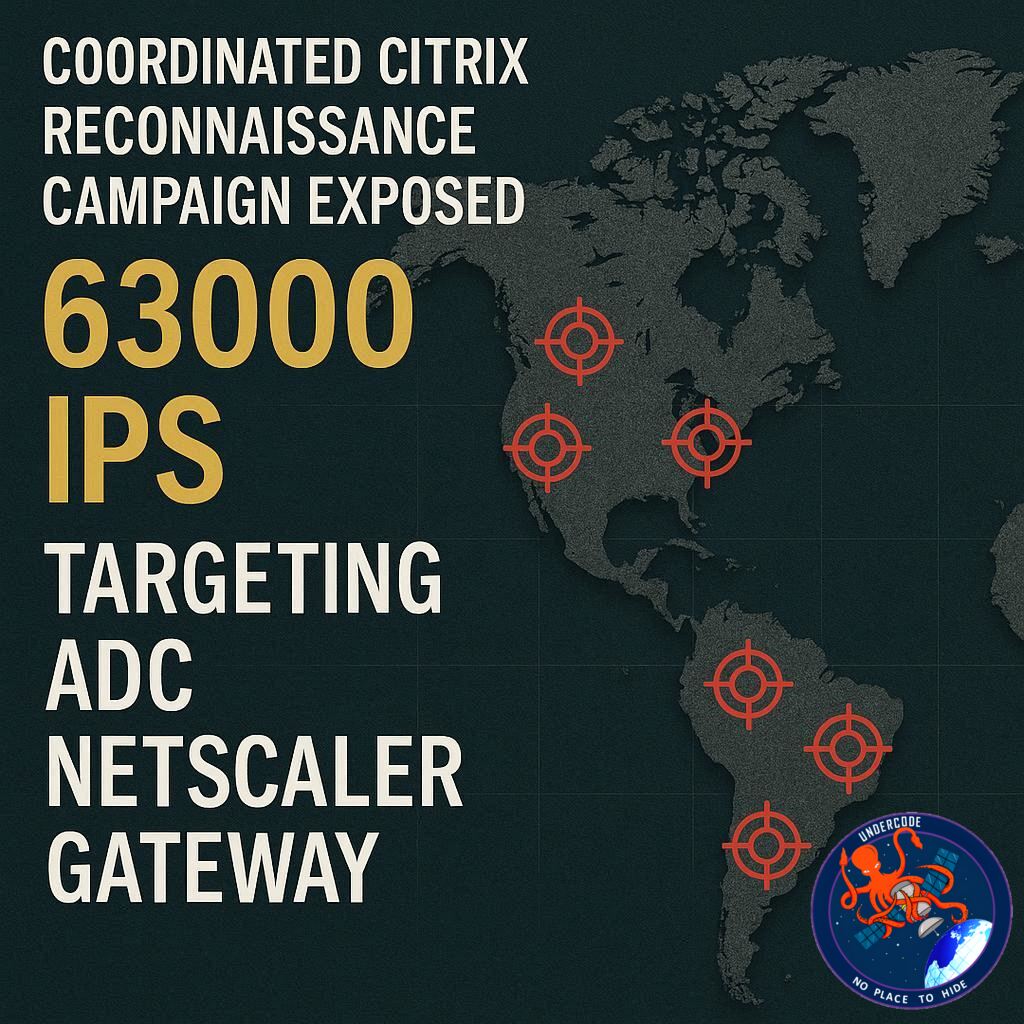
GreyNoise reported that the campaign involved 111,834 sessions originating from over 63,000 unique IP addresses, with a significant 79% of the activity directed at Citrix Gateway honeypots. This targeting rate is far above typical scanning “noise,” indicating a deliberate and focused attempt at infrastructure mapping. The operation consisted of two distinct but related campaigns: one focused on discovering login portals, the other on rapidly enumerating software versions to identify potential vulnerabilities.
The login discovery phase relied heavily on residential proxies from Windows devices routed through Linux proxies. Attackers also used a single Azure IP for a portion of the traffic, but the majority of requests came from thousands of legitimate consumer IPs, each employing unique browser fingerprints to bypass geofencing and reputation-based filters. The version enumeration phase ran over six hours from ten AWS IPs using a consistent Chrome fingerprint, showing rapid, targeted exploitation of identified endpoints.
Operational security measures were evident throughout the campaigns. Traffic routed through Azure VPNs and tunnels employed slightly smaller-than-normal maximum segment sizes (MSS), while AWS scanners used jumbo frame settings achievable only in datacenter environments. TCP analysis revealed differing infrastructures yet shared fingerprints across campaigns, suggesting that attackers utilized a common toolset or framework to compartmentalize operations while maintaining a consistent reconnaissance approach.
The ultimate goal of the reconnaissance appears to be mapping Citrix infrastructure prior to exploitation. Specifically, attackers showed interest in the EPA setup files, which could be leveraged for version-specific exploits or vulnerability validation. Security recommendations include monitoring for unusual user agents, rapid login attempts, outdated browser fingerprints, and external access to sensitive paths. Organizations are advised to limit exposure, enforce strict authentication, suppress version information, and flag suspicious traffic originating from unexpected regions.
What Undercode Say:
This Citrix reconnaissance campaign illustrates the increasingly sophisticated operational security employed by attackers targeting enterprise infrastructure. The use of over 63,000 residential proxies alongside cloud infrastructure from Azure and AWS indicates a high degree of planning and resource investment. Residential proxies allow attackers to appear as legitimate users, bypassing traditional network defenses, while datacenter resources accelerate reconnaissance without raising immediate suspicion.
The distinction between the login discovery and version enumeration phases reflects a multi-layered strategy: first locate potential targets, then quickly probe for vulnerabilities. The presence of consistent TCP option ordering across diverse networks strongly points to shared tooling, suggesting attackers maintain a modular framework capable of adapting to different infrastructures without compromising operational security.
From an organizational perspective, this activity highlights the need for proactive defense mechanisms. Traditional perimeter-based protections are insufficient against distributed reconnaissance using legitimate IPs. Security teams must leverage anomaly detection, including monitoring for unusual traffic patterns, unique browser fingerprints, and rapid sequential access attempts. Additionally, sensitive administrative endpoints, such as EPA setup files, should be closely monitored or isolated to prevent exploitation.
The reliance on both residential and cloud-based IPs also suggests attackers are testing hybrid approaches to evade detection, combining the legitimacy of consumer traffic with the performance of datacenter environments. This hybrid strategy could become a new standard for large-scale reconnaissance campaigns targeting enterprise applications, necessitating adaptive monitoring techniques.
Furthermore, the targeted nature of the campaign emphasizes the importance of reducing the attack surface. Organizations using Citrix ADC and NetScaler Gateways should minimize publicly exposed interfaces, enforce multifactor authentication, and regularly audit access logs. Suppressing version information and implementing region-based restrictions for administrative access can further hinder reconnaissance efforts.
Overall, this campaign demonstrates that attackers are evolving from opportunistic scanning to highly coordinated, infrastructure-focused reconnaissance. It also underscores the necessity of threat intelligence integration, proactive detection of unusual access patterns, and rapid response to anomalies. Enterprises must treat reconnaissance activity as a credible precursor to exploitation, not as background noise.
Fact Checker Results:
✅ Over 111,000 sessions were recorded targeting Citrix infrastructure.
✅ 79% of activity focused specifically on Citrix Gateway honeypots, indicating targeted mapping.
✅ Reconnaissance used a mix of residential and cloud-based IPs to evade detection.
Prediction:
🔮 The increasing sophistication and hybrid infrastructure use in reconnaissance campaigns suggest that future attacks on Citrix and similar enterprise gateways will escalate in scale and precision. Organizations may face automated, AI-driven scanning capable of bypassing traditional IP reputation filters, making proactive monitoring, strict authentication, and anomaly detection essential to prevent breaches.
If you want, I can also make a visually appealing version of this article for blog publication, formatted for readability and SEO. Do you want me to do that?
▶️ Related Video (82% Match):
🕵️📝✔️Let’s dive deep and fact‑check.
References:
Reported By: securityaffairs.com
Extra Source Hub (Possible Sources for article):
https://www.github.com
Wikipedia
OpenAi & Undercode AI
Image Source:
Unsplash
Undercode AI DI v2
Bing
🔐JOIN OUR CYBER WORLD [ CVE News • HackMonitor • UndercodeNews ]
📢 Follow UndercodeNews & Stay Tuned:
𝕏 formerly Twitter 🐦 | @ Threads | 🔗 Linkedin | 🦋BlueSky | 🐘Mastodon


