
Listen to this Post
Introduction
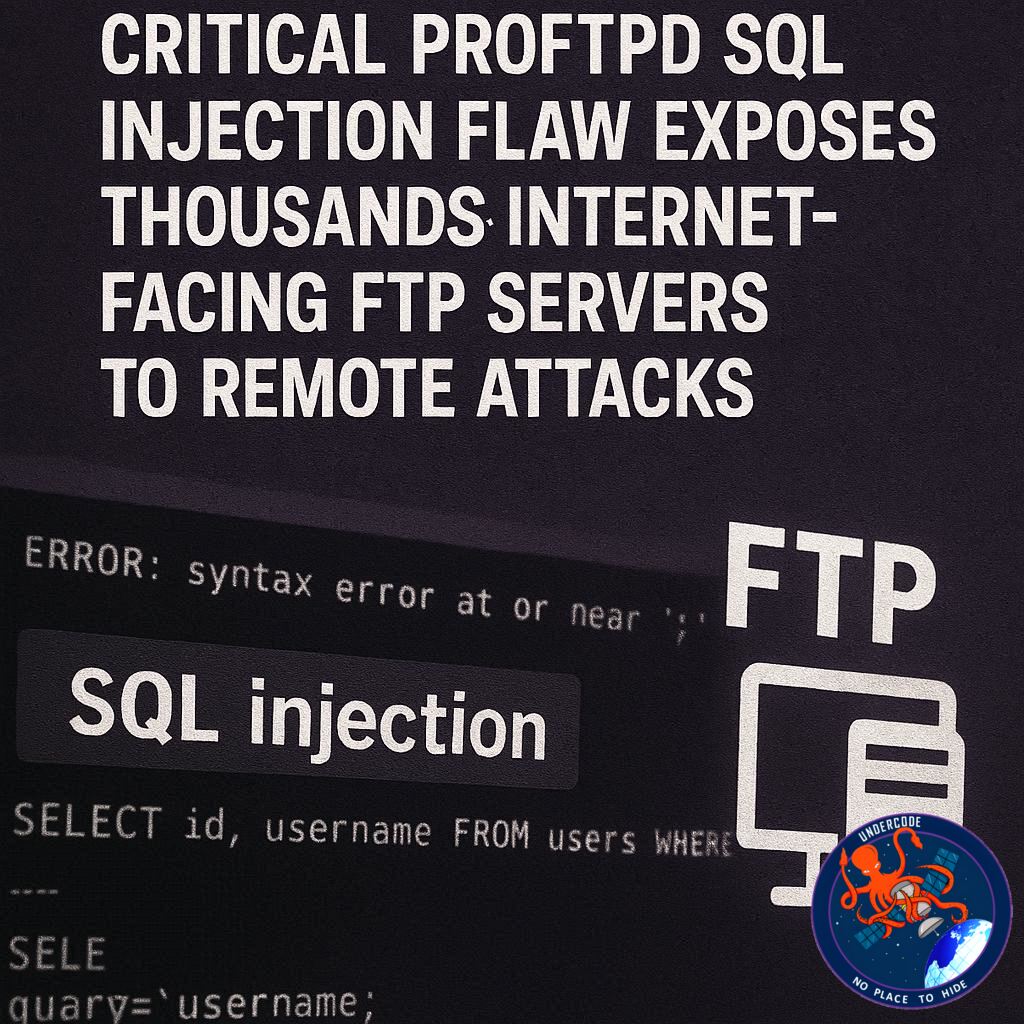
A newly disclosed security vulnerability in ProFTPD, one of the most widely used FTP server solutions on the internet, has raised serious concerns across the hosting and Linux administration community. Tracked as CVE-2026-42167, the flaw affects the mod_sql extension and can allow attackers to execute code remotely, bypass authentication, escalate privileges, and steal sensitive database information in certain environments.
With more than 162,000 publicly exposed ProFTPD instances reportedly online, the issue is especially alarming for shared hosting providers, enterprise file transfer systems, and Linux servers that still rely on FTP infrastructure. Security experts are urging administrators to patch immediately.
ProFTPD Vulnerability Explained
The security issue exists inside ProFTPD’s mod_sql module, a feature commonly used for SQL-backed authentication, quota management, logging, and access controls. Many Linux distributions ship ProFTPD with this module available by default, and it is frequently bundled into hosting control panels such as cPanel, Plesk, DirectAdmin, ISPConfig, and Webmin.
The flaw occurs when administrators use SQL logging directives like SQLNamedQuery and SQLLog. These configurations insert user-controlled session values, such as usernames, into SQL statements. Under certain conditions, ProFTPD incorrectly assumes some values are already safe and skips proper escaping.
That means an attacker can send a specially crafted username during the FTP USER command, before logging in, and inject malicious SQL code directly into the backend database query.
This makes the bug particularly dangerous because exploitation can begin before authentication.
What Attackers Can Do
The actual impact depends on how the server is configured, but several severe attack paths have been identified.
Remote Code Execution
If ProFTPD connects to a PostgreSQL database using highly privileged accounts, attackers may abuse database execution features to run system commands. This can lead to full remote code execution on the host server.
Authentication Bypass
If mod_sql is used for login authentication, malicious SQL injection could create a fake user account with attacker-controlled credentials. This would allow direct FTP access without knowing any real password.
Privilege Escalation
Attackers may manipulate home directory settings to point to /, giving them access to browse sensitive parts of the filesystem outside normal FTP restrictions.
Credential Theft
Using timing-based blind SQL injection methods, attackers may slowly extract data from backend databases, including password hashes and internal records.
Why This Matters So Much
ProFTPD has existed for decades and remains heavily deployed in legacy infrastructure. While newer organizations have moved toward SFTP or cloud storage, many hosting providers and older enterprise systems still depend on FTP services for automation, backups, and website management.
Because ProFTPD is integrated into popular web hosting panels, a single vulnerable configuration may affect many customer accounts on the same machine.
That turns this bug into more than a simple software flaw. It becomes a supply chain and multi-tenant hosting risk.
Patch Already Released
The ProFTPD Project released version 1.3.9a on April 27, 2026, which contains the official security fix. Several Linux vendors and downstream projects have also acknowledged the issue and started distributing patched packages.
Administrators should verify not only the ProFTPD version, but also whether package maintainers have backported the patch into distro-specific versions.
Immediate Mitigation Steps
Security teams should act quickly using the following measures:
Upgrade ProFTPD to 1.3.9a or later
Disable mod_sql logging if patching is delayed
Remove risky user-controlled expansions such as %U
Restrict SQL database permissions to minimum required access
Avoid using database superuser accounts
Review FTP logs for suspicious USER commands
Monitor backend databases for unexpected inserts or timing anomalies
Why Pre-Authentication Bugs Are Dangerous
Many vulnerabilities require a valid username or password first. This one does not always need that. An attacker can simply connect to the FTP service and start sending crafted login names.
That lowers the barrier dramatically. Internet-wide scanning bots can test thousands of systems quickly, meaning exposed servers may already be under automated probing.
What Undercode Say:
This ProFTPD issue is a reminder that legacy protocols continue to create modern security problems. FTP itself is old, but the software around it keeps evolving, and every added module increases attack surface.
The most dangerous detail here is not just SQL injection. It is where the injection happens. Logging systems are often trusted and ignored during audits. Attackers know this and increasingly target secondary functions like metrics, logs, or admin tooling.
Another concern is shared hosting. One outdated ProFTPD instance running on a panel-managed server could expose dozens or hundreds of websites indirectly. In many cases, customers may never know their provider uses ProFTPD in the background.
This vulnerability also highlights a common operational mistake: database over-permissioning. If ProFTPD only needed insert rights for logs, damage would be limited. But when software runs with superuser database access, a simple injection becomes a full server compromise.
The long-term lesson is clear. If organizations still depend on FTP, they should consider migrating to SFTP, FTPS, or managed transfer platforms with stronger isolation and modern authentication models.
From an attacker perspective, publicly available proof-of-concept code means exploitation attempts will likely spread quickly. Once working scripts circulate, opportunistic botnets often follow.
Expect cybercriminal groups to prioritize vulnerable hosting providers first. One compromise there can open doors to many downstream victims.
For defenders, patching alone is not enough. Log review, credential rotation, and configuration hardening should follow.
Legacy software can remain stable for years, then suddenly become the center of a global security incident. ProFTPD may now be entering that phase.
Fact Checker Results
✅ CVE-2026-42167 is described as a critical SQL injection flaw affecting ProFTPD mod_sql.
✅ Version 1.3.9a is reported as the patched release.
❌ Not every ProFTPD server is vulnerable. Risk depends heavily on whether mod_sql is enabled and how it is configured.
Prediction
🔮 Rapid exploitation attempts are likely within days because proof-of-concept details are already public.
🔮 Hosting companies using older Linux templates may discover hidden ProFTPD deployments during emergency audits.
🔮 This incident may accelerate migration away from legacy FTP infrastructure toward safer alternatives.
🕵️📝Let’s dive deep and fact‑check.
References:
Reported By: cyberpress.org
Extra Source Hub (Possible Sources for article):
https://www.digitaltrends.com
Wikipedia
OpenAi & Undercode AI
Image Source:
Unsplash
Undercode AI DI v2
Bing
🔐JOIN OUR CYBER WORLD [ CVE News • HackMonitor • UndercodeNews ]
📢 Follow UndercodeNews & Stay Tuned:
𝕏 formerly Twitter 🐦 | @ Threads | 🔗 Linkedin | 🦋BlueSky | 🐘Mastodon


