
Listen to this Post
Introduction: A New Era of AI-Powered Cyber Defense
The cybersecurity battlefield is changing rapidly. Attackers are no longer relying solely on traditional tactics; many now deploy artificial intelligence to accelerate reconnaissance, automate intrusion attempts, and evade detection systems. As a result, security teams face overwhelming volumes of alerts every day. In this environment, the speed and intelligence of defense systems determine whether a breach is stopped or spreads unnoticed.
To confront this challenge, CrowdStrike has expanded its collaboration with NVIDIA to advance a new model of cyber defense called Agentic Managed Detection and Response. By integrating advanced AI reasoning models, synthetic data generation, and autonomous security agents, the partnership aims to transform how investigations and threat triage are performed inside modern Security Operations Centers.
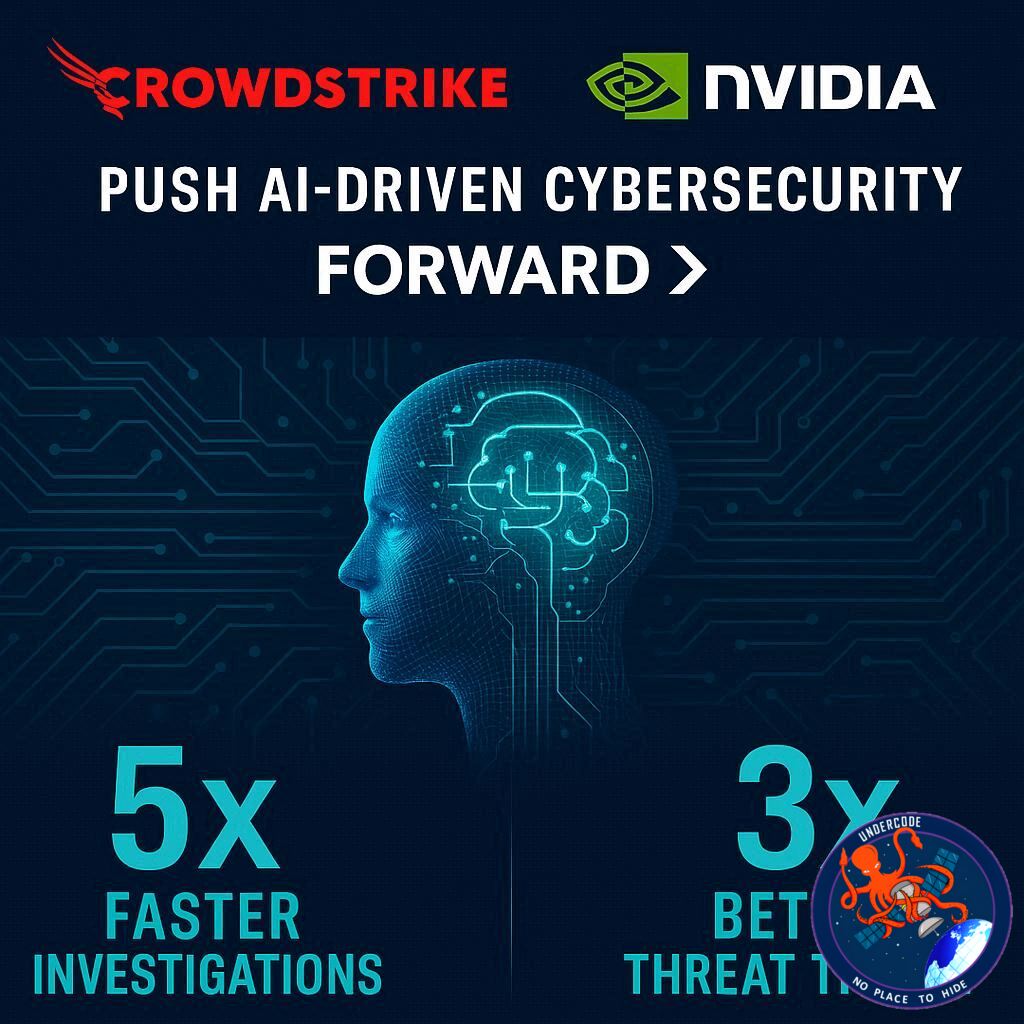
Early internal testing shows impressive results. Investigations can run up to five times faster, while triage accuracy improves more than threefold. The collaboration combines cutting-edge AI models, specialized training pipelines, and automation frameworks designed to empower analysts rather than replace them.
The result is a new generation of intelligent security operations capable of keeping pace with adversaries who are increasingly leveraging AI to launch more sophisticated attacks.
Accelerating Cyber Investigations with Advanced AI Models
At the core of this collaboration is the integration of the NVIDIA Agent Toolkit with CrowdStrike’s managed security operations platform. The toolkit uses open AI reasoning models from the NVIDIA Nemotron family, along with synthetic data generation powered by NVIDIA NeMo Data Designer.
These tools enable the creation of highly specialized security agents designed to automate investigative workflows that traditionally required significant human effort.
CrowdStrike has integrated these capabilities into its managed security service, CrowdStrike Falcon Complete Next-Gen MDR. Internal testing indicates that AI agents powered by Nemotron Nano and Nemotron Super models can reduce investigation times dramatically. What once took analysts nearly 48 minutes can now be completed in roughly 8.5 minutes.
This shift dramatically reduces the time between detection and response, which is critical in preventing attackers from escalating privileges or moving laterally across networks.
Charlotte AI AgentWorks Expands Custom Security Agent Development
Another major component of this partnership is the expansion of Charlotte AI AgentWorks, CrowdStrike’s platform for building and deploying custom AI-driven security agents.
With support for the Nemotron 3 Super model, organizations can design agents tailored to their own environments. These agents can analyze alerts, correlate telemetry, generate investigation queries, and prioritize incidents with minimal human intervention.
The concept behind AgentWorks is not to replace analysts but to amplify their capabilities. Security professionals remain in control while AI agents handle repetitive tasks, large-scale data analysis, and preliminary investigations.
This approach allows security teams to focus on complex threats and strategic defense initiatives rather than being buried under thousands of alerts.
The Growing Challenge of AI-Powered Cyber Attacks
Cybercriminal groups have already begun incorporating AI into their operations. Tools powered by machine learning can scan networks for vulnerabilities, generate phishing campaigns at scale, and even adapt attack techniques in real time.
These developments place enormous pressure on security operations centers. Many teams already struggle with staffing shortages, budget constraints, and overwhelming alert volumes.
A single enterprise environment can generate thousands of security detections each day. Analysts must manually review many of these alerts to determine whether they represent legitimate threats or harmless anomalies.
This process consumes valuable time and resources, increasing the risk that a real attack could slip through unnoticed. Faster and more accurate triage systems are therefore becoming essential for modern cybersecurity strategies.
Synthetic Data Improves AI Accuracy and Reliability
A key element of the new system is the use of synthetic data generated by NVIDIA’s NeMo Data Designer.
Instead of relying solely on historical datasets, the system learns patterns from real security telemetry and expert insights. It then generates synthetic training data that mirrors realistic attack scenarios and benign activities.
This approach produces highly structured training signals that improve the consistency and accuracy of AI models used in investigation workflows.
According to internal benchmarking results from CrowdStrike and NVIDIA, the optimized Nemotron models demonstrated several significant improvements. Investigation workflows became up to five times faster, while triage accuracy increased more than threefold in high-confidence benign classification scenarios.
This means AI agents can filter out harmless alerts more effectively, reducing the number of cases analysts must manually examine.
Natural Language Security Investigations
One of the most interesting advancements in this system is the ability to generate investigation queries using natural language.
By fine-tuning the Nemotron Nano model, CrowdStrike achieved 96 percent accuracy in generating investigation queries within Falcon LogScale. This capability allows analysts to interact with the system conversationally, rather than writing complex query syntax.
For example, an analyst could ask the system to identify suspicious authentication activity or analyze endpoint telemetry related to a specific alert. The AI agent then converts that request into structured queries that gather the necessary data.
This significantly accelerates investigative workflows and lowers the barrier for analysts who may not be experts in query languages.
Toward the Agentic Security Operations Center
The collaboration between CrowdStrike and NVIDIA represents an important step toward what many experts call the Agentic Security Operations Center.
In this model, autonomous AI agents work alongside human analysts to process alerts, investigate incidents, and recommend response actions.
The partnership also includes work on improving autonomous agent security through integration with NVIDIA OpenShell, an open-source runtime designed to securely deploy AI agents.
This framework enables organizations to implement AI-driven workflows while maintaining strict oversight and security controls.
Rather than replacing human expertise, the system creates a hybrid defense model in which machines handle high-volume analytical tasks while analysts focus on critical decision making.
What Undercode Say:
AI Security Agents Are Becoming Essential Infrastructure
The partnership between CrowdStrike and NVIDIA highlights a major transformation occurring in cybersecurity. AI agents are quickly evolving from experimental tools into essential infrastructure for security operations centers.
Organizations are no longer dealing with dozens of alerts per day. Large enterprises routinely process tens of thousands of security events daily. Without automation, analysts simply cannot keep up with the volume.
Agentic MDR changes the equation by introducing intelligent automation that operates continuously and at machine speed.
Human Analysts Still Remain the Strategic Core
Despite the heavy focus on automation, the model presented here reinforces the importance of human expertise.
AI agents perform data analysis, correlation, and preliminary investigation. However, human analysts provide context, judgment, and strategic response decisions.
This hybrid model reflects a broader trend across cybersecurity. AI augments professionals rather than replacing them.
The result is a system where analysts gain what CrowdStrike describes as “superpowers,” allowing smaller teams to defend much larger environments.
Synthetic Data Will Become a Key Competitive Advantage
Another significant takeaway from this collaboration is the use of synthetic data to train security models.
Traditional machine learning relies heavily on historical data. However, cyber threats evolve rapidly, and real-world datasets often lag behind new attack techniques.
Synthetic data generation allows security vendors to simulate emerging threats and train models on scenarios that may not yet exist in real datasets.
Companies that master synthetic training pipelines will likely gain a major advantage in detection accuracy and adaptability.
The Future SOC Will Be Autonomous But Governed
The idea of an autonomous SOC may sound futuristic, but it is already becoming reality.
AI agents can already analyze telemetry, prioritize alerts, generate investigations, and recommend response actions.
However, governance and security controls remain critical. Autonomous agents must operate within strict policies to prevent errors, abuse, or manipulation.
The integration of secure runtimes such as NVIDIA OpenShell suggests that vendors are taking these concerns seriously.
Cybersecurity Competition Is Becoming an AI Arms Race
Perhaps the most important implication is that cybersecurity is becoming an AI arms race.
Attackers are using AI to discover vulnerabilities faster and automate attack campaigns. Defenders must respond with equally sophisticated technology.
Companies that successfully integrate reasoning models, synthetic training data, and autonomous agents will likely define the next generation of cyber defense platforms.
CrowdStrike’s collaboration with NVIDIA represents a clear step in that direction.
Fact Checker Results
✅ CrowdStrike announced expanded collaboration with NVIDIA to advance Agentic MDR using the NVIDIA Agent Toolkit.
✅ Internal testing reported investigations up to 5x faster and triage accuracy more than 3x higher compared to previous models.
❌ Performance metrics are based on internal benchmarking and may vary depending on real-world environments and configurations.
Prediction
🔮 AI-driven SOC platforms will become the default architecture for enterprise cybersecurity within the next five years.
🔮 Synthetic data training will dramatically improve detection systems and enable faster adaptation to emerging threats.
🔮 Security vendors that combine AI reasoning models with human analyst oversight will dominate the managed detection and response market.
🕵️📝✔️Let’s dive deep and fact‑check.
References:
Reported By: www.crowdstrike.com
Extra Source Hub (Possible Sources for article):
https://www.digitaltrends.com
Wikipedia
OpenAi & Undercode AI
Image Source:
Unsplash
Undercode AI DI v2
Bing
🔐JOIN OUR CYBER WORLD [ CVE News • HackMonitor • UndercodeNews ]
📢 Follow UndercodeNews & Stay Tuned:
𝕏 formerly Twitter 🐦 | @ Threads | 🔗 Linkedin | 🦋BlueSky | 🐘Mastodon


