
Listen to this Post
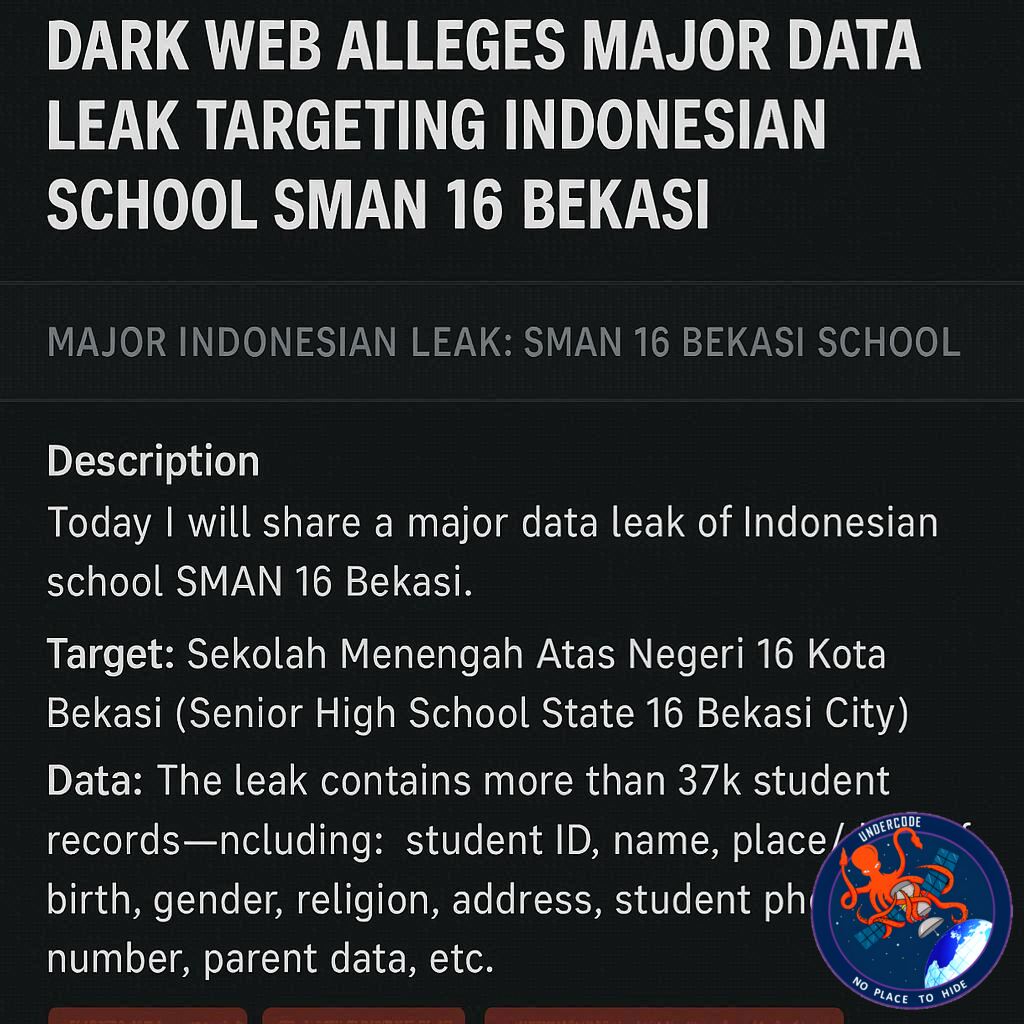
Introduction: A New Cybersecurity Alarm in Indonesia’s Education Sector
A fresh claim emerging from the dark web has sparked concern across Indonesia’s digital landscape. A threat actor has allegedly accessed and leaked sensitive data linked to SMAN 16 Bekasi, a public educational institution. While the claims remain unverified, the incident highlights a growing and troubling pattern—schools are becoming prime targets for cybercriminals. As institutions digitize their operations, the risks surrounding student and administrative data continue to escalate.
the Original Report
A post circulating on a dark web forum suggests that a malicious actor has obtained unauthorized access to a database associated with SMAN 16 Bekasi. The post reportedly advertises data that could belong to the institution, though no concrete proof has yet been provided to validate the claim. At this stage, cybersecurity observers have not confirmed whether the breach is real, how extensive it might be, or what kind of data is involved.
The source of the claim, an account focused on dark web intelligence monitoring, notes that such posts are not uncommon. However, they often require careful verification before being taken at face value. The alleged breach is said to involve database-level access, which could potentially include sensitive records related to students, staff, or school administration systems.
Educational institutions, particularly in developing digital ecosystems, often maintain large volumes of personal and operational data. This includes academic records, identification details, contact information, and sometimes even financial data. When stored across interconnected systems without robust cybersecurity measures, these datasets become attractive targets for hackers.
The post also emphasizes that no official confirmation has been issued by SMAN 16 Bekasi or relevant Indonesian authorities. This leaves the situation in a state of uncertainty, where the claim could either represent a serious breach or simply another attempt by threat actors to gain attention or sell fabricated data.
Meanwhile, the monitoring group has stated that it will continue observing developments related to this claim. Verification efforts typically involve analyzing sample data, cross-checking with known breaches, and assessing whether the data matches real-world records.
The broader context shows a rising trend of cyber threats aimed at educational institutions worldwide. Schools often lack the same level of cybersecurity infrastructure as corporations or government agencies, making them easier targets. This alleged incident, whether real or not, fits into that larger pattern.
In parallel, another unrelated claim surfaced around the same time, involving a supposed leak of an Israeli passport database. Like the SMAN 16 Bekasi case, that claim also remains unverified, reinforcing the idea that dark web forums frequently host unconfirmed or exaggerated breach announcements.
At present, there is no evidence indicating the scale, impact, or authenticity of the SMAN 16 Bekasi data leak. The situation remains under observation, with cybersecurity analysts urging caution and patience until more concrete information becomes available.
What Undercode Say: The Bigger Picture Behind Dark Web Claims
The alleged breach targeting SMAN 16 Bekasi is less about a single institution and more about a systemic vulnerability that continues to be ignored. Educational institutions are quietly becoming one of the most exploited sectors in cybersecurity, yet they rarely receive the same attention as banks, tech firms, or government systems.
The first issue lies in perception. Schools are not traditionally seen as high-value targets, but that assumption is outdated. In reality, they store highly sensitive datasets—student identities, parental information, internal communications, and sometimes even national identification numbers. For cybercriminals, this is a goldmine for identity theft, phishing campaigns, and long-term exploitation.
Second, the digital transformation of education has outpaced security readiness. Many schools rapidly adopted online systems, cloud platforms, and digital administration tools without implementing strong cybersecurity frameworks. This creates fragmented infrastructures where vulnerabilities are easy to exploit.
Another key factor is budget limitation. Unlike corporations, educational institutions often operate under strict financial constraints. Cybersecurity investments are typically deprioritized in favor of academic resources, leaving systems outdated and poorly protected.
Dark web claims themselves also follow a pattern. Threat actors frequently post alleged leaks to test market interest. Sometimes the data is real, sometimes partially real, and in many cases completely fabricated. The goal is often to attract buyers or gain reputation within underground communities. This makes verification extremely challenging.
However, even unverified claims can cause damage. They create panic, erode trust, and force institutions into reactive positions. If students and parents believe their data might be compromised, the reputational fallout can be severe regardless of whether the breach actually occurred.
From an intelligence standpoint, monitoring these claims is essential. Early detection allows institutions to respond quickly, investigate potential vulnerabilities, and communicate transparently. Silence or delayed responses often worsen the situation.
There is also a geopolitical angle to consider. As more countries digitize their education systems, cyber threats are no longer just criminal—they can become strategic. Data from schools can be used for profiling populations, targeting future workforces, or even influencing societal structures.
The SMAN 16 Bekasi case, whether real or not, should be treated as a warning signal. It exposes the gap between digital adoption and cybersecurity preparedness. Waiting for confirmation before taking action is a risky approach in today’s threat landscape.
Institutions need proactive defenses—regular security audits, staff training, encryption protocols, and incident response strategies. Cybersecurity should not be an afterthought; it must be integrated into the core infrastructure of educational systems.
Ultimately, the real issue is not whether this specific breach is authentic. The real issue is that it is entirely plausible—and that alone should be concerning.
Fact Checker Results
The claim originates from a dark web forum and remains unverified, meaning no confirmed breach has been established.
There is currently no official statement from SMAN 16 Bekasi or Indonesian authorities confirming the incident.
Similar dark web claims frequently appear and are often exaggerated or false, requiring careful validation before conclusions.
Prediction
Cyber threats targeting educational institutions will continue to rise as digital adoption expands without matching security investment. Incidents like this—verified or not—will push governments and schools to strengthen cybersecurity policies, but progress may remain uneven. In the near future, expect stricter data protection regulations in the education sector and increased collaboration with cybersecurity firms to prevent large-scale breaches.
🕵️📝Let’s dive deep and fact‑check.
References:
Reported By: x.com
Extra Source Hub (Possible Sources for article):
https://www.discord.com
Wikipedia
OpenAi & Undercode AI
Image Source:
Unsplash
Undercode AI DI v2
Bing
🔐JOIN OUR CYBER WORLD [ CVE News • HackMonitor • UndercodeNews ]
📢 Follow UndercodeNews & Stay Tuned:
𝕏 formerly Twitter 🐦 | @ Threads | 🔗 Linkedin | 🦋BlueSky | 🐘Mastodon


