
Listen to this Post
Introduction: A Cyber Shockwave Through Israel’s Health System
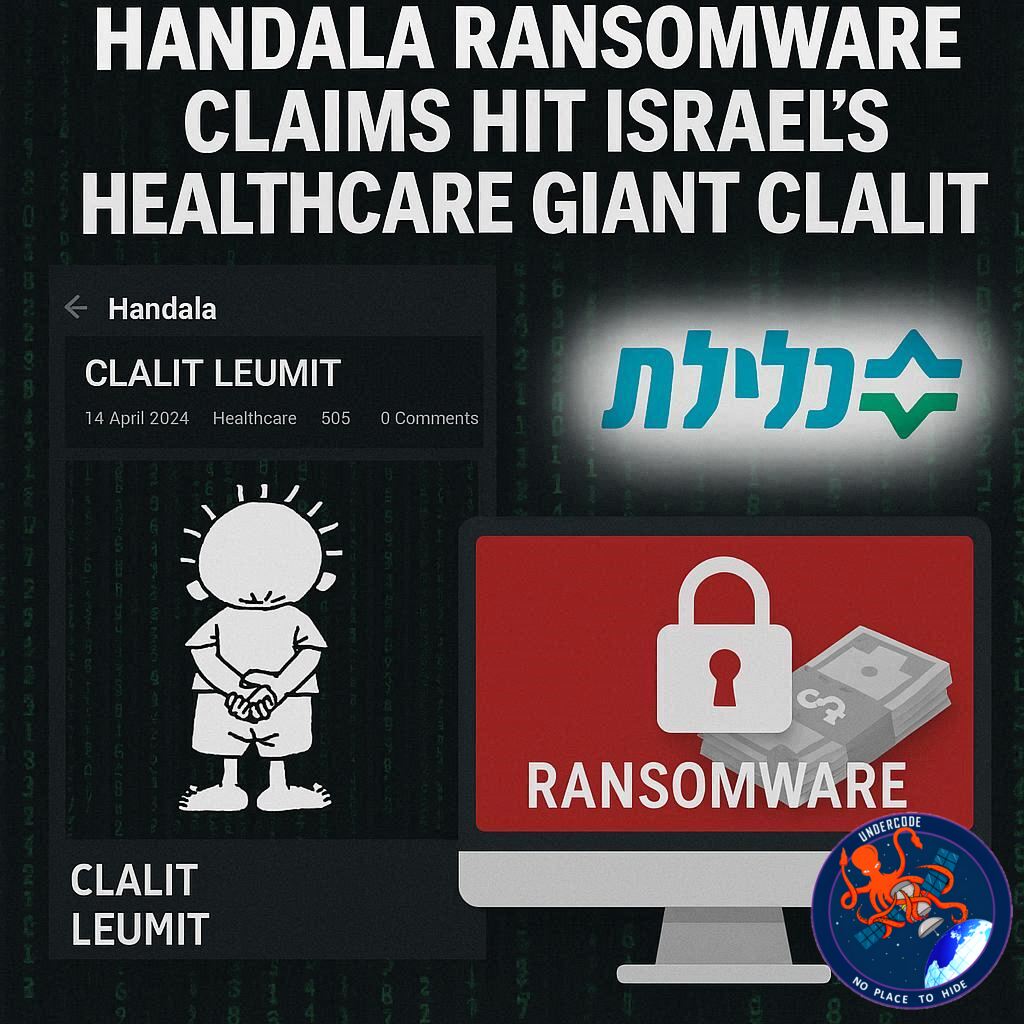
In the early hours of February 25, 2026, a new claim surfaced from the dark web that sent ripples through the global cybersecurity community. According to threat intelligence monitoring, the ransomware group known as “Handala” publicly listed Clalit Healthcare Services, Israel’s largest healthcare provider, as one of its latest victims.
While no immediate operational shutdown was confirmed, the allegation alone raises serious concerns. When a healthcare organization of this scale is named by a ransomware collective, the potential consequences extend far beyond data loss—patient trust, national resilience, and critical infrastructure stability all come into play.
the Original Report
The original report originates from dark web ransomware activity tracked by the ThreatMon Threat Intelligence Team. At approximately 6:20 AM on February 25, 2026 (UTC+3), the “Handala” ransomware group allegedly added Clalit Healthcare Services to its victim list. The information was shared publicly via social media monitoring channels, gaining moderate traction and visibility within cybersecurity circles.
The claim itself was brief and declarative, offering no technical proof such as leaked data samples, screenshots, or ransom notes. It relied primarily on attribution by monitoring tools associated with ThreatMon, an end-to-end threat intelligence platform focused on indicators of compromise (IOCs) and command-and-control (C2) infrastructure.
No official confirmation or denial was issued by Clalit at the time of posting. Likewise, no public statement detailed whether patient data, internal systems, or operational services were affected. The report exists primarily as an intelligence alert rather than a confirmed breach disclosure.
Despite its short format, the post underscores a broader pattern: ransomware groups increasingly target healthcare institutions to maximize pressure and public attention. The listing of Clalit, given its size and national importance, immediately elevated the claim’s perceived severity within the cybersecurity community.
What Undercode Say:
Strategic Context of the Alleged Attack
From an analytical standpoint, the alleged targeting of Clalit fits a well-established ransomware playbook. Healthcare organizations are high-value targets due to their reliance on continuous system availability, sensitive patient data, and regulatory pressure. Even an unverified claim can force institutions into crisis-mode decision-making.
Handala’s Messaging Over Mechanics
Notably, the “Handala” group has shown a tendency toward politically charged branding and psychological operations. By naming a nationally significant Israeli healthcare provider, the group amplifies symbolic impact regardless of whether deep technical compromise occurred. This suggests that reputation damage may be as important as financial extortion.
Absence of Proof Is a Signal in Itself
The lack of leaked samples or cryptographic proof does not automatically invalidate the claim—but it does weaken it. Mature ransomware groups often release partial data to establish credibility. Silence on this front may indicate an early-stage intrusion, a failed attack, or deliberate information withholding.
Threat Intelligence vs. Confirmed Breach
Threat intelligence alerts are not breach confirmations. They are signals—sometimes noisy, sometimes precise. In this case, the reliance on dark web listings without corroboration places the incident in a gray zone. Analysts should treat it as a high-risk indicator, not a verified event.
Healthcare Cyber Resilience Under Pressure
Regardless of this claim’s ultimate accuracy, the broader trend is undeniable. Healthcare systems are under sustained cyber pressure, and geopolitical tensions increasingly bleed into cyberspace. Organizations like Clalit must operate under the assumption that public claims alone can trigger reputational and operational harm.
Why This Claim Still Matters
Even if disproven later, such claims test incident response readiness, media handling, and stakeholder communication. In modern cyber conflict, perception can be nearly as damaging as actual system compromise.
🔍 Fact Checker Results
Verification Status of the Claim
✅ The dark web listing attributed to “Handala” was detected by a known threat intelligence platform.
❌ No public technical evidence or data leak has been released to substantiate the claim.
❌ No official confirmation from Clalit Healthcare Services was available at the time of reporting.
📊 Prediction
What Likely Comes Next
Increased monitoring of dark web channels for proof-of-life data leaks linked to Clalit.
A possible public statement or denial from Clalit to contain reputational impact.
Continued escalation of ransomware narratives targeting healthcare as both financial and symbolic leverage.
🕵️📝✔️Let’s dive deep and fact‑check.
References:
Reported By: x.com
Extra Source Hub (Possible Sources for article):
https://www.reddit.com/r/AskReddit
Wikipedia
OpenAi & Undercode AI
Image Source:
Unsplash
Undercode AI DI v2
Bing
🔐JOIN OUR CYBER WORLD [ CVE News • HackMonitor • UndercodeNews ]
📢 Follow UndercodeNews & Stay Tuned:
𝕏 formerly Twitter 🐦 | @ Threads | 🔗 Linkedin | 🦋BlueSky | 🐘Mastodon


