
Listen to this Post
Introduction: A Leak That Shook Turkey’s ISP Sector
A fresh claim emerging from dark web monitoring circles has ignited serious concern across Turkey’s digital landscape. According to a post circulating on social media and attributed to a dark web intelligence source, one of the country’s internet service providers may have suffered a deep and damaging security breach. The allegation points to a silent software backdoor, the kind that evades routine detection, potentially exposing highly sensitive personal data belonging to thousands of customers in Turkey. While authorities have not yet confirmed the incident, the scale and nature of the leaked information have already triggered alarm among cybersecurity observers.
the Original
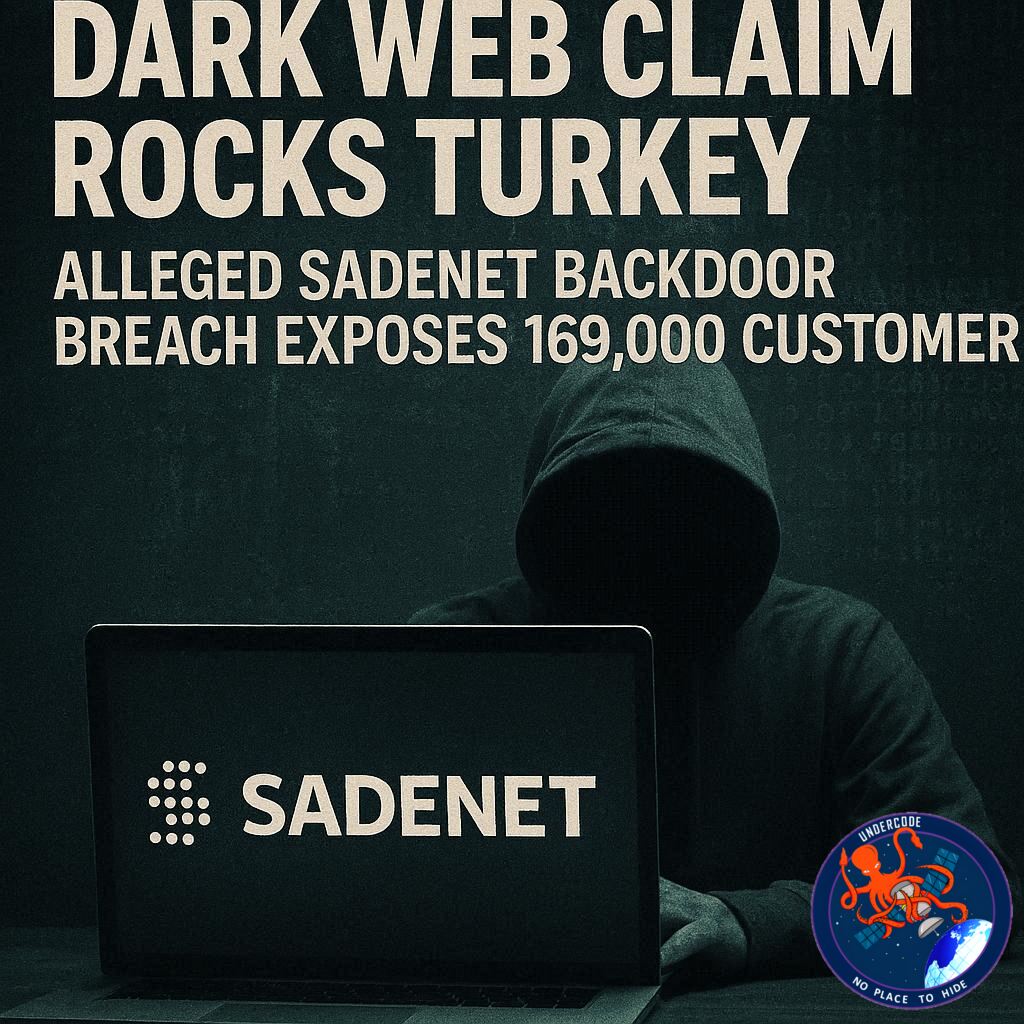
The original report, shared by Dark Web Intelligence, claims that Turkish ISP Sadenet was allegedly breached through a hidden software backdoor.
According to the post, attackers were able to extract more than 169,000 customer records.
These records reportedly contain critical personally identifiable information (PII).
Examples cited include national identification numbers and residential addresses.
Such data, if authentic, could enable identity theft, fraud, and long-term privacy violations.
The claim was amplified via the DailyDarkWeb platform, a source known for tracking underground cybercrime discussions.
No technical proof was publicly attached to the initial post.
There was also no immediate confirmation from Sadenet itself at the time of publication.
Despite this, the post gained rapid attention, drawing hundreds of views within hours.
The breach is described as originating from a software backdoor.
This suggests either a compromised internal system or a previously unknown vulnerability.
Backdoors are particularly dangerous because they can persist undetected for long periods.
The alleged data exposure affects ordinary customers rather than corporate accounts.
That detail significantly raises the potential social impact.
The report frames the incident as part of a broader pattern of ISP-targeted attacks.
Telecom providers are increasingly attractive targets due to the volume of sensitive data they hold.
The article stops short of assigning blame or identifying the threat actor.
Instead, it emphasizes the seriousness of the exposed data categories.
Readers are urged to treat the claim cautiously but not dismiss it outright.
What Undercode Say:
From an analytical standpoint, this alleged breach fits a worrying global trend rather than an isolated anomaly.
Internet service providers sit at the intersection of identity, location, and connectivity.
That makes them gold mines for threat actors seeking high-value civilian data.
The mention of a “software backdoor” is especially notable.
Backdoors often indicate either insider compromise or supply-chain weakness.
Both scenarios are harder to detect than standard external attacks.
If the claim is accurate, the breach may have gone unnoticed for months.
Turkey’s telecom infrastructure has expanded rapidly in recent years.
Rapid growth sometimes outpaces security maturity.
Smaller or regional ISPs can struggle to maintain advanced monitoring systems.
This creates asymmetric risk, where attackers need only one weak entry point.
Another red flag is the type of data allegedly exposed.
National ID numbers are considered high-risk identifiers.
Unlike passwords, they cannot simply be changed.
Once leaked, the damage becomes permanent rather than temporary.
Even if only a portion of the dataset is genuine, the implications are severe.
Criminal markets value verified identity data far more than email-password combos.
Such datasets are often reused for years across fraud schemes.
Equally important is the information source.
Dark web intelligence accounts sometimes publish unverified leads.
However, they often rely on direct access to underground forums and leak markets.
That places them closer to raw threat actor chatter than mainstream media.
The absence of an immediate denial or confirmation from Sadenet also matters.
Silence does not imply guilt, but prolonged silence increases uncertainty.
In modern breach response, speed of communication is part of damage control.
For Turkish consumers, the broader issue is trust.
ISPs are foundational services.
A loss of confidence can ripple across the digital economy.
Whether confirmed or denied, this allegation pressures providers to harden defenses.
🔍 Fact Checker Results
✅ The claim originates from a known dark web monitoring source.
❌ No independent forensic evidence has been released publicly so far.
⚠️ Sadenet has not issued an official confirmation or denial at the time of reporting.
📊 Prediction
If the allegation gains further traction or is validated, Turkish regulators are likely to respond quickly.
ISPs may face audits, mandatory disclosures, or tighter cybersecurity compliance rules.
Even if disproven, this incident will likely accelerate security investments across Turkey’s telecom sector.
🕵️📝✔️Let’s dive deep and fact‑check.
References:
Reported By: x.com
Extra Source Hub (Possible Sources for article):
https://www.pinterest.com
Wikipedia
OpenAi & Undercode AI
Image Source:
Unsplash
Undercode AI DI v2
Bing
🔐JOIN OUR CYBER WORLD [ CVE News • HackMonitor • UndercodeNews ]
📢 Follow UndercodeNews & Stay Tuned:
𝕏 formerly Twitter 🐦 | @ Threads | 🔗 Linkedin | 🦋BlueSky | 🐘Mastodon


