
Listen to this Post
Introduction: A New Allegation Emerges From the Dark Web
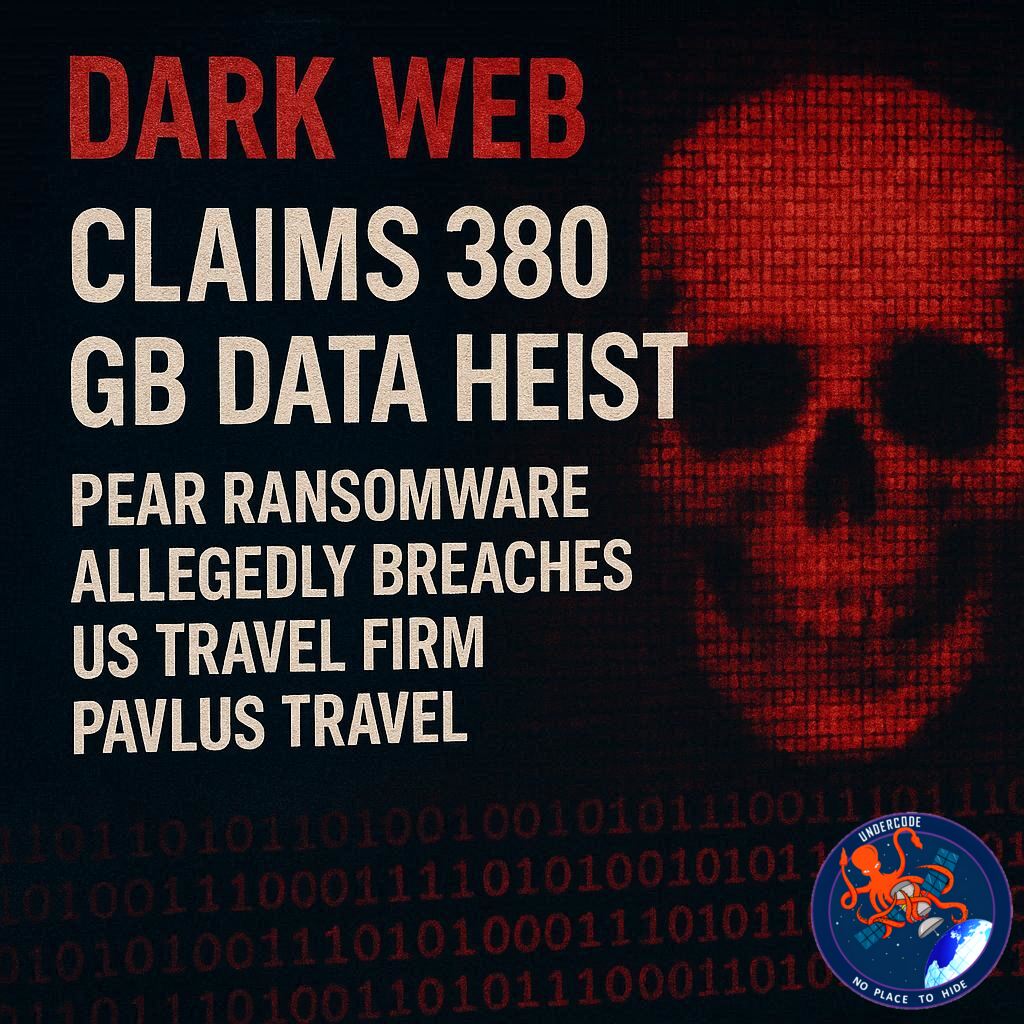
A fresh allegation circulating in dark web monitoring circles has put Pavlus Travel, a U.S.-based travel services company, in the spotlight. According to claims published by a dark web intelligence account, the PEAR ransomware group says it has successfully breached the company’s systems and exfiltrated a massive trove of sensitive data. While the company has not publicly confirmed the incident, the scale and nature of the alleged leak are already raising serious concerns across the cybersecurity and travel industries.
the Original Claim
The allegation originates from Dark Web Intelligence (@DailyDarkWeb), which reported that Pavlus Travel was targeted by the PEAR ransomware group. The attackers claim to have stolen approximately 380 GB of internal data, a volume that suggests deep and prolonged access to internal systems rather than a brief intrusion.
According to the post, the compromised data allegedly includes employee PHI (Protected Health Information), client records, and financial documents. If accurate, this would mean both internal staff and customers could be exposed to identity theft, fraud, or long-term privacy risks. The claim was shared publicly in the early hours of February 10, 2026, and linked to a longer write-up hosted on a dark web monitoring site.
The report does not include proof samples in the public post, nor does it confirm whether ransom demands have been issued or negotiations are underway. As with many ransomware claims, the information is presented unilaterally by the attackers or observers tracking them, without confirmation from the victim organization.
PEAR is a relatively lesser-known ransomware group compared to major syndicates, but like many emerging crews, it appears to rely on public shaming and data-leak threats to pressure victims into paying. The mention of sensitive travel client data and employee health-related records suggests that the attackers are emphasizing reputational and regulatory damage as leverage.
At the time of reporting, Pavlus Travel had not issued a public statement confirming or denying the breach. This silence leaves open multiple possibilities: the company may still be investigating, may be engaged in private incident response, or the claim itself may be exaggerated or partially inaccurate.
Nevertheless, the incident fits a broader pattern seen across 2025 and early 2026, where service-oriented companies—especially those handling personal and financial data—have increasingly become targets for ransomware groups seeking high-impact victims with lower security maturity than large tech firms.
What Undercode Say:
From an analytical standpoint, this alleged breach highlights several uncomfortable truths about the current ransomware ecosystem. First, the claimed data volume of 380 GB is not trivial. Exfiltrating that amount of data typically requires either weak network monitoring, misconfigured cloud storage, or extended dwell time within the victim’s infrastructure. Any of those scenarios would point to systemic security gaps rather than a single missed patch.
Second, the specific mention of employee PHI is strategically chosen. In the United States, health-related data is among the most regulated categories of information. Even the suggestion that PHI may have been exposed can trigger legal scrutiny, mandatory disclosures, and potential regulatory penalties. Ransomware groups are increasingly aware of this and tailor their narratives to maximize pressure.
Third, travel companies remain an attractive target because they aggregate high-value personal data: passports, payment details, travel histories, and sometimes medical or accessibility information. Unlike banks, many travel firms operate on thinner margins and older IT systems, making them more vulnerable to both intrusion and extortion.
Another critical factor is the role of dark web “intelligence” accounts. While they provide early warnings, they also act as amplifiers for attacker claims. This creates a challenging environment where unverified information can spread faster than official incident responses. Organizations often lose control of the narrative before they are ready to speak publicly.
It is also worth noting that newer ransomware groups like PEAR may exaggerate claims to build credibility. Inflated data sizes or broad descriptions of stolen information are common tactics used to attract attention and intimidate victims. Until proof-of-leak samples or third-party confirmations emerge, skepticism remains warranted.
From a defensive perspective, this case reinforces the importance of data minimization and segmentation. If attackers can only access limited datasets, their leverage drops significantly. Companies that still store years of legacy client data in flat, accessible repositories are effectively stockpiling risk.
Finally, the silence from Pavlus Travel—while understandable during an investigation—illustrates the tension between incident response best practices and public trust. In 2026, stakeholders increasingly expect rapid acknowledgment, even if details are still emerging. Delayed communication often fuels speculation and erodes confidence more than the breach itself.
Fact Checker Results 🔍
✅ The claim originates from a dark web monitoring source and attributes the attack to the PEAR ransomware group.
❌ There is currently no public confirmation from Pavlus Travel verifying the breach or the 380 GB data theft claim.
✅ The types of data mentioned align with common ransomware extortion tactics but remain unverified.
📊 Prediction
Ransomware groups will continue targeting mid-sized service companies like travel firms, using large, attention-grabbing data theft claims to force rapid settlements. In the coming months, increased regulatory pressure and customer scrutiny are likely to push more organizations toward faster public disclosure and stronger zero-trust security models.
🕵️📝✔️Let’s dive deep and fact‑check.
References:
Reported By: x.com
Extra Source Hub (Possible Sources for article):
https://www.twitter.com
Wikipedia
OpenAi & Undercode AI
Image Source:
Unsplash
Undercode AI DI v2
Bing
🔐JOIN OUR CYBER WORLD [ CVE News • HackMonitor • UndercodeNews ]
📢 Follow UndercodeNews & Stay Tuned:
𝕏 formerly Twitter 🐦 | @ Threads | 🔗 Linkedin | 🦋BlueSky | 🐘Mastodon


