
Listen to this Post
Introduction
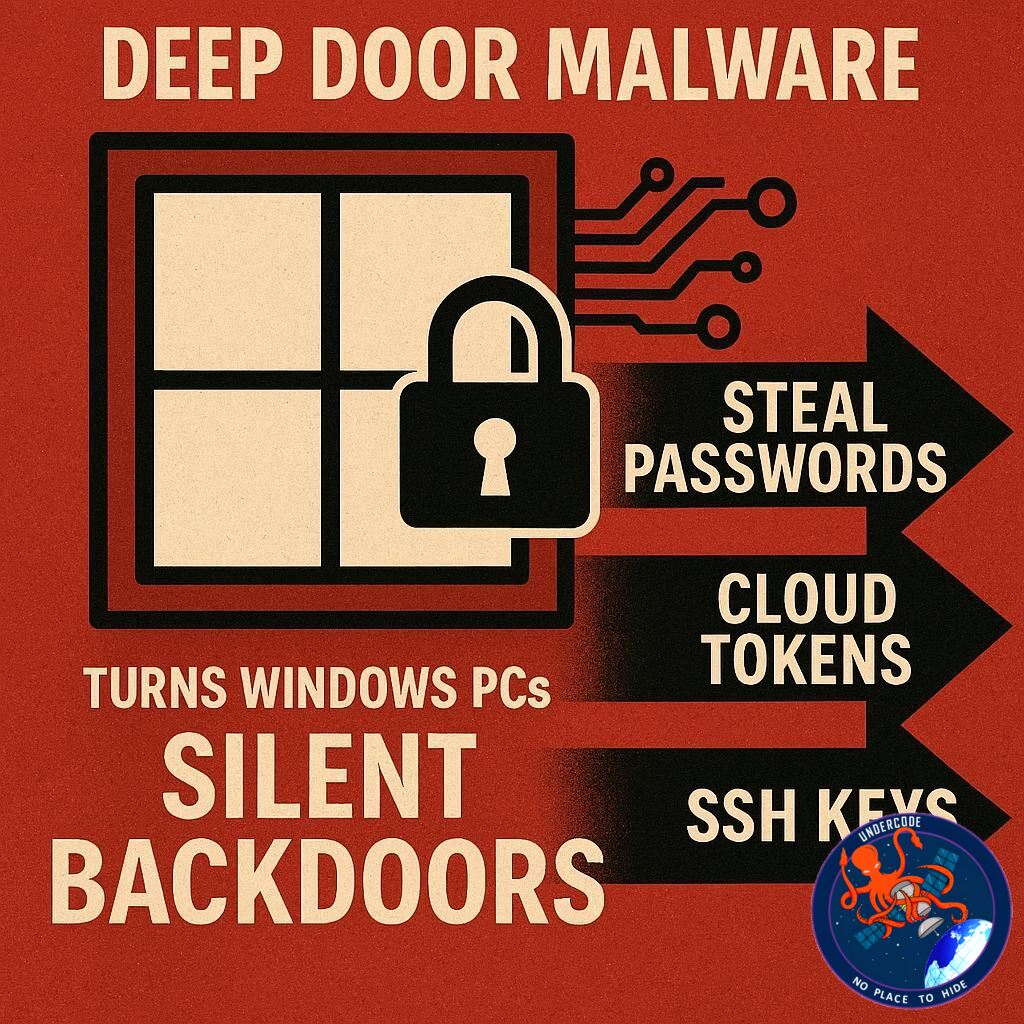
A newly exposed malware campaign known as DeepDoor is raising serious alarms in the cybersecurity world. Unlike basic password stealers that focus only on browser logins, this threat is built for long-term access, silent persistence, and deep credential theft. Security researchers describe it as a highly capable Windows backdoor that can quietly remain active while harvesting sensitive information from infected systems.
What makes DeepDoor especially dangerous is its ability to combine several attack methods into one package. It can disable security protections, survive reboots, evade detection, and collect everything from saved passwords to cloud credentials and administrator SSH keys. In practical terms, a single infected laptop could become the gateway to an entire business network.
DeepDoor Is Far More Than a Password Stealer
The malware begins its infection chain with a batch script called install_obf.bat. This file does more than execute commands. It contains an embedded Python payload hidden inside itself. Once launched, it extracts the malicious code and writes it to disk as svc.py, placing it inside a fake service folder to appear legitimate.
This tactic gives attackers an advantage. Since the malware does not need to immediately download a second payload from the internet, it creates less suspicious network traffic. Many security tools monitor unusual outbound downloads as an early warning sign, so DeepDoor attempts to avoid that visibility from the start.
The malware’s self-contained design also speeds up infections. Everything required to establish the backdoor already exists in the initial file, reducing delays and lowering the chance of detection.
Security Defenses Are Targeted Early
Before activating fully, DeepDoor reportedly attempts to weaken the infected machine’s defenses.
Researchers say the malware tampers with or disables several Windows security components, including:
Microsoft Defender protections
PowerShell logging
Firewall logging
AMSI scanning
ETW telemetry
Windows event logs
This is a major concern because these systems often help analysts trace malicious behavior after an attack. If logs are erased or security tools are bypassed, investigators lose visibility into what happened.
The malware also uses anti-analysis techniques. It checks whether it is running inside a sandbox, virtual machine, or debugger environment. If suspicious conditions are detected, the malware may reduce activity or hide completely.
Built to Survive Cleanup Attempts
DeepDoor is designed to remain active even after defenders attempt removal.
It reportedly creates multiple persistence methods, including:
Startup folder entries
Registry Run keys
Scheduled tasks
Optional WMI subscriptions
More concerning is a watchdog routine that monitors these persistence points. If one method is removed, the malware can recreate missing artifacts automatically.
That means defenders may think they cleaned the infection, only for it to silently return after reboot.
What DeepDoor Can Steal
Once established, the malware behaves like a full remote access trojan.
Capabilities include:
Keylogging typed passwords
Clipboard monitoring
Screenshot capture
Webcam access
Microphone recording
Remote command execution
System reconnaissance
This gives attackers both visibility and control over the victim system.
Credential Theft Extends Beyond Browsers
DeepDoor does not stop at browser passwords.
Researchers say it targets:
Chrome stored credentials
Firefox saved logins
SSH private keys
Windows Credential Manager secrets
AWS credentials
Microsoft Azure tokens
Google Cloud credentials
This makes the malware especially dangerous for IT administrators, developers, and remote workers.
For example, one infected device could expose:
Personal email passwords
Corporate VPN access
SSH keys for production servers
Cloud tokens managing infrastructure
That single compromise could escalate into a full enterprise breach.
Clever Command-and-Control Techniques
DeepDoor reportedly uses bore[.]pub as part of its command-and-control communication. Instead of relying only on attacker-owned servers, it leverages a tunneling-style service that may blend into normal traffic patterns.
This makes detection harder because defenders often block known malicious infrastructure, but traffic routed through common services can appear legitimate.
Researchers also noted:
Encoded configuration values
Dynamic port generation
Challenge-response authentication
Automatic reconnection attempts
Port scanning for active endpoints
These features help the malware stay connected even when network conditions change or defenders block certain ports.
Warning Signs for Defenders
Security teams should investigate systems showing:
Unexpected batch file execution
PowerShell tampering
Missing security logs
Suspicious scheduled tasks
Tunnel-like outbound connections
Unusual credential access activity
Memory inspection may also reveal patched system libraries or hidden malicious processes.
What Undercode Say:
DeepDoor reflects a modern shift in malware design. Attackers no longer depend on loud ransomware or obvious trojans. Instead, they want quiet, persistent access that can be monetized later.
Stealing passwords alone is valuable, but stealing cloud tokens and SSH keys is even more profitable. Those credentials can bypass many traditional defenses because they belong to legitimate users.
This campaign also highlights a growing trend: using scripting languages like Python inside Windows malware. Python gives threat actors flexibility, faster development, and easier updates compared to traditional compiled malware.
Another notable point is persistence layering. Many organizations still focus on antivirus alerts but overlook startup folders, WMI subscriptions, and registry abuse. Malware writers know this and intentionally spread across multiple persistence paths.
The use of tunneling infrastructure is equally strategic. It allows malicious traffic to hide among ordinary administrative or developer tools. Blocking every tunnel service is difficult because many legitimate teams use similar platforms.
For businesses, the real danger is identity compromise. Once attackers steal cloud access tokens or admin SSH keys, they may not need malware anymore. They can simply log in as authorized users.
This turns endpoint infections into identity attacks.
DeepDoor also demonstrates why laptops used for both personal and business activity are risky. A single machine storing saved passwords, developer keys, and browser sessions becomes a treasure chest.
Organizations should strengthen:
Multi-factor authentication
Hardware-backed key storage
Privileged access separation
Endpoint detection tools
Cloud token monitoring
User behavior analytics
Traditional antivirus alone is no longer enough.
The malware’s silent and layered approach suggests attackers are prioritizing long-term espionage, credential resale, or later-stage ransomware deployment.
DeepDoor may be one campaign today, but its techniques are likely to be copied by many others tomorrow.
Fact Checker Results
✅ DeepDoor is described as more than a password stealer, with backdoor capabilities and persistence mechanisms.
✅ It reportedly targets browser passwords, SSH keys, and cloud credentials including AWS, Azure, and Google Cloud.
❌ No public evidence in the provided report confirms the exact threat actor or geographic origin of the campaign.
Prediction
🔮 Malware campaigns like DeepDoor will increasingly focus on identity theft instead of file destruction.
🔮 More attackers will abuse legitimate tunneling services to hide command-and-control traffic.
🔮 Security teams will shift investment toward credential monitoring and behavioral detection rather than signature-based antivirus alone.
🕵️📝Let’s dive deep and fact‑check.
References:
Reported By: cyberpress.org
Extra Source Hub (Possible Sources for article):
https://www.quora.com/topic/Technology
Wikipedia
OpenAi & Undercode AI
Image Source:
Unsplash
Undercode AI DI v2
Bing
🔐JOIN OUR CYBER WORLD [ CVE News • HackMonitor • UndercodeNews ]
📢 Follow UndercodeNews & Stay Tuned:
𝕏 formerly Twitter 🐦 | @ Threads | 🔗 Linkedin | 🦋BlueSky | 🐘Mastodon


