
Listen to this Post
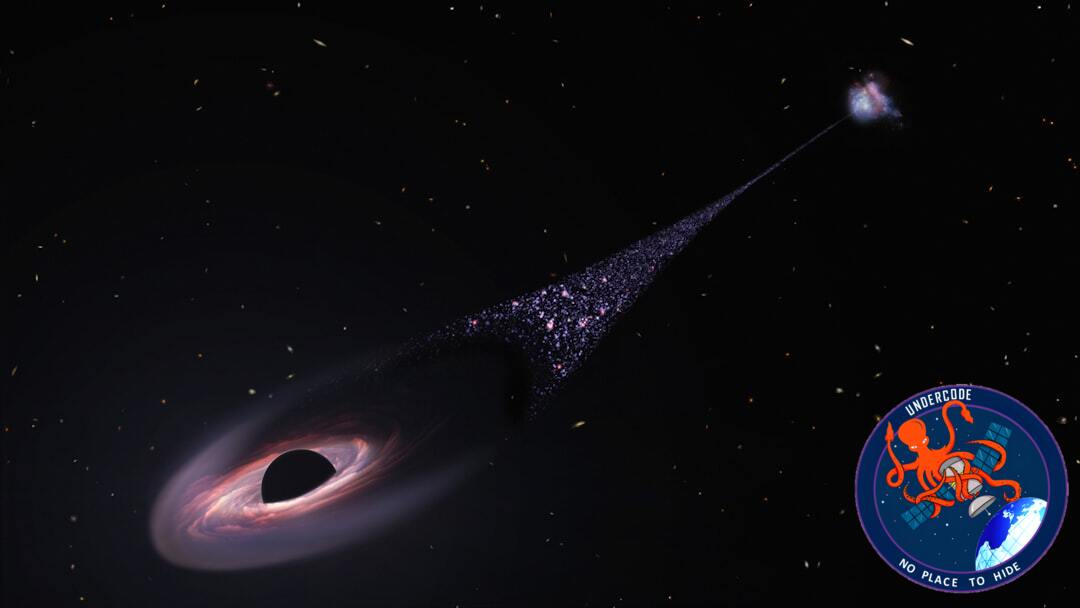
Introduction
For decades, astronomers believed galaxies came first. The traditional idea suggested that stars formed inside young galaxies, massive stars eventually died and collapsed into black holes, and over billions of years those black holes merged and consumed surrounding matter until they became supermassive giants. It was a logical sequence that shaped how scientists understood the birth and evolution of the universe.
But a groundbreaking discovery using the James Webb Space Telescope is now challenging that entire picture. Researchers studying one of the earliest known cosmic objects have found evidence suggesting that some enormous black holes may have formed first, long before fully developed galaxies existed around them.
If confirmed, this finding could fundamentally change one of astronomy’s most established theories and force scientists to rethink how structures in the early universe emerged.
A Cosmic Mystery Scientists Could Not Explain
Astronomers have long struggled to understand how supermassive black holes appeared so quickly after the Big Bang. Thousands of giant black holes have been detected in the early universe, many containing millions or even billions of times the mass of our Sun.
The problem is timing.
Under conventional models, black holes begin as remnants of massive stars. Those stellar black holes gradually grow by merging with others and absorbing surrounding gas and matter. However, the early universe simply may not have provided enough time for some of these giant objects to grow naturally into the enormous structures scientists observe today.
This mystery has fueled years of debate among astronomers.
Now researchers using NASA’s James Webb Space Telescope may finally have evidence pointing toward a completely different explanation.
The Discovery of Abell2744-QSO1
Scientists focused their investigation on an object known as Abell2744-QSO1, sometimes called QSO1, an extremely distant object that existed only about 700 million years after the Big Bang.
QSO1 belongs to a category of mysterious objects astronomers call “Little Red Dots,” compact and unusually bright sources discovered by the James Webb telescope in the distant universe.
Although QSO1 spans only around 1,300 light-years across, its light traveled over 13 billion years before reaching Earth.
Researchers had an advantage when studying this object because it sits behind the massive galaxy cluster Abell 2744, often nicknamed Pandora’s Cluster. The cluster acts like a cosmic magnifying glass through gravitational lensing, enlarging and duplicating the appearance of distant objects.
QSO1 appears in three separate positions in the sky due to this gravitational effect, giving astronomers a rare opportunity to examine it in remarkable detail.
Initial observations hinted something extraordinary.
Scientists suspected that QSO1 might consist primarily of glowing hydrogen and helium gas orbiting around a massive black hole approximately 40 million times heavier than our Sun.
But proving that idea required direct evidence.
Measuring the Impossible
A major challenge in studying ancient black holes is that scientists usually estimate their mass indirectly.
Astronomers typically rely on assumptions derived from nearby galaxies and apply them to distant cosmic environments. But researchers could never be entirely certain whether those assumptions remained accurate billions of years into the past.
The James Webb Space Telescope changed that.
Using Webb’s Near Infrared Spectrograph instrument, researchers tracked hydrogen gas swirling around the center of QSO1.
Graduate researcher Ignas Juodžbalis and scientist Cosimo Marconcini mapped how hydrogen moved through the system.
The results revealed a striking pattern.
The gas followed Keplerian motion, orbiting the center in a way similar to how planets orbit the Sun.
This was critical.
If stars contributed most of QSO1’s mass, gravity would produce a different motion pattern. Instead, nearly all gravitational influence pointed toward one concentrated central object.
A black hole.
For the first time, researchers directly measured the mass of an ancient black hole from the universe’s earliest period.
The answer shocked them.
An Enormous Black Hole in a Tiny Environment
The black hole inside QSO1 weighs approximately 50 million solar masses.
Even more astonishing, it appears to account for at least two-thirds of the entire object’s mass.
That ratio is dramatically different from nearby galaxies today.
Modern galaxies typically contain black holes representing only a tiny fraction of total galactic mass.
QSO1 breaks that pattern completely.
Researchers also examined the chemical composition of material surrounding the black hole.
The environment contained almost pure hydrogen and helium, with extremely low amounts of heavier elements like oxygen.
Astronomers call heavier elements “metals,” and they are generally produced by stars over time.
QSO1 contained less than 0.5% of the Sun’s metallicity.
That makes it one of the cleanest and most untouched cosmic environments ever observed.
The evidence suggests something extraordinary.
This black hole likely did not emerge from generations of stars slowly collapsing and merging.
It may have been born enormous.
Could Black Holes Come Before Galaxies?
The implications are enormous.
Scientists now believe QSO1 may represent evidence for direct-collapse black holes or primordial black holes.
Primordial black holes are hypothetical objects that may have formed during the earliest moments following the Big Bang itself.
Another possibility involves giant gas clouds collapsing directly into massive black holes without needing stars as an intermediate step.
Either explanation challenges traditional galaxy-first theories.
Instead of galaxies creating black holes, massive black holes may have acted as cosmic anchors that later attracted gas, dust, and stars to build galaxies around them.
In other words, black holes might have come first.
Researchers believe QSO1 may not be unique.
Scientists are already studying additional Little Red Dots discovered by James Webb to determine whether early giant black holes commonly existed before galaxies fully formed.
If similar examples appear repeatedly, astronomy textbooks may eventually require major revisions.
Deep Analysis
The importance of this discovery goes beyond simply identifying another large black hole.
It attacks one of cosmology’s core assumptions about structure formation.
Modern astronomy largely views galaxy evolution as a bottom-up process. Small objects form first, gradually combining into larger structures.
QSO1 introduces evidence supporting a more complex picture.
Massive black holes appearing almost immediately after cosmic birth suggest certain regions of the early universe evolved dramatically faster than expected.
This also demonstrates the transformational power of the James Webb Space Telescope.
Previous observatories struggled to probe such distant cosmic history with enough precision.
Webb is changing that rapidly.
Little Red Dots themselves have become one of astronomy’s biggest surprises since Webb began operations.
Scientists did not predict finding so many compact, red, bright sources in the early universe.
Now those mysterious objects may become key evidence for understanding how the universe organized itself shortly after creation.
Another major implication involves dark matter and early cosmic density fluctuations.
If primordial black holes truly exist, they may connect with some of physics’ deepest unanswered questions.
The discovery also reinforces an important scientific principle.
Good theories survive testing.
Great discoveries happen when observations force old theories to evolve.
Astronomy repeatedly advances through moments exactly like this.
Scientists believed galaxies created black holes.
James Webb may now reveal the opposite.
What Undercode Say:
This discovery highlights a growing trend in modern astronomy: observational technology is advancing faster than theoretical models can adapt.
James Webb is not merely confirming existing knowledge. It is exposing areas where scientific understanding remains incomplete.
QSO1 represents more than a distant object. It acts as a stress test for decades of astrophysical assumptions.
If black holes formed before galaxies, researchers may need to redesign simulations explaining early universe evolution.
Supercomputer models built around slow black hole growth may no longer fully match observations.
Another fascinating angle involves galaxy engineering at cosmic scales.
A giant black hole naturally influences surrounding gas through gravity. If enough material accumulates, star formation begins.
This means black holes may not simply live inside galaxies.
They may actively create conditions that allow galaxies to emerge.
That reverses traditional thinking.
The finding also demonstrates why early universe astronomy remains one of science’s most exciting frontiers.
Looking farther into space means looking farther backward in time.
James Webb effectively functions as a time machine.
Every ancient object discovered becomes a data point describing cosmic infancy.
Little Red Dots may eventually become one of Webb’s most important scientific legacies.
Scientists originally expected them to be observational oddities.
Instead, they could reveal a hidden phase of universe formation previously invisible to humanity.
The discovery further emphasizes how science progresses.
Old ideas are not failures.
They are foundations.
New evidence improves those foundations.
The galaxy versus black hole question may ultimately reshape cosmology similarly to how discoveries about dark energy transformed astronomy decades ago.
If future observations confirm QSO1 is not unusual, astronomy may enter an entirely new era of understanding cosmic origins.
That possibility alone makes this one of the most important James Webb discoveries yet.
Fact Checker Results
✅ Researchers directly measured the black hole mass in QSO1 using gas motion observations from the James Webb Space Telescope.
✅ QSO1 exists approximately 700 million years after the Big Bang and contains an unusually massive black hole relative to its size.
❌ Scientists have not definitively proven primordial black holes exist. Current findings provide evidence supporting possibilities, not final confirmation.
Prediction
🔭 Future James Webb observations will likely identify additional early universe objects similar to QSO1.
🚀 Cosmological models explaining galaxy formation may require significant updates within the next decade.
🌌 The idea that supermassive black holes formed before galaxies could evolve from a controversial hypothesis into mainstream astrophysical theory if more evidence emerges.
▶️ Related Video (80% Match):
🕵️📝Let’s dive deep and fact‑check.
References:
Reported By: science.nasa.gov
Extra Source Hub (Possible Sources for article):
https://www.instagram.com
Wikipedia
OpenAi & Undercode AI
Image Source:
Unsplash
Undercode AI DI v2
Bing
🎓 Live Courses & Certifications:
Join Undercode Academy for Verified Certifications
🚀 Request a Custom Project:
Secure, high-velocity infrastructure and disruptive technological engineering. Contact our engineering team for high-tier development and proprietary systems:
[email protected]
🔐JOIN OUR CYBER WORLD [ CVE News • HackMonitor • UndercodeNews ]
📢 Follow UndercodeNews & Stay Tuned:
𝕏 formerly Twitter 🐦 | @ Threads | 🔗 Linkedin | 🦋BlueSky | 🐘Mastodon | 📺Youtube


