
Listen to this Post
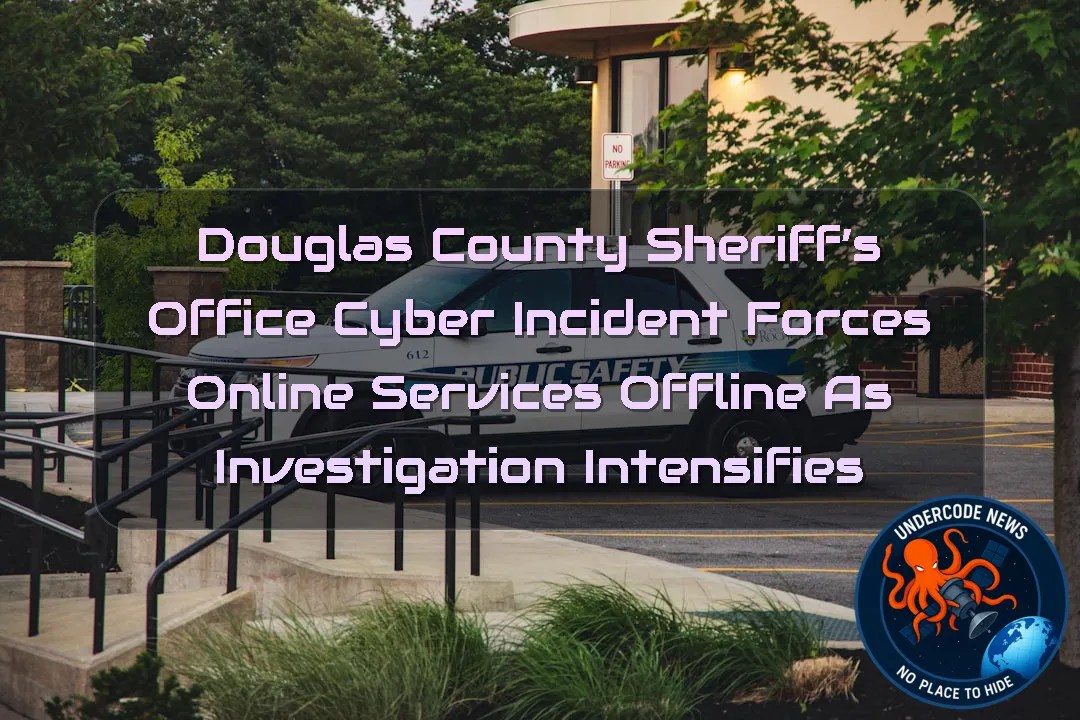 Introduction: When a Cyber Incident Becomes a Public Safety Concern
A cyberattack against a law enforcement agency is never just an IT problem. When systems supporting a sheriff’s office suddenly go offline, the consequences can reach far beyond websites and email accounts. Public services may be interrupted, internal communications can become more difficult, and sensitive law enforcement information may be placed at risk.
The Douglas County Sheriff’s Office has confirmed that it is dealing with a serious cyber incident that forced online services offline while suspicious activity is being investigated. Officials have released limited details, citing concerns involving public safety and confidential records.
The situation highlights a difficult reality facing public-sector organizations across the United States. Cybercriminals increasingly understand that government agencies, police departments, emergency services, healthcare providers, and local authorities operate systems that cannot simply remain unavailable indefinitely. Every hour of disruption can create operational pressure.
At this stage, the full scope of the Douglas County incident has not been publicly disclosed. It remains unclear what systems were accessed, whether data was taken, how the suspicious activity began, or whether the incident involved ransomware, unauthorized access, data theft, or another form of compromise.
What is clear is that the incident was serious enough to force online services offline and trigger an active investigation.
Original Incident Summary: Suspicious Activity Forces Systems Offline
According to the reported information, the Douglas County Sheriff’s Office experienced a serious cyber incident that resulted in online services being taken offline.
Authorities are reviewing suspicious activity connected to the incident while limiting the amount of information released publicly. The restricted disclosure appears to be connected to concerns over public safety and the protection of confidential records.
Law enforcement agencies maintain large volumes of highly sensitive information. Their systems can contain criminal investigations, witness information, evidence records, intelligence, personnel data, emergency communications, and other material that could create serious consequences if exposed or manipulated.
Because of these risks, investigators often cannot immediately disclose every technical detail during an active cyber incident.
The Douglas County case therefore represents more than a temporary technology outage. It is a developing cybersecurity event involving an organization responsible for public safety and sensitive government information.
Why a Sheriff’s Office Is a High-Value Cybersecurity Target
Law enforcement agencies represent attractive targets for cybercriminals because their environments contain valuable and sensitive information.
A successful compromise can potentially expose names, addresses, case information, evidence, investigative reports, internal communications, and other confidential records.
Attackers may also understand that police and sheriff departments cannot tolerate long-term disruption.
A normal business may temporarily operate with reduced digital services. A law enforcement organization, however, may depend on technology to support dispatch operations, records management, investigations, public communication, evidence handling, and coordination with other agencies.
This creates pressure.
Cybercriminals have repeatedly exploited operational pressure as part of extortion strategies.
An attacker does not necessarily need to encrypt every system to create a crisis. Stealing sensitive data, disrupting online portals, accessing internal systems, or threatening to release confidential records can be enough to place an organization under significant pressure.
Limited Disclosure Does Not Mean the Incident Is Minor
One important aspect of this case is the limited public disclosure.
Some observers may assume that a lack of technical details means that the incident was small. That assumption can be dangerous.
During an active investigation, organizations often restrict information because investigators are still determining what happened.
Prematurely releasing technical details could interfere with the investigation.
It could also reveal information that attackers could exploit.
In the case of law enforcement agencies, public statements must also consider the possible impact on active investigations, confidential records, victims, witnesses, officers, and public safety operations.
For this reason, the absence of detailed information should not automatically be interpreted as evidence that the event is insignificant.
The confirmed disruption of online services and the investigation into suspicious activity already demonstrate that the incident required a serious operational response.
The Risk to Confidential Records
Confidential data is one of the most serious concerns in any cyber incident involving law enforcement.
Records held by
This could include investigative materials, personal information, internal reports, criminal intelligence, evidence-related documentation, and other sensitive records.
If attackers accessed or copied this information, the consequences could extend beyond the initial technical compromise.
A data exposure could create privacy risks.
It could affect ongoing investigations.
It could expose individuals connected to criminal cases.
It could also create legal and financial consequences for the affected agency.
This is why forensic analysis becomes critical after a cyber incident.
Investigators must determine not only how attackers entered the environment, but also what they were able to access, copy, modify, or destroy.
Taking Services Offline Can Be a Defensive Decision
The decision to take online services offline can sometimes be an important containment measure.
When suspicious activity is detected, continuing to operate potentially compromised systems can allow attackers to move deeper into the environment.
Disconnecting systems can reduce the opportunity for lateral movement.
It can also give incident responders time to identify compromised accounts, isolate affected infrastructure, preserve evidence, and begin forensic analysis.
However, containment also creates disruption.
Employees may lose access to internal tools.
Public portals may become unavailable.
Normal workflows may need to move to manual processes.
The organization may be forced to operate under temporary restrictions while its digital environment is examined.
This creates a difficult balance between maintaining operations and preventing additional damage.
What Investigators Will Likely Examine
A major cyber incident investigation generally begins with determining the initial point of access.
Investigators may examine authentication logs, VPN activity, remote access systems, exposed services, administrator accounts, endpoint telemetry, cloud platforms, and network traffic.
They will attempt to build a timeline.
When did the suspicious activity begin?
Which account or system was compromised first?
Did the attackers move laterally?
Were administrative privileges obtained?
Was sensitive data accessed?
Was information copied outside the network?
Were systems encrypted or modified?
These questions can take days or even weeks to answer depending on the complexity of the environment.
The challenge becomes even greater if attackers attempted to delete logs or disable security tools.
Ransomware Cannot Be Assumed Without Evidence
The reported incident confirms suspicious cyber activity and service disruption, but the available information does not publicly establish the exact attack type.
That distinction matters.
Many serious cyber incidents are quickly labeled as ransomware attacks because ransomware has become one of the most visible forms of cybercrime.
However, disruption can also result from unauthorized access, destructive activity, credential compromise, data theft, software exploitation, or defensive containment.
Until investigators release additional findings, the specific nature of the Douglas County incident should not be treated as publicly confirmed.
The investigation may eventually provide more information about the attack method, affected systems, possible data exposure, and the actors responsible.
Public-Sector Cybersecurity Faces an Expanding Threat Landscape
Local governments and public safety agencies have become increasingly attractive targets for cybercriminal groups.
Many organizations operate large and complex technology environments with limited cybersecurity resources.
Legacy systems can create additional risk.
Budget limitations can delay modernization.
Smaller IT teams may be responsible for protecting networks that support multiple critical functions.
Attackers understand these weaknesses.
They also understand that public-sector organizations often face pressure to restore services quickly.
This combination can make government networks attractive to financially motivated cybercriminals as well as espionage-focused actors and other threat groups.
The Douglas County incident is another reminder that cybersecurity resilience has become a core component of public safety.
The Human Impact of a Digital Incident
Behind every cyber incident are people.
Employees may suddenly lose access to the systems required to perform their work.
Residents may encounter unavailable online services.
Investigators may need to change established workflows.
IT and cybersecurity teams may be required to work continuously to contain the incident and restore operations.
The public may also be left with questions.
Was personal information exposed?
Are emergency services affected?
Can records still be accessed?
When will services return?
These questions can create uncertainty even when officials are actively managing the situation.
Clear communication becomes essential, but it must be balanced against the need to protect the investigation.
Recovery Is More Difficult Than Restoring a Website
Restoring a system after a cyber incident is not simply a matter of turning it back on.
Incident responders must determine whether the environment is safe.
A compromised server that is restored without removing the original attacker access could be compromised again.
Recovery may therefore involve rebuilding systems, resetting credentials, reviewing privileged accounts, deploying additional monitoring, validating backups, and applying security patches.
Each system must be evaluated carefully.
Critical infrastructure may be prioritized first.
Public-facing services may return gradually.
Other systems may remain unavailable until forensic teams complete their analysis.
This process can take time, but rushing recovery can create additional risk.
The Importance of Secure Backups
One of the most important elements of cyber resilience is maintaining secure and tested backups.
Organizations should not assume that a backup exists simply because backup software reports successful jobs.
Backups must be tested.
They should also be protected from the same compromise affecting the production environment.
If attackers obtain administrative access to a network, they may attempt to delete or encrypt accessible backups.
For this reason, organizations increasingly rely on offline, immutable, or otherwise isolated backup strategies.
A successful recovery depends on knowing that clean copies of critical systems and data are actually available.
Threat Actors Are Increasingly Patient
Modern cyberattacks are not always immediate.
An attacker may gain access and remain inside an environment for an extended period before taking visible action.
During this time, they may map the network.
They may identify backup infrastructure.
They may search for privileged credentials.
They may locate sensitive data.
They may attempt to disable security controls.
This means that the moment suspicious activity is discovered may not represent the moment the compromise began.
Forensic investigators may need to examine historical logs and evidence to determine how long the attacker had access.
That investigation can significantly change the understanding of the incident.
What Residents Should Watch For
Individuals connected to an affected public organization should remain alert for official notifications.
If an agency later confirms that personal information was exposed, affected individuals may receive guidance about protective actions.
Residents should also be cautious about phishing attempts.
Cybercriminals often exploit public incidents by sending fraudulent messages claiming to provide updates, compensation, security advice, or access to restored services.
Users should avoid clicking suspicious links.
They should verify communications through official channels.
They should also use unique passwords and multi-factor authentication wherever possible.
A cyber incident can create a secondary wave of fraud targeting people who are already concerned about the original attack.
The Investigation Will Determine the Real Scope
The Douglas County Sheriff’s Office is still reviewing suspicious activity, and the full impact of the incident remains unclear from the available information.
The most important unanswered questions include whether sensitive information was accessed, whether data was removed, which services were affected, how attackers entered the environment, and whether the disruption was connected to a known threat group.
These details may emerge as the investigation progresses.
Until then, responsible analysis requires separating confirmed information from assumptions.
The confirmed facts currently indicate a serious cyber incident, disruption to online services, and an ongoing investigation involving concerns about public safety and confidential records.
The remaining technical details require further confirmation.
What Undercode Say:
The Douglas County incident demonstrates how quickly a cybersecurity problem can become a public safety issue.
A sheriff’s office is not an ordinary business network.
Its infrastructure may support investigations, communications, evidence, records, and public-facing services.
Taking services offline may have been disruptive, but containment is often preferable to allowing suspicious activity to continue.
The first priority in an incident of this nature should be identifying the scope of compromise.
Security teams need to determine which systems communicated with suspicious infrastructure.
They need to identify unusual authentication activity.
They need to examine privileged accounts.
They need to review administrative changes made before the incident was detected.
A major concern is lateral movement.
An attacker who compromises one system may attempt to reach file servers, identity infrastructure, backup systems, or cloud services.
Identity systems should therefore receive immediate attention.
Password resets alone may not be enough if attackers created additional accounts or obtained persistent access.
Investigators should look for unexpected administrator accounts.
They should review recent group membership changes.
They should identify unusual remote sessions.
Endpoint telemetry can help establish a timeline.
Network logs can help reveal connections between affected systems.
DNS activity may reveal suspicious domains contacted by internal devices.
Authentication logs can expose impossible travel patterns or unusual login locations.
Backup systems should also be examined carefully.
If attackers accessed backup infrastructure, recovery plans may need to change.
Organizations should avoid restoring potentially compromised systems without validating them first.
Forensic preservation is also essential.
Logs, disk images, and memory artifacts may contain evidence needed to understand the intrusion.
Destroying evidence too early can make attribution and root-cause analysis significantly harder.
Public agencies should also prepare for secondary attacks.
Threat actors may use stolen information for phishing and social engineering.
Employees may become targets if attackers obtained names, email addresses, or internal documents.
The incident also reinforces the importance of network segmentation.
A compromised workstation should not automatically provide access to critical records or infrastructure.
Privileged access should be tightly controlled.
Administrative accounts should be separated from everyday user accounts.
Multi-factor authentication should protect remote access and high-value systems.
Security monitoring should focus on abnormal behavior rather than relying only on known malware signatures.
Unknown attackers may not trigger traditional detection tools.
Behavioral monitoring can reveal suspicious credential use, unusual data transfers, or unexpected administrative activity.
The most important lesson is that resilience must be planned before an incident occurs.
Organizations should know which systems are critical.
They should know who is responsible for incident response.
They should know how to communicate during a prolonged outage.
They should test their backups.
They should practice recovery.
Cybersecurity preparedness is no longer optional for public safety organizations.
The Douglas County incident should be treated as another warning that digital resilience and public safety are now directly connected.
✅ The available report states that the Douglas County Sheriff’s Office experienced a serious cyber incident that forced online services offline while suspicious activity was reviewed.
✅ Limited disclosure is consistent with the stated concerns involving public safety and confidential records, although the full technical scope of the incident has not been publicly detailed.
❌ There is currently no confirmed public evidence in the provided information proving that ransomware, a specific threat actor, or a data theft operation was responsible for this incident.
Prediction
(-1) The investigation will likely uncover a broader operational impact than what is currently visible, and additional services may remain restricted while forensic teams determine whether sensitive systems or confidential records were accessed.
If evidence of data access or exfiltration emerges, the incident could develop from a service disruption into a significant data security and public trust issue.
Public-sector organizations will continue to face increased pressure from cybercriminals because disruption to government and law enforcement services can create immediate operational consequences.
A thorough forensic investigation and properly isolated recovery process could strengthen the Douglas County Sheriff’s Office infrastructure and improve its long-term cyber resilience.
Deep Analysis: How Incident Responders Can Investigate and Contain Suspicious Activity
The following defensive commands illustrate the type of analysis security teams may perform during a Linux-based incident investigation. Commands should be adapted to the organization’s environment and incident-response procedures.
Checking Recent Authentication Activity
last -a | head -50
lastlog
grep "Failed password" /var/log/auth.log | tail -50
These commands can help investigators identify unusual login activity and repeated authentication failures.
Identifying Recently Modified Files
find /etc -type f -mtime -7 -ls
find /var/www -type f -mtime -7 -ls
Recently modified files may reveal persistence mechanisms, altered configurations, or unexpected activity.
Reviewing Running Processes
ps auxf
pstree -ap
top
Investigators should look for unknown processes, unusual parent-child relationships, or applications running under unexpected accounts.
Reviewing Active Network Connections
ss -tulpn
ss -tpn
lsof -i -P -n
These commands can help identify unexpected listening services or suspicious outbound connections.
Checking for New User Accounts
cut -d: -f1,3,6,7 /etc/passwd
awk -F: '$3 >= 1000 {print $1, $3, $6, $7}' /etc/passwd
Unexpected accounts should be investigated immediately, particularly if they possess administrative privileges.
Reviewing Privileged Access
getent group sudo
grep -R "ALL=(ALL" /etc/sudoers /etc/sudoers.d/ 2>/dev/null
These checks can reveal unauthorized privilege assignments or suspicious changes to sudo configuration.
Searching System Logs for Errors and Warnings
journalctl -p warning..alert --since "7 days ago"
journalctl --since "24 hours ago"
A timeline of warnings and system events may help investigators determine when abnormal activity began.
Creating a Basic Evidence Hash
sha256sum suspicious_file.bin
Hashing evidence allows investigators to track files and verify that collected artifacts remain unchanged during analysis.
Checking Persistence Locations
systemctl list-unit-files --state=enabled
crontab -l
ls -la /etc/cron.
Threat actors frequently attempt to establish persistence through services, scheduled tasks, or modified startup mechanisms.
Monitoring for Unusual Network Traffic
tcpdump -i any -nn
iftop
Network monitoring should focus on unexpected external destinations, unusual data volumes, and connections originating from sensitive systems.
The Douglas County incident is still developing, and the final technical findings may significantly change the current understanding of what happened. Until investigators provide additional information, the most responsible approach is to focus on what has been confirmed: a serious cyber incident disrupted online services, suspicious activity is under investigation, and concerns surrounding public safety and confidential records have limited the amount of information released.
For law enforcement agencies everywhere, the message is increasingly clear. A cyberattack can disrupt more than computers. It can interrupt public services, place sensitive information at risk, and test the resilience of organizations responsible for protecting entire communities.
▶️ Related Video (82% Match):
🕵️📝Let’s dive deep and fact‑check.
🎓 Live Courses & Certifications:
Join Undercode Academy for Verified Certifications
🚀 Request a Custom Project:
Secure, high-velocity infrastructure and disruptive technological engineering. Contact our engineering team for high-tier development and proprietary systems:
[email protected]
💎 Smart Architecture | 🛡️ Secure by Design | ⭐ Trusted by Thousands
References:
Reported By: x.com
Extra Source Hub (Possible Sources for article):
https://www.medium.com
Wikipedia
OpenAi & Undercode AI
Image Source:
Unsplash
Undercode AI DI v2
🔐JOIN OUR CYBER WORLD [ CVE News • HackMonitor • UndercodeNews ]
📢 Follow UndercodeNews & Stay Tuned:
𝕏 formerly Twitter 🐦 | @ Threads | 🔗 Linkedin | 🦋BlueSky | 🐘Mastodon | 📺Youtube


