
Listen to this Post
Introduction: Fragile Peace Talks Trigger Market Anxiety
Global financial markets opened under pressure as geopolitical tensions once again cast a shadow over investor sentiment. Despite a temporary ceasefire agreement between the United States and Iran, uncertainty surrounding its durability has unsettled traders. Combined with a sharp rise in oil prices and lingering concerns over Middle East stability, Wall Street began the session on a cautious note, reflecting how deeply interconnected geopolitics and financial markets have become.
Market Summary: Dow Slides Amid Rising Oil Prices and Geopolitical Risk
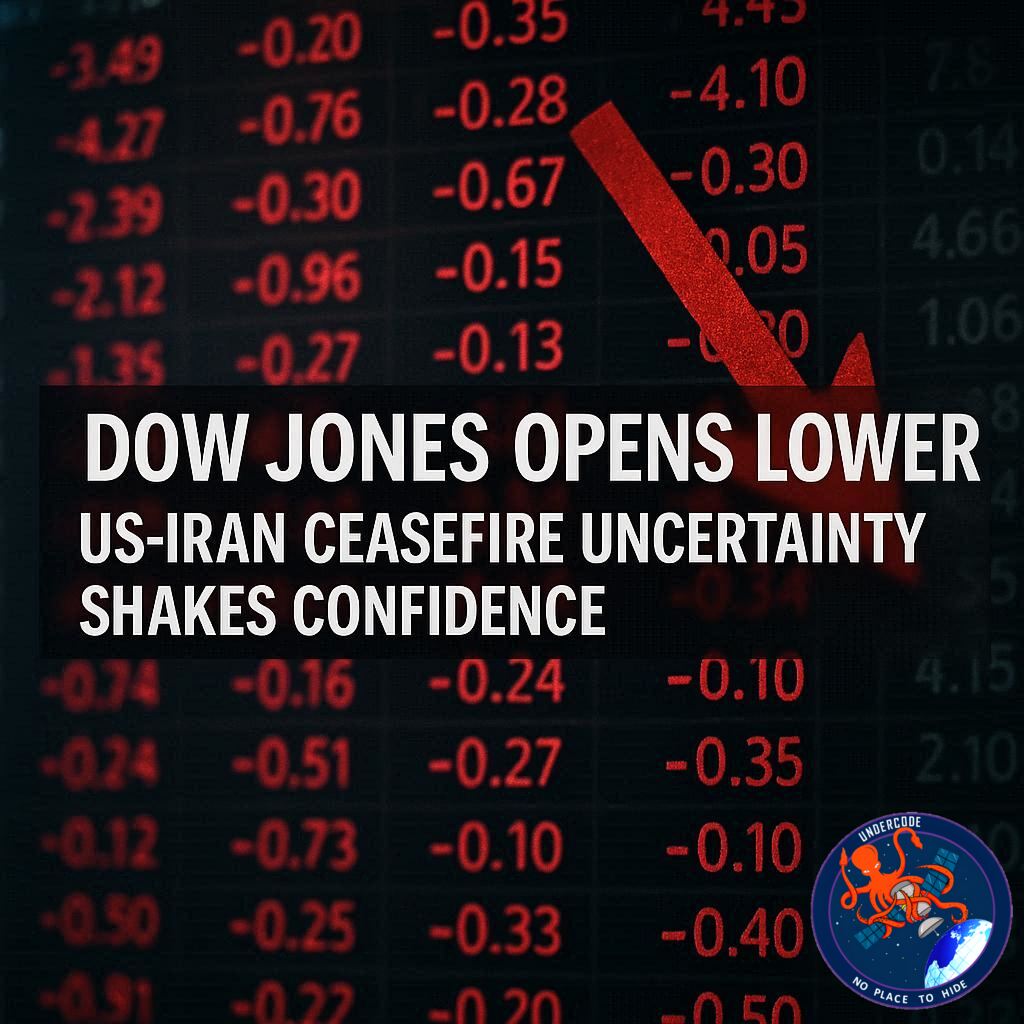
The Dow Jones Industrial Average opened lower on April 9, falling 135.50 points to 47,774.42 shortly after the market opened. This decline follows a strong rally the previous day, when the index surged by 1,325 points, marking its largest gain in nearly a year. However, that optimism quickly faded as doubts emerged over the sustainability of the ceasefire between the United States and Iran.
Although both nations agreed to a two-week truce, tensions remain high due to ongoing military actions in Lebanon involving Israel. Iranian officials have issued strong warnings, signaling that the ceasefire may not hold if regional conflicts escalate further. These developments have introduced a layer of uncertainty that investors are struggling to price in.
Compounding the issue is the surge in crude oil prices. Futures for West Texas Intermediate (WTI) crude briefly climbed above $100 per barrel, representing a nearly 6% increase compared to the previous day. This spike is largely attributed to concerns over supply disruptions, particularly as Iran maintains control over the Strait of Hormuz, a critical chokepoint for global energy transportation. Reduced shipping activity through the strait has heightened fears of constrained oil supply, further fueling price volatility.
Economic data released the same day offered limited reassurance. The Personal Consumption Expenditures (PCE) price index for February rose 2.8% year-over-year, matching market expectations and showing no acceleration in inflation. Meanwhile, initial jobless claims came in at 219,000, slightly above forecasts of 210,000. While these indicators suggest relative economic stability, they failed to offset the dominant geopolitical concerns weighing on the market.
Among individual stocks, major components of the Dow experienced declines. Companies such as Salesforce, Home Depot, and Microsoft were among the notable laggards. Other blue-chip names like IBM, Visa, and Walt Disney also traded lower.
On the other hand, some stocks showed resilience. Amazon, Chevron, and Caterpillar posted gains, benefiting in part from rising energy prices and defensive positioning. Cisco Systems and Johnson & Johnson also moved higher.
Meanwhile, the Nasdaq Composite Index, heavily weighted toward technology stocks, showed mixed movement. Semiconductor companies like Broadcom and Micron Technology saw early buying interest, along with Meta Platforms. However, losses in Palantir Technologies and Adobe offset some of those gains.
What Undercode Say: Deep Analysis of Market Behavior Under Geopolitical Stress
Financial markets are often described as forward-looking mechanisms, yet moments like this reveal just how reactive they can be to geopolitical instability. The sudden shift from a historic rally to a cautious pullback highlights a classic pattern, markets surge on hope, then retreat on uncertainty. The ceasefire between the United States and Iran initially acted as a catalyst for optimism, but the lack of clarity around its enforcement quickly undermined that confidence.
What stands out is not just the existence of geopolitical tension, but the layered complexity of the situation. This is not a binary conflict. The involvement of Israel in Lebanon introduces a third dimension that complicates diplomatic efforts. Investors are not merely reacting to headlines, they are attempting to interpret a web of alliances, risks, and احتمالات escalation that are difficult to quantify.
Oil prices play a central role in this narrative. The Strait of Hormuz remains one of the most strategically important waterways in the world, and any disruption there sends shockwaves through global markets. A 6% spike in oil prices in a single session is not just a commodity story, it is a macroeconomic signal. Higher energy costs ripple through supply chains, increase inflationary pressure, and ultimately impact consumer spending.
Interestingly, the muted reaction to economic data suggests that macro fundamentals are currently taking a backseat. Normally, inflation data and jobless claims would drive market direction. But in this case, they are overshadowed by geopolitical developments. This shift in focus indicates that markets are in a risk-sensitive phase, where external shocks carry more weight than internal economic indicators.
Sector performance also reveals underlying sentiment. Technology stocks, typically growth-oriented and sensitive to interest rates, showed mixed signals. Meanwhile, energy and industrial stocks gained traction, reflecting a rotation toward sectors that benefit from higher commodity prices and infrastructure demand. This kind of sector rotation often signals a defensive posture among investors.
Another subtle but important factor is profit-taking. After a massive rally, it is natural for investors to lock in gains. The timing of the pullback suggests that geopolitical concerns provided a convenient trigger for this behavior. In other words, the market was already primed for a correction, and the news cycle simply accelerated it.
Looking ahead, the key variable remains the outcome of the upcoming peace talks scheduled in Pakistan. Markets are likely to remain volatile until there is greater clarity. A successful negotiation could reignite bullish momentum, while further escalation could deepen the current downturn.
Ultimately, this episode underscores a fundamental truth, markets do not operate in isolation. They are deeply intertwined with global politics, energy dynamics, and investor psychology. Understanding this interconnectedness is essential for navigating periods of heightened uncertainty.
Fact Checker Results
✅ The Dow Jones declined after a previous sharp rally, consistent with profit-taking behavior.
✅ Oil prices surged due to concerns over supply disruptions linked to Middle East tensions.
❌ Economic data had a major immediate impact on markets, in reality, its influence was limited compared to geopolitics.
Prediction
📊 Markets will remain volatile as geopolitical developments unfold, with oil prices acting as a key driver.
📊 A stable ceasefire could trigger another strong rally, especially in tech and growth stocks.
📊 Continued tension may push investors toward defensive sectors like energy and healthcare.
🕵️📝✔️Let’s dive deep and fact‑check.
References:
Reported By: xtechnikkeicom_bafd4151d15bff4c64eb22dd
Extra Source Hub (Possible Sources for article):
https://www.pinterest.com
Wikipedia
OpenAi & Undercode AI
Image Source:
Unsplash
Undercode AI DI v2
Bing
🔐JOIN OUR CYBER WORLD [ CVE News • HackMonitor • UndercodeNews ]
📢 Follow UndercodeNews & Stay Tuned:
𝕏 formerly Twitter 🐦 | @ Threads | 🔗 Linkedin | 🦋BlueSky | 🐘Mastodon


