
Listen to this Post
Introduction: A Quiet Update That Could Transform Security Operations
In the constantly evolving world of cybersecurity, even a small software update can fundamentally change how organizations defend themselves against cyber threats. One such update recently emerged from Elastic, a company widely recognized for its powerful search, observability, and security analytics tools.
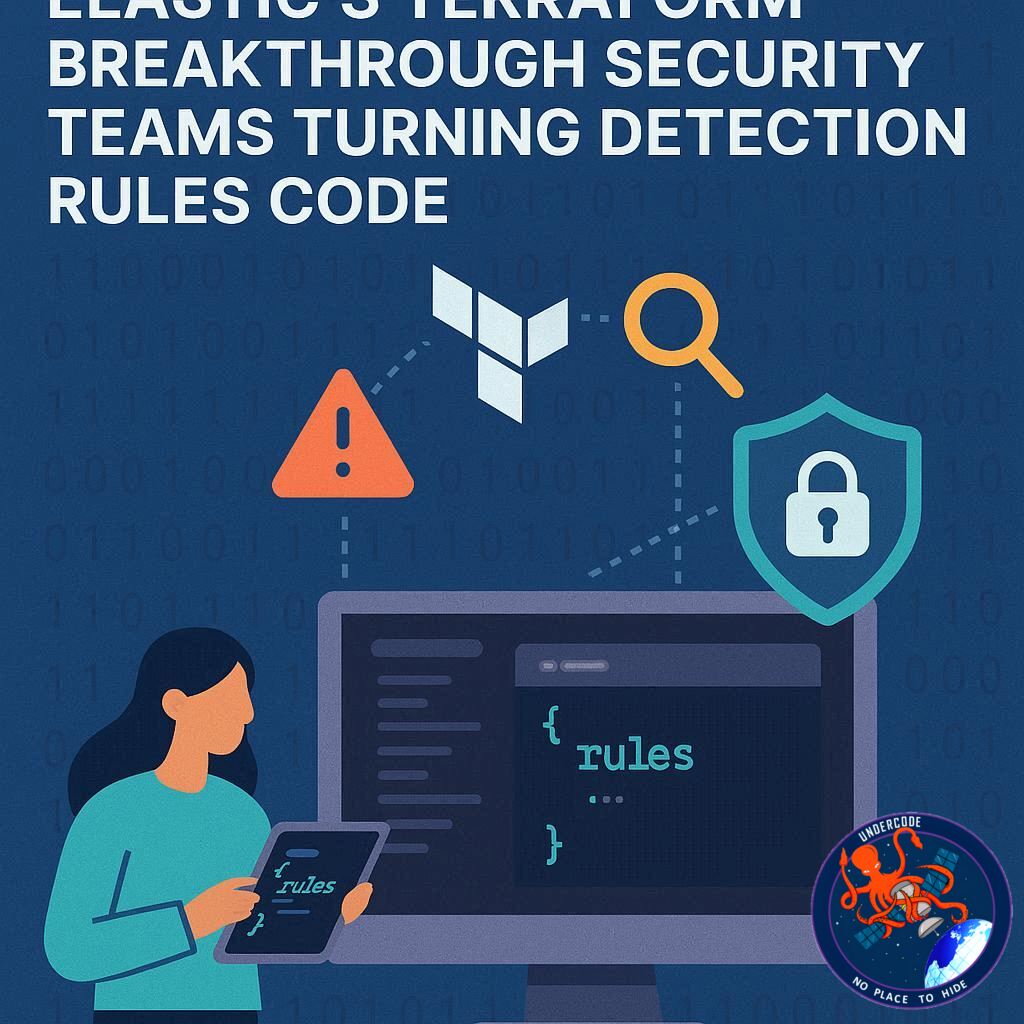
Elastic has introduced new capabilities in its Terraform provider for Elastic, beginning with version v0.12.0, that allow cybersecurity teams to manage detection rules and exception lists directly as code. The development merges modern Infrastructure as Code (IaC) practices with advanced detection engineering — a shift that could significantly improve how organizations build and maintain their security defenses.
At the center of this change is the integration of Terraform, Elastic Security, the new ES|QL, and the emerging capabilities of the Elastic AI Assistant. Together, these technologies promise to make detection engineering faster, more consistent, and easier to automate.
The update might appear technical at first glance, but its implications reach far beyond configuration files. It represents a broader shift in cybersecurity — where detection logic becomes programmable, reproducible, and scalable.
the Original Report
A recent cybersecurity update highlighted a major enhancement to Elastic’s Terraform provider starting with version v0.12.0. This update enables organizations to manage detection rules and exception lists as part of their Infrastructure as Code workflows.
Traditionally, security teams create detection rules manually within security platforms. These rules monitor logs, events, and telemetry data to detect suspicious activity such as unauthorized access attempts, malware behavior, or unusual network traffic. However, manual configuration often leads to inconsistent rule deployment across environments and makes it difficult to track changes over time.
Elastic’s latest Terraform integration addresses this issue by allowing detection rules to be defined and maintained directly inside Terraform configurations. With this approach, security teams can treat detection logic the same way DevOps teams manage infrastructure — through version-controlled code repositories.
One of the key additions in the update is support for ES|QL queries, Elastic’s query language designed to analyze security data. By embedding ES|QL queries into Terraform resources, engineers can create sophisticated detection logic while maintaining centralized configuration management.
The update also introduces support for managing exception lists, which allow security teams to exclude known benign activities from triggering alerts. These exception lists are now configurable through Terraform, enabling organizations to maintain consistent detection tuning across environments.
Another notable feature is the integration with Elastic’s AI Agent, which helps generate Terraform configurations automatically. This AI-driven assistance can reduce the complexity of writing configuration files, especially for teams that may not be deeply experienced with Terraform syntax.
Overall, the update strengthens the connection between infrastructure management and cybersecurity operations. By enabling detection rules to be codified, version-controlled, and automated, Elastic is pushing security teams toward a more engineering-driven model of threat detection.
What Undercode Says:
The Rise of Detection Engineering as Code
The integration of detection rules into Infrastructure as Code platforms signals a major cultural shift in cybersecurity. Security operations are increasingly adopting engineering principles once reserved for software development.
Historically, detection rules lived inside dashboards and graphical interfaces. This made them easy to deploy but difficult to track, audit, or replicate across environments. When rules changed, teams often had little visibility into who made the modification or why.
By bringing these rules into Terraform configurations, security teams gain the benefits of version control, automated testing, and reproducible deployments. In other words, detection logic becomes portable and auditable.
This approach aligns closely with the emerging discipline known as Detection Engineering, where security teams design, test, and continuously improve threat detection logic using structured development workflows.
Why Infrastructure-as-Code Is Expanding Into Security
Infrastructure as Code platforms like Terraform were originally designed to manage servers, networks, and cloud resources. Over time, however, the same principles have proven valuable for security operations.
Security environments often suffer from configuration drift — a situation where systems gradually diverge from their intended state. Detection rules can easily become inconsistent between environments such as development, staging, and production.
Managing detection rules as code solves this problem. Organizations can store their entire detection framework in a Git repository, track changes through commits, and deploy updates automatically through CI/CD pipelines.
This approach dramatically improves both transparency and scalability.
AI’s Emerging Role in Security Configuration
Another interesting aspect of Elastic’s update is the integration of its AI Agent to generate Terraform configurations.
Security configuration is notoriously complex. Even experienced engineers can struggle with the syntax and structure of Infrastructure as Code tools. AI-assisted configuration could significantly reduce this barrier.
Instead of writing lengthy configuration blocks manually, security engineers may soon describe their detection logic in natural language, allowing AI systems to translate the request into valid Terraform code.
If implemented effectively, this could accelerate security deployment across organizations that lack large DevSecOps teams.
The Strategic Importance of ES|QL
Elastic’s query language, ES|QL, is also playing a central role in this shift. Query languages determine how effectively analysts can explore security data and define detection patterns.
Embedding ES|QL directly into Terraform resources allows organizations to deploy complex analytical queries alongside infrastructure configuration.
This tightly integrated approach means that the detection logic evolves together with the infrastructure generating the telemetry data.
For example, when a new cloud service is deployed, its monitoring queries and detection rules can be deployed simultaneously.
The DevSecOps Convergence
The broader takeaway from this development is the ongoing convergence of DevOps and security operations.
Modern security teams increasingly operate within DevSecOps frameworks, where security is integrated directly into development and deployment pipelines.
Managing detection rules through Terraform represents a natural extension of this philosophy.
Security becomes part of the infrastructure lifecycle rather than an afterthought.
Organizations adopting this approach may gain faster response times, better detection coverage, and more resilient security architectures.
🔍 Fact Checker Results
Verification of Elastic Terraform Provider Update
✅ Elastic has released updates to its Terraform provider allowing expanded management of security resources including detection rules and exception lists.
Accuracy of ES|QL Integration Claims
✅ ES|QL is a real query language developed by Elastic for advanced data analysis across security and observability datasets.
Validity of AI Configuration Assistance
⚠️ AI-assisted configuration tools are emerging in Elastic’s ecosystem, but capabilities and automation levels continue to evolve and vary by deployment.
📊 Prediction
Infrastructure-as-Code Will Soon Control Entire Security Stacks
The integration of detection rules into Terraform may represent only the first step toward fully programmable security infrastructures.
Over the next few years, it is likely that entire Security Operations Centers (SOCs) will operate through code-driven pipelines. Detection rules, response playbooks, threat intelligence feeds, and automated remediation workflows could all be deployed using Infrastructure as Code frameworks.
As AI-assisted configuration becomes more advanced, security engineers may increasingly rely on automated systems to generate detection logic, optimize rule performance, and identify blind spots in monitoring coverage.
If this trend continues, the traditional SOC dashboard could gradually evolve into something closer to a software development environment — where defending an organization from cyber threats becomes as much about writing code as it is about monitoring alerts.
🕵️📝✔️Let’s dive deep and fact‑check.
References:
Reported By: x.com
Extra Source Hub (Possible Sources for article):
https://www.discord.com
Wikipedia
OpenAi & Undercode AI
Image Source:
Unsplash
Undercode AI DI v2
Bing
🔐JOIN OUR CYBER WORLD [ CVE News • HackMonitor • UndercodeNews ]
📢 Follow UndercodeNews & Stay Tuned:
𝕏 formerly Twitter 🐦 | @ Threads | 🔗 Linkedin | 🦋BlueSky | 🐘Mastodon


