
Listen to this Post
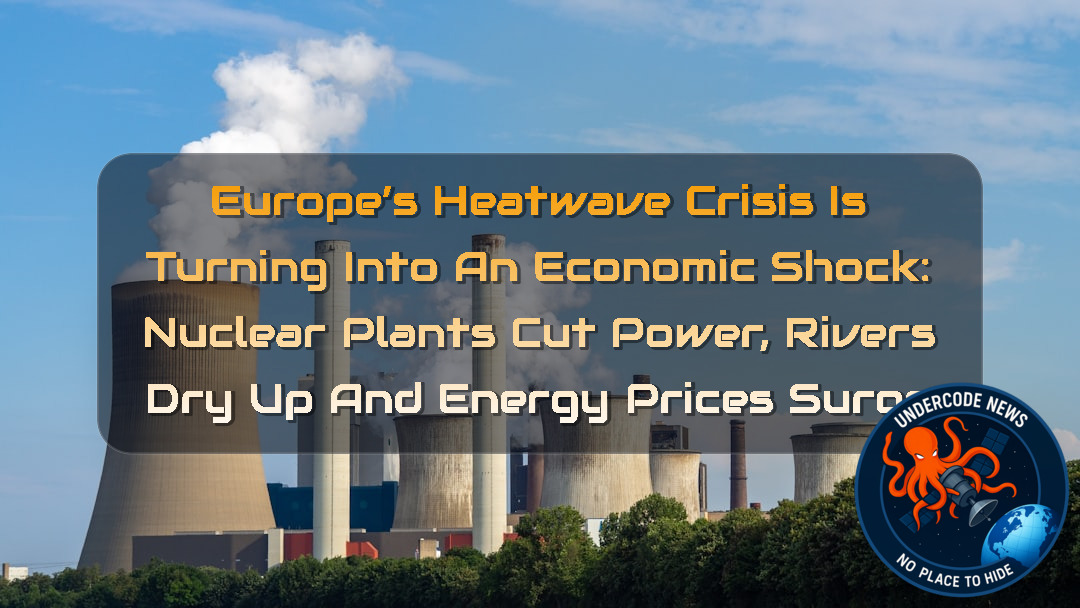 A Summer of Extreme Heat Is Testing Europe’s Economic Resilience
Europe is entering a dangerous new phase of climate and energy stress. What once looked like isolated episodes of extreme summer weather is increasingly affecting the systems that keep the continent’s economy moving.
Nuclear reactors are being forced to reduce or suspend operations because rivers no longer contain enough cool water. Major waterways are becoming too shallow for normal industrial transport. Farmers are working through the night because daytime heat is drying crops too quickly. Tourist attractions are closing early as temperatures become dangerous for visitors and workers.
At the same time, Europe is trying to rebuild natural gas reserves ahead of winter while facing higher global energy competition and disruptions connected to the war in the Middle East.
The result is a complicated economic problem in which climate, energy, agriculture, transportation and geopolitics are no longer separate risks. They are beginning to reinforce one another.
Romania’s Nuclear Power System Comes Under Pressure
Romania has become one of the clearest examples of how extreme heat can threaten critical infrastructure.
Nuclearelectrica, the country’s state-owned nuclear power producer, began disconnecting its sole operational reactor from the electricity grid after record-low water levels in the Danube created difficulties for the cooling system.
The Danube is not simply a major European river. For Romania, it is also an important component of the infrastructure supporting industrial activity, transportation and electricity generation.
When water levels fall dramatically, nuclear facilities face a fundamental problem. Nuclear reactors generate enormous amounts of heat, and reliable cooling is essential for safe operation.
Energy Security Is Becoming a Summer Problem
Romania has declared a state of energy emergency for August and has asked businesses and households to voluntarily reduce electricity consumption.
That response highlights an important shift.
Energy security in Europe has traditionally been associated with winter heating demand, gas shortages and geopolitical disruptions. Extreme summer heat is creating a second pressure point as air-conditioning demand rises while some power-generation infrastructure becomes harder to operate.
Europe is therefore confronting an increasingly complicated energy equation: demand rises precisely when environmental conditions can reduce the availability of certain forms of generation.
France and Hungary Face Similar Nuclear Constraints
Romania is not alone.
France and Hungary have also been forced to curtail nuclear power production because of combinations of low river levels and unusually high temperatures.
Nuclear energy remains one of
This creates a paradox.
The hotter Europe becomes, the more electricity households and businesses may require for cooling. Yet extreme heat and drought can simultaneously make it more difficult for certain power plants to operate at maximum capacity.
Europe’s Heatwave Could Cost €180 Billion
The economic consequences could be enormous.
An estimate from Netherlands-based Triodos Bank suggests that Europe’s extreme summer weather could cost approximately €180 billion, or around 1% of the region’s GDP, during the year.
That figure is particularly significant because it is roughly comparable with the European Union’s expected economic growth.
In other words, even if
Productivity Is Becoming the Hidden Cost
The biggest economic impact may not come from spectacular infrastructure failures.
It could come from millions of people simply becoming less productive.
When temperatures remain dangerously high, outdoor workers face physical limitations. Construction projects slow down. Agricultural schedules change. Factory environments become more difficult to operate. Transportation workers face additional risks.
Offices also consume more electricity as cooling systems operate continuously.
The economic damage therefore spreads across thousands of ordinary decisions and working hours rather than appearing as a single dramatic event.
Europe Has Already Experienced Multiple Heatwaves
Large parts of Europe are experiencing another major heatwave after exceptionally hot conditions earlier in the summer.
Britain, France, Spain and Italy have all faced periods of extreme temperatures.
The Copernicus Climate Change Service has reported exceptionally high temperatures across Western Europe, reinforcing concerns that extreme heat is becoming a recurring feature rather than an unusual event.
That distinction matters for businesses.
Companies can absorb a one-off weather disruption. Repeated disruptions are much harder to manage.
Paris Is Feeling the Heat
Even some of
Extreme temperatures have forced attractions such as the Eiffel Tower and the Louvre to close earlier on certain days.
Tourism is particularly sensitive to weather because visitors are exposed to outdoor conditions for long periods.
Restaurants, hotels, transportation networks, museums and entertainment venues can all experience changes in demand when visitors decide that extreme temperatures are simply too uncomfortable.
A city can remain open while its tourism economy quietly loses productivity.
The Energy Shock Could Become Worse in Winter
Europe’s summer problem is also creating a winter problem.
Natural gas storage is being replenished during the summer months, traditionally the period when European countries build inventories before cold-weather demand begins.
But high summer electricity demand, geopolitical tensions and constrained gas supplies are making that process more difficult.
Gas storage across the European Union was reported at around 59% full, significantly below typical levels for that point in the year.
That leaves European energy markets with less room for error.
The Strait of Hormuz Adds Another Layer of Risk
The geopolitical situation surrounding the Strait of Hormuz has intensified the pressure.
The waterway is one of the
If LNG cargoes become scarce, European buyers must compete with Asian markets for the remaining supply.
That competition can push prices higher even when Europe itself has not experienced a physical shortage.
Energy markets respond not only to what is available, but also to what traders believe will be available several months from now.
Natural Gas Prices Are Already Much Higher
The European benchmark natural gas contract was reported at approximately €61 per megawatt-hour, compared with roughly €32 per megawatt-hour on the same day a year earlier.
That represents a dramatic increase.
For households, higher wholesale gas prices can eventually translate into more expensive energy bills.
For businesses, the consequences can be even broader.
Manufacturers that rely heavily on gas face higher production costs. Fertilizer producers can become less competitive. Chemical companies may reduce output. Food producers can face rising costs throughout their supply chains.
Europe Is Not Facing Another 2022 Yet
Despite the alarming numbers, analysts caution against comparing today’s situation directly with Europe’s 2022 energy crisis.
Since
The continent has also reduced overall gas consumption.
Gas demand is estimated to be roughly 20% below 2021 levels, giving Europe a larger buffer than it had during the earlier crisis.
This is an important distinction.
Europe is vulnerable, but it is not starting from the same position it occupied before the 2022 energy shock.
Europe Can Still Buy Its Way Out of a Crisis
Some energy analysts believe the risk of actual shortages is being overstated.
Europe has access to global LNG markets and can compete for cargoes when necessary.
The problem is that buying additional supply can become extremely expensive.
That means the continent could potentially avoid physical blackouts while still suffering significant economic damage through higher prices.
Energy security is therefore not simply about whether gas exists.
It is also about whether consumers and businesses can afford it.
The Rhine Is Becoming an Economic Warning Signal
Germany faces another problem.
The Rhine is one of
Low water levels can make navigation difficult, forcing companies to reduce cargo loads or search for alternative transportation.
Economists at ING have estimated that disruptions on the Rhine could reduce German GDP growth by approximately 0.3 percentage points.
For an economy growing at less than 1% annually, that is a significant hit.
BASF Shows How Water Shortages Reach Factories
Germany’s chemical industry illustrates how quickly a climate problem can become a manufacturing problem.
BASF has warned that low Rhine water levels could restrict deliveries of important raw materials and potentially prevent the company from fulfilling some orders.
The company has responded by shifting cargo to trucks and rail and using vessels capable of operating in shallower water.
But every alternative has a cost.
Rail capacity can be limited. Trucks require more fuel and drivers. Alternative routes can take longer.
A river that becomes difficult to navigate can therefore increase costs throughout an industrial supply chain.
Governments Are Already Making Emergency Adjustments
The German response has included temporary changes to transportation restrictions, including the suspension of some Sunday truck-driving bans.
Such measures demonstrate how governments can be forced to modify regulations when environmental conditions threaten critical supply chains.
But emergency measures are not a permanent solution.
If drought becomes more frequent, governments will eventually need to redesign infrastructure rather than simply relax rules during each crisis.
Climate Adaptation Could Cost Trillions Over Time
The European Commission has estimated that EU member states should invest roughly €70 billion annually through 2050 in climate adaptation.
That is an enormous financial commitment.
However, the cost of adaptation must be compared with the cost of repeatedly repairing infrastructure after extreme weather.
Stronger bridges, redesigned ports, improved water management, drought-resistant agriculture and resilient energy systems may look expensive today.
Failing to build them could become much more expensive tomorrow.
Farmers Are Changing Their Working Hours
The agricultural sector is already adapting in ways that would have seemed unusual only a few years ago.
At Rookery Farm in England, harvesting has shifted into the early morning hours.
Workers begin harvesting at around 3 a.m. because crops can become too dry during the heat of the day.
This is an extraordinary example of how climate change can alter something as fundamental as the working schedule of a farm.
The harvest is no longer simply about avoiding rain.
Farmers are increasingly trying to avoid excessive heat and moisture loss.
Food Prices Could Become the Next Pressure Point
Agriculture is particularly vulnerable because crops cannot simply be switched off when conditions become unfavorable.
Drought can reduce yields. Heat can accelerate crop maturation. Wildfires can destroy farmland. Water restrictions can limit irrigation.
When several regions experience poor harvests at the same time, food prices can rise.
That creates another inflationary pressure for European households already dealing with expensive energy.
The danger is not one individual failed harvest.
The danger is a chain reaction across multiple agricultural regions and commodities.
Wildfires Are Adding to the Economic Damage
Drought also increases the risk of severe wildfires.
Wildfires destroy forests, homes, infrastructure and agricultural land while requiring significant public resources to control.
They can also disrupt tourism and transportation.
The economic consequences continue long after the flames disappear because destroyed land must be rehabilitated and damaged infrastructure must be rebuilt.
Extreme heat therefore generates both immediate and delayed economic costs.
The Real Problem Is the Interaction Between Risks
Europe’s biggest vulnerability may not be any single crisis.
It is the interaction between them.
Heat increases electricity demand.
Drought reduces water availability.
Low river levels disrupt transportation.
Transportation disruptions increase industrial costs.
Higher industrial costs contribute to inflation.
Geopolitical tensions increase gas prices.
Higher gas prices raise household and business expenses.
Together, these pressures can become much more damaging than any one factor would suggest.
What Undercode Say:
Climate Risk Is Becoming Infrastructure Risk
Europe’s current situation demonstrates that climate change should no longer be treated exclusively as an environmental issue.
It is becoming an infrastructure problem.
Power plants depend on water.
Factories depend on rivers and transportation networks.
Farmers depend on predictable weather.
Cities depend on electricity grids capable of handling extreme demand.
Tourism depends on safe and comfortable public spaces.
When extreme heat disrupts one component, the effects can spread quickly.
Nuclear Power Has a Water Dependency
Nuclear energy is often discussed primarily in terms of fuel availability and reactor safety.
Water availability deserves equal attention.
A reactor can have sufficient fuel and remain technically sound while still facing operational restrictions if its cooling resources become constrained.
This means future nuclear planning must consider long-term hydrological conditions.
Building nuclear capacity without considering future water availability could create another form of infrastructure vulnerability.
Rivers Are Economic Infrastructure
The Rhine and Danube are often thought of as geographic features.
They are actually economic infrastructure.
Factories, ports, warehouses and industrial clusters have developed around these waterways because rivers provide efficient transportation.
When water levels fall,
That makes drought a supply-chain problem.
Heat Is Becoming an Economic Variable
Businesses have traditionally treated weather as an external factor.
That assumption is becoming increasingly outdated.
Extreme heat now affects labor availability, electricity demand, equipment performance, transportation and customer behavior.
Companies will increasingly need to model temperature scenarios in the same way they model interest rates, energy prices and currency fluctuations.
The 3 a.m. Harvest Is a Powerful Warning
A farmer harvesting at 3 a.m. may sound like an isolated story.
It is actually a powerful indicator of adaptation.
When normal working hours become incompatible with environmental conditions, businesses change their schedules.
That same pattern could appear across construction, transportation, logistics and outdoor services.
Europe may gradually develop an economy where certain activities routinely operate around extreme temperatures rather than normal daytime conditions.
Summer Energy Demand Is Changing
Air conditioning is becoming increasingly important in Europe.
Historically,
As temperatures rise, summer electricity demand becomes more significant.
That means grids must prepare for two different seasonal stress periods.
Winter brings heating demand.
Summer brings cooling demand.
Both require reliable energy infrastructure.
Gas Storage Matters More Than Ever
The current gas-storage situation highlights the importance of preparation.
Europe may have enough gas to avoid an immediate shortage.
But lower storage levels mean there is less protection against a prolonged winter, another geopolitical disruption or an unexpected supply shock.
Energy markets react aggressively when inventories are perceived as insufficient.
That can create price volatility long before physical shortages appear.
The Asia-Europe Competition Is Critical
Europe cannot assume that every LNG cargo will automatically come its way.
Asian buyers can compete aggressively for global supplies.
If Asian demand increases while European inventories remain low, European buyers may have to pay substantially more.
The continent therefore depends not only on its own infrastructure, but also on global energy-market conditions.
Europe’s Advantage Is Diversification
Europe has learned painful lessons since 2022.
It has diversified energy supplies, expanded LNG infrastructure and reduced dependence on Russian pipeline gas.
Those changes provide important protection.
They do not eliminate vulnerability.
Diversification reduces the probability of catastrophic shortages, but it does not prevent expensive energy markets.
Price Pain Could Arrive Before Physical Shortages
This distinction is critical.
Consumers may never see empty gas storage facilities.
They may never experience widespread blackouts.
Yet they can still suffer from a major energy crisis through higher prices.
Businesses may reduce production because electricity or gas is too expensive.
Households may reduce consumption because bills become unaffordable.
That is an economic crisis even without a physical shortage.
Germany Is Particularly Exposed
Germany’s industrial economy is heavily dependent on efficient logistics and competitive energy costs.
Low Rhine water levels therefore create a double vulnerability.
The country can face transportation disruption at the same time that energy prices rise.
That combination is especially painful for energy-intensive manufacturing.
Europe’s Industrial Model Is Being Tested
European manufacturing already faces pressure from global competition, particularly from China.
Adding expensive energy and climate-related disruptions creates another disadvantage.
European policymakers must therefore solve two problems simultaneously.
They must reduce emissions and strengthen climate resilience while keeping European factories competitive.
That is a much more complicated challenge than simply adding renewable energy capacity.
Adaptation Is Now an Economic Investment
The proposed €70 billion annual climate-adaptation requirement should not be viewed only as government spending.
It can also be considered infrastructure investment.
Improved water management can protect agriculture.
Stronger grids can reduce energy volatility.
Better rail infrastructure can compensate for unreliable rivers.
Drought-resistant crops can protect food production.
Adaptation can therefore create economic value if investments are targeted correctly.
The Cost of Doing Nothing Could Be Higher
Governments frequently hesitate to spend billions on infrastructure that may not appear necessary today.
Extreme weather changes that calculation.
If drought repeatedly shuts down transport routes, the economic losses can quickly exceed the cost of improving alternative infrastructure.
The same principle applies to power grids, reservoirs, cooling systems and flood defenses.
Europe Needs More Flexible Infrastructure
The future energy system cannot depend on a single source.
The future logistics system cannot depend entirely on rivers.
The future agricultural system cannot depend on historical weather patterns.
Resilience requires alternatives.
That means more storage, stronger interconnections, flexible transportation, diversified energy sources and improved water management.
Climate Adaptation Must Become Operational
It is not enough to publish climate strategies.
Companies need concrete operating plans.
Factories need alternative supply routes.
Energy companies need drought scenarios.
Farmers need different planting and harvesting strategies.
Cities need heat-response plans.
Governments need emergency transportation and energy protocols.
Resilience becomes meaningful only when it can be activated.
Data Will Become More Valuable
Businesses will increasingly rely on real-time information about water levels, weather, electricity demand and commodity markets.
A factory that knows several days in advance that a river will become unnavigable can reroute materials.
An electricity operator that anticipates extreme cooling demand can prepare additional capacity.
A farmer who receives accurate heat and moisture forecasts can adjust harvesting schedules.
Better information can reduce the economic cost of uncertainty.
Insurance Markets Could Also Feel the Pressure
As extreme weather becomes more frequent, insurers face greater exposure.
Higher wildfire losses, agricultural damage and infrastructure disruption can increase premiums.
Some risks may eventually become difficult or expensive to insure.
That would transfer more financial responsibility to governments and businesses.
The climate problem could therefore migrate into the financial system.
Tourism Faces a Different Kind of Risk
Europe remains one of the
But extreme heat can change visitor behavior.
Tourists may avoid cities during peak summer periods.
Outdoor attractions can become less appealing.
Visitors may shift travel toward cooler seasons.
That could eventually change
Cities May Need to Redesign Summer Life
European cities were not historically designed around prolonged extreme heat.
Buildings, public transportation systems and outdoor spaces can become uncomfortable or dangerous during heatwaves.
Future urban planning may require more shade, cooling infrastructure, green spaces and water-management systems.
Architecture will increasingly have to account for climate conditions that were previously considered exceptional.
The Energy Transition Is Only Part of the Solution
Renewable energy expansion remains important, but adding generation capacity alone will not solve Europe’s resilience problem.
Power grids also need storage, transmission capacity and flexibility.
Nuclear plants need resilient cooling strategies.
Gas infrastructure needs diversified supply.
Hydropower needs sufficient water.
Every energy source has physical dependencies.
Europe Is Entering an Era of Compound Disruption
The most serious risk is a convergence of events.
Imagine a hot summer followed by a dry autumn, weak gas storage, high Asian LNG demand and a geopolitical disruption affecting shipping.
Each problem would amplify the others.
That is the scenario European policymakers should prepare for.
Resilience Will Become a Competitive Advantage
Companies that adapt faster may eventually gain an advantage.
Firms with flexible supply chains can continue production when competitors cannot.
Farmers who adopt heat-resistant crops can protect yields.
Energy-intensive manufacturers with efficient facilities can better absorb price shocks.
Climate resilience may therefore become part of corporate competitiveness.
Europe Still Has Time to Act
The current situation is serious, but it is not irreversible.
Europe has significant financial resources, advanced infrastructure and strong scientific institutions.
The challenge is converting those advantages into practical resilience before repeated extreme-weather events become more expensive.
The longer adaptation is delayed, the more expensive emergency responses are likely to become.
Deep Analysis: Monitoring Europe’s Climate and Energy Risk
Check Current System Pressure
A Linux administrator or security analyst monitoring infrastructure can use basic system tools to establish a disciplined operational baseline:
uptime
free -h
df -h
top
These commands are not climate-analysis tools by themselves, but they demonstrate the same principle required for critical infrastructure monitoring: establish a baseline before interpreting anomalies.
Monitor Network and Infrastructure Dependencies
For digital infrastructure supporting energy and industrial operations, administrators can inspect active network connections:
ss -tulpn
ip -s link
ip route
Unexpected network instability during a physical infrastructure crisis can complicate already fragile operations.
Track External Data Programmatically
Organizations can combine weather, river-level, energy-price and electricity-demand feeds into monitoring systems.
A simple Linux workflow could begin with:
curl -I https://example.com
and move toward automated collection, validation and alerting through scheduled jobs.
Build Automated Alerts
Critical infrastructure teams should establish thresholds for temperature, river depth, gas storage, electricity demand and power-generation availability.
A basic scheduled monitoring framework can be managed through:
crontab -e
The objective is not merely collecting data.
The objective is identifying when multiple warning indicators begin moving in the wrong direction simultaneously.
Analyze Correlated Risks
A useful monitoring system should compare variables rather than examine them individually.
For example:
Temperature ↑
Electricity demand ↑
River levels ↓
Nuclear output ↓
Gas demand ↑
Storage levels ↓
Wholesale prices ↑
When several indicators move simultaneously, the probability of economic disruption rises.
Protect Monitoring Infrastructure
Energy companies and industrial operators should also protect the digital systems used to monitor physical infrastructure.
Basic Linux security checks can include:
systemctl --failed
journalctl -p warning -b
last
These commands can help administrators identify failed services, system warnings and unexpected access activity.
The Bigger Lesson
The European heatwave is not simply a weather story.
It is a stress test for interconnected infrastructure.
The nuclear sector is affected by rivers.
Factories are affected by waterways.
Farmers are affected by soil moisture.
Energy markets are affected by geopolitics.
Consumers are affected by prices.
Governments are affected by all of them.
That is why the economic consequences can become much larger than the original temperature increase suggests.
Energy Infrastructure
✅ Fact:
European Energy Markets
✅ Fact: Low gas storage, higher LNG competition and geopolitical disruptions can increase Europe’s exposure to higher winter energy prices.
Economic Impact
✅ Fact: The reported €180 billion estimate represents a forecast of potential economic damage, not a guaranteed final loss, and should therefore be treated as an economic estimate rather than an established final figure.
Prediction
(+1) Europe Will Accelerate Climate Adaptation Spending
Europe is likely to increase investment in water management, electricity-grid resilience, alternative transportation infrastructure and heat-resistant agriculture.
(+1) Night-Time Agriculture Will Become More Common
As daytime temperatures rise, farmers are likely to increasingly move labor-intensive activities into cooler nighttime and early-morning periods.
(+1) Summer Electricity Demand Will Become More Important
Air conditioning and cooling will increasingly influence
(+1) Energy Diversification Will Continue
European governments and businesses will continue seeking diversified LNG, renewable, nuclear and storage options to reduce exposure to individual supply disruptions.
(-1) Climate Disruptions Will Not Remain Localized
A drought affecting one river may eventually disrupt manufacturing, transportation and energy markets far beyond the immediate region.
(-1) Energy Prices Are Unlikely to Become Predictable Again Soon
Europe’s energy market will remain vulnerable to geopolitical developments, global LNG competition and weather-driven demand.
The Bigger Warning for Europe
Europe’s current heatwave crisis should not be dismissed as another uncomfortable summer.
The deeper warning is that climate extremes are beginning to collide with infrastructure designed around yesterday’s assumptions.
A nuclear plant needs water.
A factory needs transportation.
A farmer needs predictable growing conditions.
A city needs affordable electricity.
A tourist destination needs safe public spaces.
A household needs manageable energy bills.
When all of those requirements are placed under pressure at the same time, the result is more than extreme weather.
It becomes an economic resilience test.
Europe has already demonstrated that it can adapt to major energy disruptions. The question now is whether it can adapt quickly enough to a climate environment in which extreme heat, drought, geopolitical instability and energy-market volatility increasingly arrive together.
The most important lesson may be the simplest one: the next European energy crisis does not necessarily have to begin with an empty gas pipeline.
It could begin with a river that becomes too shallow, a reactor that cannot run at full capacity, a harvest that must start at 3 a.m., or a power grid pushed beyond its summer limits.
And by the time those individual warnings become visible to everyone, the economic damage may already be spreading through the system.
▶️ Related Video (68% Match):
🕵️📝Let’s dive deep and fact‑check.
🎓 Live Courses & Certifications:
Join Undercode Academy for Verified Certifications
🚀 Request a Custom Project:
Secure, high-velocity infrastructure and disruptive technological engineering. Contact our engineering team for high-tier development and proprietary systems:
[email protected]
💎 Smart Architecture | 🛡️ Secure by Design | ⭐ Trusted by Thousands
References:
Reported By: edition.cnn.com
Extra Source Hub (Possible Sources for article):
https://www.medium.com
Wikipedia
OpenAi & Undercode AI
Image Source:
Unsplash
Undercode AI DI v2
🔐JOIN OUR CYBER WORLD [ CVE News • HackMonitor • UndercodeNews ]
📢 Follow UndercodeNews & Stay Tuned:
𝕏 formerly Twitter 🐦 | @ Threads | 🔗 Linkedin | 🦋BlueSky | 🐘Mastodon | 📺Youtube


