
Listen to this Post
Introduction: When Winning Costs Everything
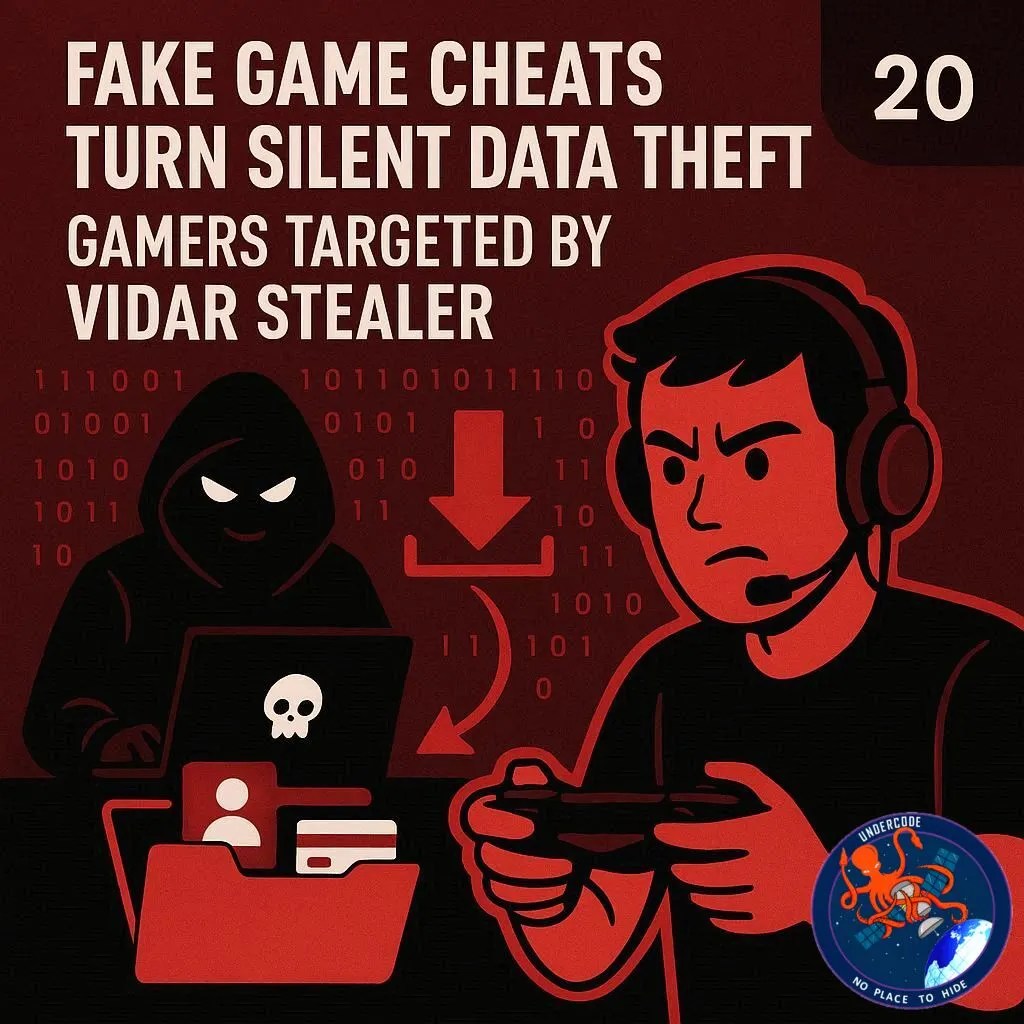
The pursuit of an edge in competitive gaming has always existed, but in today’s digital landscape, that desire is being weaponized. Cybersecurity researchers have uncovered a growing wave of malware campaigns that specifically target gamers searching for free cheats online. What appears to be a shortcut to victory often becomes a direct path to personal data theft. Behind polished download pages and convincing instructions lies a dangerous payload: Vidar Stealer 2.0, a sophisticated malware designed to quietly harvest sensitive information.
This emerging threat highlights a harsh reality. The gaming ecosystem is no longer just about entertainment. It has become a lucrative hunting ground for cybercriminals who exploit curiosity, impatience, and the temptation of unfair advantage.
Summary of the Original Findings
Cybersecurity analysts have identified multiple coordinated campaigns distributing Vidar Stealer 2.0 through fake game cheat tools. These attacks primarily target players of competitive titles such as Counter-Strike, Valorant, Fortnite, and Call of Duty, where the demand for cheats like aimbots and wallhacks is particularly high. Attackers take advantage of this demand by offering “free” tools that promise performance enhancement but instead deliver malware.
The infection chain often begins on platforms like GitHub, Reddit, Discord, and gaming forums. Attackers post links to supposed cheat tools, presenting them as legitimate utilities. These posts are carefully crafted to look authentic, often including installation guides, user comments, and even fake endorsements. In many cases, GitHub repositories are used as a front, hosting either the malicious files directly or redirecting users to external download sites controlled by attackers.
Once downloaded, the files appear harmless, often named something convincing like TempSpoofer.exe, Monotone.exe, or CFXBypass.exe. These names suggest tools designed to bypass anti-cheat systems or hardware bans, increasing their appeal to gamers seeking an advantage. However, deeper analysis reveals these executables are actually PowerShell-based loaders compiled into .NET binaries.
After execution, the loader connects to a Pastebin link to retrieve a second-stage payload hosted elsewhere, frequently on GitHub. This multi-stage delivery helps attackers avoid detection. The malware then installs itself by creating a randomly named folder within the AppData directory, hiding its presence before executing its final payload.
At the core of these campaigns is Vidar Stealer 2.0, an upgraded version of a well-known information-stealing malware that has been active since 2018. The newer version includes enhanced performance, multithreading capabilities, and improved anti-analysis techniques, making it more effective and harder to detect.
Once active, Vidar begins collecting a wide range of sensitive data. It targets browser credentials, cookies, cryptocurrency wallets, FTP and SSH credentials, browser extensions, and locally stored files. It can also capture screenshots and extract authentication tokens from messaging platforms like Discord and Telegram, potentially giving attackers access to entire accounts.
To conceal its command-and-control infrastructure, Vidar uses legitimate services such as Telegram bots and Steam profiles as dead-drop resolvers. These platforms store the real server addresses used by the malware, making it more difficult for security researchers to trace and shut down operations.
Researchers suggest that the rise of Vidar campaigns may be linked to recent law enforcement actions that disrupted other major malware families like Lumma and Rhadamanthys. As those tools became less reliable, cybercriminals shifted toward Vidar as an alternative for credential theft.
Security experts emphasize that downloading software from unofficial sources, particularly cheat tools, significantly increases the risk of infection. Gamers are strongly advised to avoid such downloads and rely on trusted platforms and security solutions to protect their systems.
What Undercode Say: The Psychology Behind the Attack
The Exploit Is Not Technical, It Is Human
At its core, this campaign is not just about malware sophistication. It is about human behavior. The attackers are not breaking into systems directly. They are convincing users to open the door themselves. The promise of a competitive edge taps into a powerful psychological trigger: the desire to win with minimal effort.
Gamers, especially in competitive environments, often face intense pressure to perform. When skill reaches its limits, shortcuts become tempting. Cybercriminals understand this mindset and design their lures accordingly. The malware is simply the final step in a carefully engineered social manipulation process.
GitHub as a Weaponized Trust Platform
One of the most concerning aspects is the abuse of GitHub. Traditionally seen as a trusted platform for developers, it provides an air of legitimacy that attackers exploit effectively. A well-designed repository with documentation and version history can easily convince users that the tool is genuine.
This represents a broader shift in cybercrime tactics. Instead of relying on obviously malicious websites, attackers now hide within trusted ecosystems. The line between legitimate and malicious content becomes increasingly blurred, making user judgment less reliable.
Multi-Stage Delivery Shows Growing Sophistication
The use of loaders, Pastebin links, and staged payload delivery is not accidental. It reflects a mature and evolving threat model. By separating the infection process into multiple steps, attackers reduce the likelihood of detection at any single stage.
This modular approach also allows them to update payloads dynamically without changing the initial distribution method. In practical terms, even if one part of the operation is discovered, the rest can continue functioning with minimal disruption.
Vidar’s Evolution Signals a Shift in the Malware Market
Vidar Stealer 2.0 is not new, but its resurgence is significant. The disruption of other malware families has created a vacuum, and Vidar is stepping in to fill it. This indicates a highly adaptive underground economy where tools rise and fall based on law enforcement pressure.
It also suggests that malware development is becoming more competitive. Features like multithreading and anti-analysis are not just enhancements. They are selling points in a criminal marketplace where efficiency and stealth determine success.
Gamers Are Becoming High-Value Targets
Historically, gamers were not considered prime targets compared to corporate environments. That perception has changed. Modern gamers often store valuable data on their systems, including payment information, cryptocurrency wallets, and access to multiple online accounts.
Additionally, gaming communities are highly interconnected. A compromised account can be used to spread malware further, turning victims into distribution channels. This amplifies the impact of each successful infection.
The Hidden Cost of “Free”
The concept of free software has always carried risks, but in this case, the cost is particularly high. Victims are not just losing access to a game or account. They are potentially exposing their entire digital identity.
Credentials, cookies, and tokens can be used to bypass security measures, including two-factor authentication in some cases. Once stolen, this data can be sold, reused, or leveraged for further attacks, creating long-term consequences that extend far beyond gaming.
Security Awareness Is Still the Weakest Link
Despite advances in cybersecurity technology, user awareness remains a critical vulnerability. Many users still underestimate the risks associated with unofficial downloads. The belief that “it won’t happen to me” continues to fuel these campaigns.
Education and awareness are essential, but they must evolve alongside the threats. Users need to understand not just what to avoid, but why these attacks work. Without that understanding, the same patterns will continue to repeat.
Fact Checker Results
✅ Vidar Stealer is a known malware family active since 2018 and widely used for credential theft.
✅ GitHub and social platforms have been repeatedly abused in malware distribution campaigns.
❌ There is no guarantee that all cheat-related downloads are malicious, but the risk is extremely high and well-documented.
Prediction
🔮 Malware targeting gamers will continue to rise as gaming ecosystems grow in value and connectivity.
🔮 Attackers will increasingly use trusted platforms like GitHub and Discord to distribute malicious tools.
🔮 Future variants of information stealers will focus more on bypassing modern authentication systems and harvesting session-based access tokens.
🕵️📝✔️Let’s dive deep and fact‑check.
References:
Reported By: cyberpress.org
Extra Source Hub (Possible Sources for article):
https://www.reddit.com
Wikipedia
OpenAi & Undercode AI
Image Source:
Unsplash
Undercode AI DI v2
Bing
🔐JOIN OUR CYBER WORLD [ CVE News • HackMonitor • UndercodeNews ]
📢 Follow UndercodeNews & Stay Tuned:
𝕏 formerly Twitter 🐦 | @ Threads | 🔗 Linkedin | 🦋BlueSky | 🐘Mastodon


