
Listen to this Post
Introduction
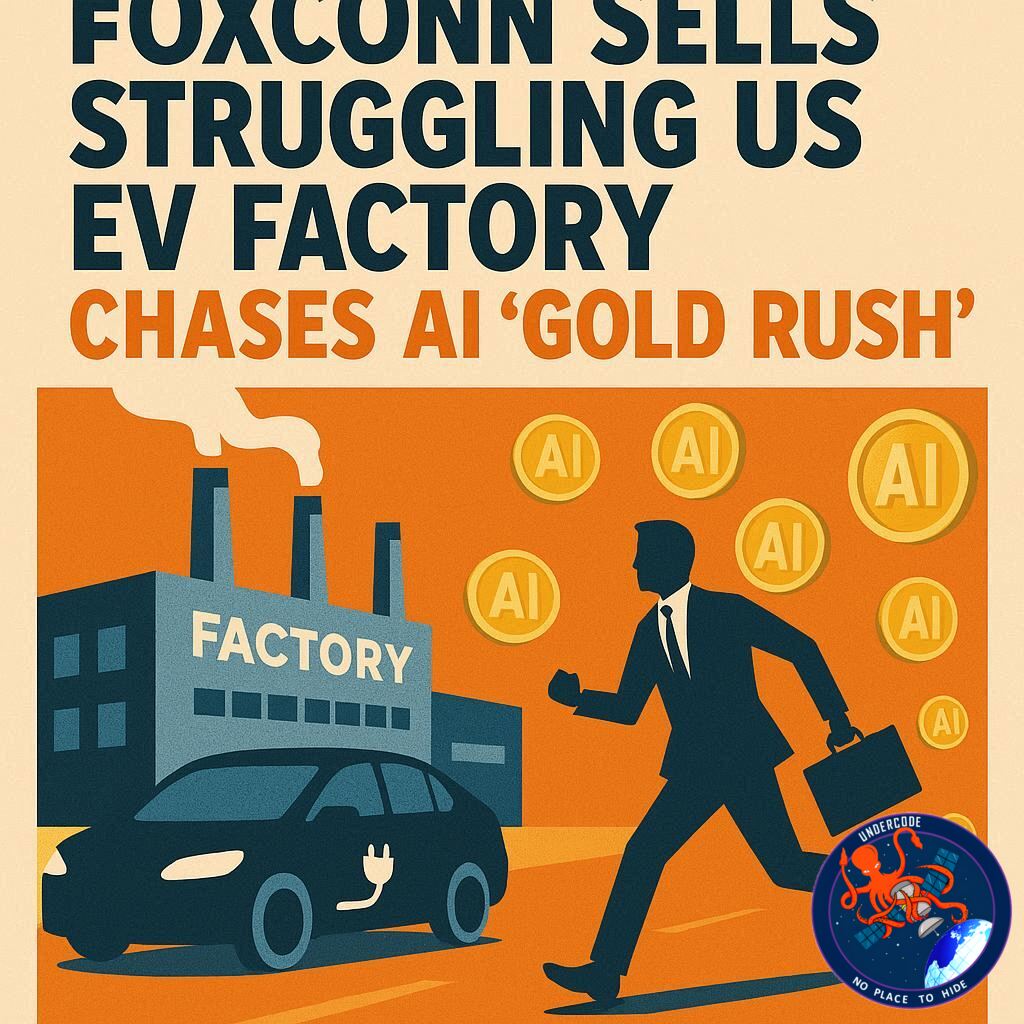
Foxconn, the Taiwanese electronics giant known for assembling Apple products, is making a bold strategic pivot. After struggling to breathe life into its Ohio-based electric vehicle (EV) plant, the company is cutting its losses and turning its gaze toward the booming artificial intelligence (AI) sector. On August 4th, the company confirmed the sale of the underperforming EV facility for \$375 million, signaling a major shift in its U.S. operations. But this isn’t a total retreat—Foxconn plans to keep the facility running and repurpose it for AI-related ventures like data centers. The move marks a telling evolution in the global tech landscape, where AI is rapidly outshining even once-hyped sectors like EVs.
the Original
Taiwan’s Foxconn Technology Group (also known as Hon Hai Precision Industry) announced it will sell its electric vehicle (EV) manufacturing facility in Ohio, USA, for \$375 million USD. The plant, originally owned by General Motors, was acquired in 2022 as part of a joint venture with U.S. EV startup Lordstown Motors. Despite the hype, the facility has suffered from low production output and underwhelming results. Now, Foxconn aims to exit the floundering EV initiative and redirect its U.S. operations toward the booming artificial intelligence sector, particularly data center infrastructure.
Although the real estate and equipment will be sold, Foxconn isn’t entirely abandoning the plant. It plans to continue operations within the facility and potentially repurpose it to support AI growth. The pivot reflects broader industry trends: while EVs continue to face capital and supply chain challenges, AI is experiencing explosive demand for infrastructure, especially for compute-intensive applications like large language models and cloud AI services.
The sale is seen as a recalibration rather than a withdrawal. With AI poised to become a cornerstone of tech investment over the next decade, Foxconn is positioning itself to capitalize on this shift. It may also be a sign that Foxconn’s broader U.S. ambitions are becoming more aligned with next-gen tech infrastructure rather than physical product manufacturing.
What Undercode Say:
Foxconn’s strategic redirection offers a microcosm of a larger industrial evolution. The electric vehicle sector, once considered the “next big thing,” is now beginning to face economic and logistical headwinds. EV startups are burning cash, supply chains are still shaky, and consumer adoption isn’t happening as fast as hoped. In this context, Foxconn’s decision to pull out from an underperforming EV plant isn’t a failure—it’s a recalibration for survival.
The key takeaway here is Foxconn’s flexibility. The company is known for its razor-thin margins and tight operational models, but here we see it making a forward-looking bet on data infrastructure. With AI workloads skyrocketing, particularly in areas like cloud services, edge computing, and generative AI, data centers are becoming the factories of the future.
Ohio, with its moderate energy costs and vast land availability, is an ideal location for such facilities. By repurposing the EV plant into a data center hub or AI R\&D zone, Foxconn ensures its American assets remain relevant—even if they’re not building EVs anymore.
Another factor to note is that Foxconn is no stranger to U.S. headlines involving bold promises and under-delivered outcomes. Its much-hyped Wisconsin factory from 2017 was dubbed the “eighth wonder of the world” by then-President Trump but ended up dramatically scaled down. With this Ohio move, Foxconn seems more cautious, pragmatic, and possibly more realistic.
It also points to a growing trend of Asian tech companies diversifying into Western AI infrastructure, not merely as contractors but as primary stakeholders. In the near term, the switch from EV to AI might seem like damage control, but in the long run, it could be a first-mover advantage in the next trillion-dollar industry.
From a broader geopolitical angle, Taiwan’s Foxconn reinforcing its U.S. presence in AI infrastructure might also serve as a subtle hedge against rising tensions in the Asia-Pacific. It gives the company strategic geographic diversification—something increasingly valuable in a bifurcating tech world.
Ultimately, this sale is more than a transaction. It’s a weather vane for where global tech is heading. AI isn’t just an application layer anymore—it’s becoming the new industrial backbone, and Foxconn wants in.
🔍 Fact Checker Results:
✅ Foxconn officially confirmed the \$375 million EV factory sale
✅ The plant was previously owned by General Motors and later Lordstown Motors
✅ Foxconn plans to keep operations running and explore AI applications like data centers
📊 Prediction:
By 2027, Foxconn will likely become a key player in U.S.-based AI infrastructure development. Its Ohio facility will be transformed into a major data center hub, supporting both cloud computing and enterprise AI services. Expect new partnerships with U.S. tech giants (possibly Microsoft or Amazon Web Services) as Foxconn seeks to embed itself deeper into the AI supply chain—not just as a manufacturer, but as a foundational infrastructure provider.
🕵️📝✔️Let’s dive deep and fact‑check.
References:
Reported By: xtechnikkeicom_7ac9075ce7667329c024f70f
Extra Source Hub:
https://www.reddit.com
Wikipedia
OpenAi & Undercode AI
Image Source:
Unsplash
Undercode AI DI v2
🔐JOIN OUR CYBER WORLD [ CVE News • HackMonitor • UndercodeNews ]
📢 Follow UndercodeNews & Stay Tuned:
𝕏 formerly Twitter 🐦 | @ Threads | 🔗 Linkedin | 🦋BlueSky | 🐘Mastodon


